
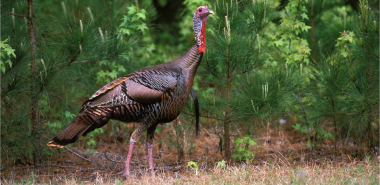
2026 spring turkey hunting forecast
ODFW biologists share the latest updates for wild turkey hunting in their local districts, as well as tips for bagging a bird.
Statewide prospects
Last year's estimated spring harvest of 7,514 wild turkeys was the highest on record, up 26 percent from the 2024 harvest of 5,941 birds. However, some issues with the mandatory harvest report survey may have inflated harvest numbers from 2025.
The spring and summer of 2025 was fairly warm and dry when wild turkeys were producing their broods. Turkey and other upland game bird populations did not produce well last year. The winter of 2025-26 has been extremely mild and dry in most parts of wild turkey range. These conditions mean good overwintering survival for wild turkeys, but there may be fewer 1-year old birds in the huntable population.
Given the dry conditions, we expect turkeys may initiate breeding activities earlier than usual. Hunters will be able to access higher elevations without encountering snow. Wild turkeys will focus on ridgetops with new green-up during the spring season. Western Oregon wild turkeys typically begin breeding activity sooner than eastern Oregon.

2025 turkey harvest by unit
Harvest and effort data can help you identify promising places to hunt. Statistics include harvest, hunter days, birds per hunter and percent of birds harvested on public land.
Tips to be a better turkey hunter
The sight and sound of a turkey's mating display is enough to quicken the pulse of even the most experienced hunter—and makes calling in a spring tom as exciting as calling in a bull elk. While turkeys are notoriously difficult to sneak up on due to their excellent eyesight, the urge to mate makes wary toms a little less cautious when they hear the call of a hen or competing tom in the spring.
In general, turkeys will be moving higher in elevation in the spring, following the snow line. They do not favor areas with a lot of underbrush for mating displays, so look for openings in the forest meadows. Don't forget to visit recent burns or clear-cuts when doing your pre-season scouting. Wild turkeys will vocalize most in the morning and evening, so scout early and stay late to figure out where the birds are spending their time and find the location of their roost.
Toms can become harder to hunt and less vocal later in the hunting season as the mating season falls off. A realistic jake or hen decoy may also draw the bird's attention away from you and make him a better target.
- Wait for green up conditions during season.
- Look for tracks and signs of activity.
- Scout early morning and evening.
- Consider hen or tom calls.
- Avoid detection. Camo and quiet are key.
- Remember to look for the beard – emphasize ethical shot.
- Tag your turkey and report your hunt.
- Take special care field dressing, guidelines available here.
ODFW education offers pre-season youth clinics and adult workshops with an opportunity to hunt--register for an event now.
Hunter's plan for wild turkey in Oregon is an online comprehensive turkey hunting course that covers everything you'll need to know to hunt wild turkey, including seasons and regulations, weapons and gear, finding and calling birds, and processing your harvest.
Regulation requirements
The statewide spring turkey season is from April 15 to May 31.
Youth spring turkey gets a jump on the season--April 11 & 12 *(an adult 21 years or older, who may not hunt, must accompany not more than one youth).
The daily bag limit is one male turkey or a turkey with a visible beard (hens with beards may be lawfully taken). The season limit is three legal turkeys; hunters must purchase a tag for each turkey prior to hunting in the field. See Oregon Game Bird Regulations for more information.
Report your hunt
All hunters who purchase a 2026 spring turkey tag are required to report their hunt results online or with an ODFW license vendor no later than Jan. 31, 2027. Reporting is required even for those who did not hunt or were unsuccessful. ODFW uses this information to determine harvest and effort, and set future hunting regulations.
Reports from local areas follow.
NORTHWEST AREA
NORTH AND MID-COAST

Wild turkey can be a great introduction to hunting for youth. Turkeys are only found on the east side of the Coast Range in these units. The best place to find turkeys is on the private agricultural lands with rolling oak woodlands adjacent to the larger private timber holdings. However, less dense populations of turkeys can be found on publicly accessible timber company grounds, especially in areas of mixed oak woodlands. The east side of the Stott Mtn – N Alsea TMA is an easily accessible area to scout for turkeys. Typically, the areas closer to the Willamette Valley are better for finding turkeys.
Additionally, some of the smaller timber companies in these units will allow access with a free permit and can hold decent numbers of turkeys. Potentially accessible lands outside the towns of Monroe, Alsea, Philomath, Blodgett, throughout Kings Valley, Falls City, and Dallas are good places to scout. Remember to get permission to hunt on private land.
WILLAMETTE UNITS
Trask and Willamette Units
Finding a place to hunt turkeys continues to be challenging in northwest Oregon. Turkeys are primarily found on private lands and are not readily available to the public. Those hunters without local contacts should be out talking to landowners to acquire access to the few and widely scattered flocks. Some hunters knock on landowners' doors where they see turkeys and ask permission to hunt. Reports of turkey activity in the eastern foothills of the coast range highlight limited opportunity on predominantly private lands.
To find public land opportunities, consult Bureau of Land Management (BLM) or U.S. Forest Service maps and look for pockets of public land off the main roads, but adjacent to agricultural land and mixed hardwood forests -- turkeys key in on both acorns, and grubs and other insects in meadows. Other opportunities may exist on publicly accessible private timber lands at lower elevations near agriculture in the SE Trask unit. Be sure to check with each landowner, generally through their website, to ensure public access is allowed before entering private property to hunt.
Hunters can also apply to hunt on a handful of private land properties in the Willamette Valley using ODFW's Hunt by Reservation Program.
Scappoose Unit
Turkey populations are extremely low and not widely distributed. Hunters will need to have scouted early to find turkey flocks and obtained permission to hunt on private property to be successful.
Santiam, N. Indigo, and McKenzie Units
Hunting success is dependent upon securing access to private lands with turkeys, and on early scouting. Hunters who are having issues gaining access to private lands are advised to participate in ODFW Hunt by Reservation Program. Turkeys are most often found on private lands in the foothills along the west side of these units, although there are scattered flocks in some of the checkerboard BLM land too. Locating areas with oak habitat can be helpful in finding turkeys. It is uncommon to find turkeys in the Douglas-fir forests at higher elevations.
For hunters who have done their homework and obtained access to private lands, hunting can be very good in the McKenzie, N. Indigo, and southern portions of the Santiam units. Decent numbers of turkeys exist outside the towns of Brownsville, Lebanon, Sweet Home, Lacomb, Scio, and Lyons. There have been recent reports of turkeys on private lands around the outskirts of Silverton and Oregon City, so limited private land opportunities do exist, but turkeys are not abundant in the northern portions (north of Silverton) of the Santiam Unit and hunters will have difficulty finding the few scattered flocks.
SOUTHWEST AREA
COOS COUNTY
After a mild winter, conditions remain drier than normal into spring this year, it is not likely the conditions will be a significant problem for turkey survival in Coos County. For turkeys in this area, nesting may begin earlier keeping the hunt season on track. What remains to be seen is whether significant rain will occur after hatching takes place. Rain in May and June has a higher likelihood of creating problems for turkey poult survival.
That being said, the spring rains may affect the distribution of turkeys. Prior to green up turkeys get much of what they eat from agriculture lands. Some of these birds will likely move out to clearcuts and other forest openings as the weather improves.
Gaining permission to hunt on private land is clearly the most effective way to hunt turkeys in Coos County. However, looking for pockets of public land that are in close proximity to private land birds can be a productive tactic for hunting these birds too. In Coos County much of the BLM lands are scattered small tracts of land surrounded by private lands.
Turkey abundance is highest in the vicinity of Coquille, Myrtle Point, Powers, and Fairview but there are a few turkeys in other parts of the county, as well. Scouting for turkeys before the hunt is key to finding them, especially if hunting public land or private timberlands.
A great late season tactic is sleeping in a bit and going out for a mid-morning or early afternoon hunt. As the season gets longer into late May, the hens tend to leave to go nest in the morning leaving still active gobbling males to be interested in your calls which can lead to success.
CURRY COUNTY
The turkey population has been low for several years. Reproduction along the coast is often slower than inland areas; survival is harder with the rains that occur here and this year we have seen decreased snow levels. Hunters will need to have scouted early to find turkey flocks and obtain permission to hunt on private property. Look in areas where oak groves and grass prairies for roost sights can be found.
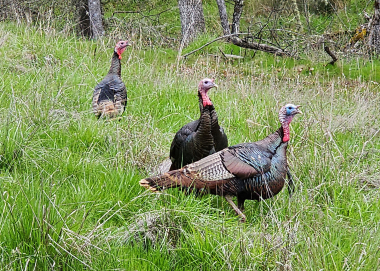
Southwest Oregon is known for larger populations of turkeys due to the natural oak savannas, a prime habitat for birds. DOUGLAS COUNTY
We experienced cold wet conditions this winter in most of the county. This weather pattern seemed to slow breeding activity in the area compared to recent years. The past few weeks toms have started to become more active with the longer days.
Douglas County has a strong turkey population due to an abundance of oak-savannah and oak woodland habitat in the Umpqua Valley. The highest concentrations of birds are found around private property at lower elevations, so access will be an issue. There is public hunting opportunities on National Forest and BLM lands, especially in the South Umpqua drainage.
Other areas to consider are BLM lands adjacent to private lands, like North Bank Habitat Management Area, providing opportunities for hunting in low elevation oak savannah habitat. ODFW has also supplemented prime habitat within the Umpqua National Forest with turkeys over the last several years.
If you are looking for a private lands hunt, asking for permission later in the season, after landowner's friends, family and guides have hunted, sometimes gets results. It can be hard for a regular hunter to gain access on some private property on the valley floor because some landowners work with guides that have clients that hunt exclusively on their property.
JACKSON COUNTY
Southwest Oregon boasts some of the largest turkey populations in the state. This year's turkey numbers remain very strong, and hunting is expected to be above average. Breeding usually peaks around the first part of April, however, with early spring weather, males were displaying in early March. We recommend getting out as soon as the season opens to maximize your success. Turkeys can be found feeding on green grasses and insects in and around open forest floors, under oak canopies.
A great strategy to locate turkeys in an area is to use locator calls (crow calls or turkey calls) before light or after dark to identify roosting trees. Come back to that area in the early morning, before daylight, and set up in an area of their travel to begin calling as light approaches.
Turkey flocks continue to be found in a wide variety of places in Jackson County. While most turkeys are found on private lands, plenty of public lands have turkeys, including grassy/oak savannas on BLM lands and lower elevation timber/meadow lands of the Rogue National Forest
The Obenchain fire (2020) burned through a large portion of both public and private land between Hwy 140 and Butte Falls Hwy. This area is continues to see regrowth, which has proven very productive for turkey hunters in the spring.
The best areas in the Rogue Unit to hunt are roads along the Butte Fall-Prospect Hwy between Butte Falls and Prospect. Dead Indian Memorial Rd, the Green Springs Hwy and Denman Wildlife Area are very productive. Other spots are found in areas within the Jackson Cooperative Travel Management Area map (valid through April 31).
However, don't limit yourself to these areas as turkeys are widespread throughout Jackson County. Other public places to focus your efforts would include the Howard/Hyatt area in eastern Jackson County, BLM sections along Evans Creek, and BLM areas near the towns of Jacksonville and Ruch.
JOSEPHINE COUNTY
Turkey numbers in Josephine County remain very strong. Hunting is expected to be good to above average. Breeding in the area usually peaks around the first part of April, so get out as soon as the season opens to maximize success.
Turkeys can be tough to hunt in the county as most are found on private property. Don't be afraid to ask landowners to hunt on their property; turkeys can be a problem for many landowners that grow crops and they may be willing to allow hunters to come and hunt turkeys to reduce damage.
Find turkeys along the Applegate River drainage and on most BLM lands. Galice Rd is a productive area for turkey hunters and in recent years the number of turkeys around the town of Cave Junction has increased. The regrowth in burn scars can provide productive areas for turkey hunters. The Slater fire (2020), Smith River Complex fire (2023), and areas south of Cave Junction are worth scouting.
COLUMBIA AREA
White River and Hood Units

Reagen's first youth hunt, 2024, White River Wilderness Access in the White River and Hood units should not be a problem this year. Recent warm temperatures have reduced the snowpack and opened roadways. Main roads are clear and accessible up to 4,000+ feet in elevation. Side roads at higher elevations still have snow and may be blocked by downed trees. Consider bringing a chainsaw in your vehicle while hunting.
The White River Wildlife Area (WRWA) is a very popular area to hunt with decent turkey numbers. The Larch Creek fire burned approximately 8,000 acres of the wildlife area near Postage Stamp Butte in July 2024. Vegetation within the burn is beginning to green up but turkey movement and use within the burn may be altered this year.
There are plenty of quality turkey hunting spots across the White River Wildlife Area where hunters may want to focus their efforts this year. A parking permit is required for all users of the wildlife area (permit comes with your hunting license but don't forget to put it on your car dash). Please obey all wildlife area signs and be cautious of other hunters.
The Mt. Hood National Forest throughout the White River Unit has high turkey counts and is a popular place to hunt. Harvest success is low, likely due to heavy hunting pressure. Try hunting on weekdays or evenings when it's less crowded. There are turkeys spread out over most of the Mt. Hood National Forest, but bird density tends to increase towards the eastern edge of the Forest Service boundary.
The eastern edge of the White River Unit contains a diverse mix of oak/pine overstory, and hunting areas that have recently burned or contain openings with abundant forbs. These are all good places to find turkeys. Hunt drainages with large roost trees along a ridgetop at first light.
Locate roosting birds the evening before your hunt with an owl hoot, coyote call or crow call. Doing some preseason scouting to identify roost trees, travel routes, and feeding grounds will increase your likelihood of harvesting a bird.
Private timberlands throughout the Hood and western portion of the White River unit have great turkey habitat and good bird numbers providing an excellent hunt. These lands are primarily owned by Green Diamond and Twin Creeks Timber and are open to public access. The portion of Twin Creeks Timber between Lost Lake Rd and Green Pt. Rd is closed to the public.
Access will remain the same as in previous years (there are no restrictions on access), but please obey all posted signs and drive only on designated roads in this area. Up to date information on access and closures can be found on the Green Diamond website here. Hood River County Forest also owns property in this area and provides open access. These lands are excellent turkey habitat and provide good hunting opportunities.
Maupin and West Biggs
Turkey populations are expanding within these units. Most of them are on private lands, so ask permission to access these areas. Focus on riparian zones and areas with trees available for roosting. Turkey also can be found in the Deschutes and John Day River canyons as well as many other side-drainages of these river canyons, some on BLM and state-managed lands. These areas could be a great place to get away from other hunters.
CENTRAL AREA

Cousins Joe and David with a couple of mountain gobblers, Central Oregon CROOK COUNTY
Find turkeys on forestland in the Ochoco, Grizzly and Maury WMU's. Turkey numbers and distribution in the district are gradually increasing, with groups scattered throughout the national forest. Turkeys were relocated to the southern portion of the Ochoco WMU and the Eastern portion of the Maury WMU this past winter.
Late snow at higher elevations and north-facing areas of the forest is still present, so travel may be limited. Green up is occurring below the snow line and turkeys can often be found in these areas.
Hunters should contact both the Ochoco National Forest and Prineville BLM offices for road conditions and motorized access restrictions. Motorized restrictions remain in effect year-around in the South Boundary Cooperative Travel Management Area (TMA) along the southern boundary of the Ochoco National Forest. Maps of the area are available at entry portal signs, and at ODFW and Ochoco National Forest offices in Prineville.
DESCHUTES COUNTY
Turkey populations remain low and not widely distributed throughout Deschutes County. Numbers are increasing in the northern portion of the Upper Deschutes Unit and select areas of the Metolius Unit. The absence of winter conditions should result in strong winter survival.
There is a growing population around the Sisters area, however they are often found on private property. Some turkeys can be found on Forest Service ground but can move long distances once the season begins and they start getting pressured. Make sure to ask for permission before hunting on private lands.
Scouting will be key for both Deschutes and Jefferson Counties, as the low densities of birds can make them scatter and spread across the vast landscape. Locating roost trees during the evenings can make for an effective morning hunt the following day.
JEFFERSON COUNTY
The best locations to hunt turkey in Jefferson County are in the Metolius Unit on Green Ridge from Black Butte north to the Warm Springs Reservation, and east into the juniper zone. There can be a surprising number of birds in lowland juniper, so don't overlook hunting lower country. Hunting pressure usually drops off significantly after opening week.
This year, higher elevation road access is not restricted because of snow, but lower elevation roads may be soft and muddy. Birds may spread out from the lowlands to the top of the ridge, so finding signs and scouting will increase success rates.
The mild winter should result in strong overwinter survival, resulting in a stable to increasing turkey population. Contact the Sisters Ranger District of the Deschutes National Forest for road conditions and motorized access restrictions.
SOUTH CENTRAL AREA

Pioneer Hunter, Ken Gibson with a beautiful mature Spring Rio Grande Turkey, photo by Dan Ward LAKE COUNTY
In Lake County, turkey numbers are extremely low. Previous translocations have made for some opportunity on public land, but due to natural dispersal many have moved away from their original release site.
Late winter conditions may limit access in many parts of Lake County. Expect many roads to be accessible only with a 4-wheel drive vehicle due to snow or muddy conditions.
Turkeys are restricted to the southern portion of the county on or near national forestland along the west and north sides of the Goose Lake Valley in the Interstate Unit.
KLAMATH COUNTY
In Klamath County, turkeys are mostly restricted to the Keno Unit. Mild winter conditions will allow access to most elevations. Turkeys should be well dispersed with no snow to prohibit them from accessing higher elevations. Many 2-track roads and trails could be too muddy to travel without causing extensive damage to the road.
Much of the suitable habitat for turkeys in the south side of the unit are either open-to-hunt private timberland (Green Diamond Resource Company), or BLM land. Areas to check for turkey activity are south of Hwy 66 and west of the Klamath River Canyon to Copco Road. Find turkeys north of Hwy 66 around Johnson Prairie. Hunters who take a banded turkey are asked to please contact the local ODFW district office in Klamath Falls (541) 883-5732. Due to the elevated risk of High Path Avian Influenza (HPAI), no translocations have occurred over the last two winter seasons.
SOUTHEAST AREA
HARNEY COUNTY
In Harney County, turkeys live in small numbers around the forest fringe and further towards Grant County on the Malheur National Forest. This year low snowpack accumulation should benefit turkey populations in the South Blue Mountains.
Access into higher elevations on the forest is good this year due to a 22% median snowpack, with very little snow in the forest. Most turkeys in the county are found on public lands but do not forget to ask permission before entering private lands.
Look to riparian areas and hillsides with green up occurring on them. Turkey populations in Harney County have increased in recent years, but successful hunters tend to hunt further North into Grant County where densities are much higher.
Utilizing various decoys and beginning calling sessions at a low volume with clucks and soft yelps then transitioning to a higher volume tends to work well. Practicing yelps, clucks, and cuts with your call of choice during the off season can benefit turkey hunters looking to bag a bird.
MALHEUR COUNTY
Over the last several decades, Blue Mountain turkeys have expanded their range to include a small population in the northern portion of Malheur County.
2026 will be a better year to hunt turkey in the Malheur District. Minimal snow accumulations in the forested portion of the Beulah unit where most public-ground turkeys reside will help increase those populations. Most of the birds will be down in and associated with the Treasure Valley agricultural lands where limited public access exists.
Enthusiastic hunters might explore major stream drainages like Willow Creek, Clover Creek, or Bully Creek to intercept birds pushed off the National Forest in down years such as this.
NORTHEAST AREA

Cole Morgan with his spring turkey in Baker County BAKER COUNTY
Turkey numbers going into the winter were good in Baker County. A mild winter with favorable conditions in the late fall should have led to good over winter survival. Turkeys are widely distributed throughout the county.
Things are just starting to green-up at lower elevations and hunters should concentrate their efforts near these areas. Hunters can improve their early season success by walking into areas that are not accessible by vehicles due to snow. Access to forestlands in the mid to upper elevations will still be limited due to snow in April. As the season progresses and snow lines retreat, turkeys will follow. There are public land hunting opportunities on the BLM and the Wallowa-Whitman National Forest as well as the ODFW-managed Elkhorn Wildlife Area. The Pine Creek, Sumpter and Keating units all hold good numbers of birds on public land. Remember to ask for permission before hunting on private properties.
GRANT COUNTY
Turkeys are widely distributed, and numbers continue to increase throughout the county. Last year's chick production and survival appear to be very good. Due to an unseasonably warm winter, the forest will be more accessible than usual during the early part of the season. However, snow drifts may still be present on north facing corners so hunters should use caution.
During early season, some turkeys may persist on private property and hunters will need permission to hunt. However, most birds start to move up slope to forest land about the middle of April. Hunters may focus on the forest edge as birds move up. Hunters have been successful in finding birds in the Middle Fork John Day River, Murderers Creek, and North Fork John Day River drainages.
Other drainages recommended for hunters who are unfamiliar with the area are Ingle Creek, Fields Creek and Deer Creek in the Murderers Creek Unit. In the Northside Unit, hunters may try Camp Creek, Pass Creek, Fox Creek, Slide Creek, Cottonwood (but much of Cottonwood is private), and Dixie Creek for the large tracts of National Forest. In the Desolation Unit, hunters may focus in the areas of Big Creek, Mosquito Creek, Vinegar Creek or Desolation Creek.
MORROW, GILLIAM, WHEELER COUNTIES
Turkey numbers continue to improve after increased nesting success over the last couple of years. Forest Service land and the surrounding forested habitat hold good numbers of turkeys and provide opportunity for hunters. Over-winter survival appears good again this year.
Heavy snowpack this year will lead to reduced access into the National Forest. Hunters will want to target the lower elevation (mainly western) portions of the Umatilla National Forest at least until the snowpack recedes. Also target the north slopes of the Blue Mountains as well as the North Fork John Day drainage. As the snow recedes, the turkeys will continue to move upslope following the receding snow line.
UMATILLA COUNTY
Below average snowfall this winter will allow for increased access to turkey habitat for this season's turkey opener. Turkey numbers are plentiful all along the face of the Blue Mountains and they have continued to expand into new areas within Umatilla County.
Although much of Umatilla County consists of private lands, there are good numbers of turkeys available to the public in the following areas:
- Central and South Ukiah Unit throughout Umatilla National Forest lands.
- Northern Ukiah Unit on the Meacham Travel Management Area.
- Umatilla National Forest lands in the eastern portion of the Heppner Unit.
Manulife lands in NE Oregon will be open through the 2026 turkey season but starting June 1, 2026, a permit will be needed to access all Manulife lands in NE Oregon.
The Walla Walla Unit has turkeys on lands enrolled in ODFW's Access and Habitat program. Turkeys in the Ukiah unit generally are found in relatively flat terrain in open ponderosa pine habitat.
Turkeys in Mt. Emily tend to avoid steeper areas and inhabit flatter ridgetop areas. These can be challenging to access until later in the season and in some years, they are inaccessible due to snow.
Turkeys will inhabit the low and mid-elevation areas while the snow is still present in high elevation habitats. As spring weather melts off snow in the district, turkeys will move up-slope to newly accessible areas. Hunters can call the Pendleton ODFW office for current information on snow levels and access as the season opener approaches (541) 276-2344.

Tom in full plume. UNION COUNTY
Turkey numbers are expected to be good based on the summer brood route surveys, as well as the very easy winter that the county experienced. We are far below average snowpack for our district this year, which will help a lot in terms of early season access and green up. Hunters should still focus lower in elevation first where there is noticeable green-up, as that is where the majority of turkeys are going to be close to.
It's important to note that turkeys may use areas with residual snow cover which will be limited this year, so don't overlook these areas when scouting or hunting even though access may be limited.
Look for birds at the north end of the Grande Ronde Valley, Palmer Valley and the south end of the Catherine Creek Unit. The highest concentrations of birds will be in the west Sled Springs, Wenaha and east slopes of the Mount Emily units within Union County.
The Wallowa Whitman National Forest holds great turkey habitat around the edges of the Grande Ronde Valley, such as Spring Creek, and the national forest area surrounding Vey Meadows. The Little Catherine Creek Travel Management Area on Manulife property provides access into road systems on the east side of the Grande Ronde valley. Manulife lands are currently open to the public and provide several walk-in hunting opportunities within Union County. However, after May 31, users of Manulife property will need to purchase a permit to access those lands.
At Ladd Marsh Wildlife Area, turkeys are known to reside on Glass Hill. These birds spend their time in the transition between the open fields and the dense forest feeding and traveling along the brush.
WALLOWA COUNTY
Turkey hunters can expect good numbers of birds in most areas of the county. Road access to high elevations is expected to be difficult, due to snowdrifts, through April. Snow is mostly gone from low elevation areas and south-facing slopes, providing green forage for birds.
Turkeys in the valley are already displaying but birds are beginning to scatter throughout forested areas so hunters should put in some time hiking, listening and looking for signs of turkey activity. Call for them or just listen for their calls early in the morning and late in the evening. Hunters are reminded that cooperative travel management areas are in effect in the Wenaha and Sled Springs Units.

Check out the Recreation Report
Current conditions and opportunities to hunt, fish and see wildlife. Updated weekly by fish and wildlife biologists throughout the state.