

Columbia Walleye Check all the Boxes
Columbia River walleye check a lot of boxes. They are challenging to find, fun to catch and excellent to eat.
Perhaps the best thing about this fishery is the timing. You can easily fit walleye fishing in between your other favorite fishing priorities. The season is open all year and you can get them to bite in the summer heat and the cold of winter.
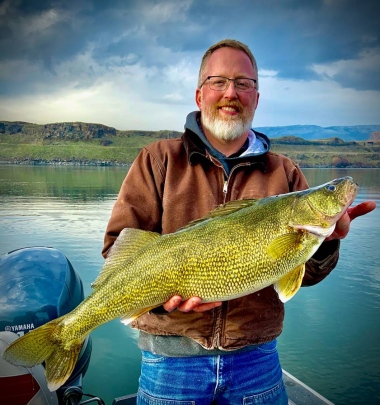
That's not to say that they are equally easy to catch every day of the year. In warmer water they have a higher metabolism and are thus more aggressive feeders. In the dead of winter you might have to get your offering right in front of them to get bit.
ODFW's Marty Olson likes to chase salmon and other fish when they are running, but in the winter and early spring you can find him pursuing walleye on the big river.
"I just really enjoy the fishery," he said. "Boats are usually a lot less numerous and are more spread out than when you're fishing for salmon. You can focus on the fishing and not worry about crowded conditions."
The only drawback to Columbia walleye is that they are not a great fish for bank anglers. They are caught from the bank in certain spots, however, the vast majority of walleye are bagged from boats.
Experienced Columbia anglers recommend a boat of at least 16 feet and a healthy respect for the currents and waves that can change throughout the day. When the wind comes up fast, the fishing needs to take a backseat to safety. It pays to monitor the weather before and during your trip.
The best bet is to go with a guide or an experienced friend in their boat before you take your own boat out on the Columbia. And when you do take your own boat out, it never hurts to have a buddy boat nearby.
Electronics are a big help for the Columbia angler. Knowing the water depth and bottom features are sometimes the key to finding fish. Of course, the more expensive fish finder technology can provide advantages, but a basic fish finder will work.
Olson fishes near The Dalles in a variety of water types. During certain times of the year, the fish seem to be on gravel beds or flats 25-35 feet deep. Other times, they can be found in deep holes. The best spots can vary between narrow and cliffy to wide and flat, depending on conditions.
Although walleye live throughout the Columbia and in parts of the Willamette, Olson suspects most fishing pressure is near the boat ramps from Portland to Irrigon. He suggests that beginning anglers can learn where to start by watching where other boats are fishing. Of course, it's not cool to horn in on other boats, but nothing is wrong with observing the types of areas people are targeting.
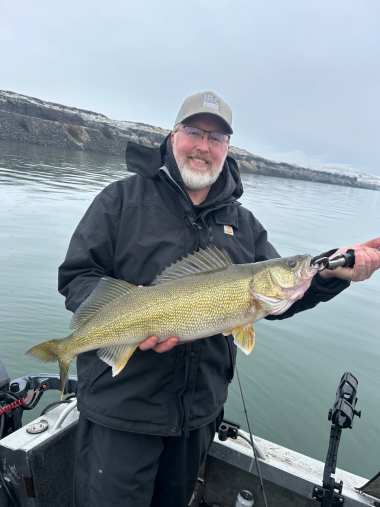
Due to the size of the Columbia and the remote stretches between boat ramps, walleye are in no danger of being overfished. The low angler pressure also means Oregon is a good spot if you're hoping to catch a big walleye. The state record, caught in the Columbia in 1990 was barely shy of 20 lbs--bigger than the record in most other states.
Anglers use a wide variety of tactics and tackle. People troll crankbaits, jig with artificial grubs, use worm harnesses behind a bottom walker and more.
Olson favors slow jigging with nightcrawlers on a jig head. Sometimes, he will add a trailer hook. He admits that he generally sticks with chartreuse jig heads and varies the weight according to conditions.
"Everyone has their own technique," he said. "I like to keep my line straight up and down when I'm jigging, so sometimes it takes a little effort to keep the boat moving the same speed as the current, especially when the wind picks up."
Olson likes a 6-8 foot rod with a medium action and a sensitive tip. That, combined with 12-15 pound braided line, gives you the ability to detect bites which can be subtle at times.
Walleye in the Columbia are plentiful and challenging. Keep boating safety at the top of your list and you can't help but have a blast chasing these tasty fish.

Check out the Latest Recreation Report
Current conditions and opportunities to fish, hunt and see wildlife. Updated weekly by fish and wildlife biologists throughout the state.