
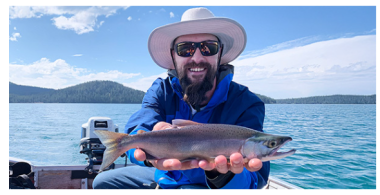
Tech Tips for Kokanee Fishing
Tom Schnell, former board member with Kokanee Power of Oregon, shares tips on tech to use to increase your kokanee fishing success.
Kokanee are delicious landlocked salmon that live in more than 20 Oregon lakes and reservoirs. They favor cool temperatures so they are most common in higher elevation waterbodies. Search for them on MyODFW.com and you'll get a lot of great information including a list of the locations where you can find them.
They feed on zooplankton in open water, so they are usually well out of reach for bank anglers. Unlike other species, they are not cruising the shoreline looking for crayfish or minnows. Even people with boats can be frustrated at the lack of structure to target. In some ways, it's like fishing on the open ocean because your intended target could be almost anywhere. That's where electronics can really help.
Like a lot of people who grew up in Oregon, Tom Schnell started kokanee fishing before electronics were super common or advanced. He would often go to Lake Billy Chinook and troll around with heavy gear, hoping to find the fish and stay on them. Kokanee gear has lightened up a lot since the 1980s and electronics are now very common among avid kokanee fishers.
There is no rule that says you have to use electronics, but it is a good idea. Schools of fish move around horizontally and vertically. A good bite today does not guarantee a good bite tomorrow at the same depth and location.
"Electronics are a tool like anything else," Schnell, former board member of Kokanee Power of Oregon, says. "If you have the right tools and use them correctly, it can really improve your success rate."
At the lower end of the cost spectrum, a standard depth finder is extremely useful in determining the depth of the water, location of schools of fish and sometimes the depth of your gear. By paying attention to the screen, you may discover a lot about where you are. However without a map, you may not learn much about what lies ahead of you with a standard depth finder.
"I always like to have a map, mostly digital mapping because that lets me know if I'm headed for hump or contour that makes the water depth go suddenly from 50 feet to 10 feet or something drastic," he said. "If you are running deep, especially with downriggers, you can lose a lot of gear running up on something you didn't know was there."
There are times when no electronics are needed. Early in the spring you may get a chance to "run and gun" casting jigs at schools of fish jumping or otherwise disturbing the surface. However, as the weather warms, you are more likely to be looking for fish somewhat deeper as they seek out cooler water.
"When I'm targeting fish later in the spring and summer, it seems like they hang out in water around 56 degrees," Schnell said. "And electronics can help you find where that thermocline is by noticing where you're marking fish."
For the angler with a few extra bucks to spend, the upper end electronics include livescope, real-time scanning sonar with forward, backward and top-down viewing modes. The high resolution makes it seem like you're watching live video of your trolling gear or jig and the fish chasing them. Schnell said several top brands offer very similar functionality, so the angler needs to research which one they find easiest to use and best for their purposes.
"Generally, livescope is more helpful in shallow water than a traditional depth finder is," Schnell said. "You can use it looking forward to see what's coming as you troll along. And looking back is helpful because you can clearly see your lures." Lure depth can change significantly even when your boat speed is constant according to your GPS. The result of a deep current moving opposite to your trolling direction can be lures riding higher in the water than you think they are. But livescope helps you see exactly how deep the lures are so you can adjust.
"Not only can you see your lures, you can watch how the fish are reacting to them," he said.
Schnell said fish behavior can be very telling. If he trolls repeatedly through a school of fish and they show absolutely no interest, he may suspect they are not kokanee and move on. If they follow but do not commit to striking, he considers tweaking his lure color, scent or trolling speed. It's amazing how a minor speed change can affect a lure's attractiveness to fish.
"Occasionally, I have wondered why the kokanee wouldn't bite and then noticed some big fish under them," he said. "In those cases, I think the kokanee are scared of the mackinaw trying to eat them, so they are in no mood to bite my lures."
Perhaps the best thing about these pricey gadgets is that they can be used for just about every other kind of fishing when you're not on the kokanee lake.
On a cautionary note, Schnell says the boat captain needs to remember safety and not be so transfixed by his electronics that he forgets to navigate. The best approach might be to let someone else watch the screen while the captain navigates and watches the rods and downriggers. He adds, "Remember why you're out there in the first place. You want to enjoy the sights and sounds of being outdoors."
Everyone wants to have a successful fishing day without breaking the bank on fishing gear. There is never a guarantee that gadgetry will make your trip successful, However, upper end electronics can be worth it if you have the resources and want to elevate your kokanee game.

Check out the Latest Recreation Report
Current conditions and opportunities to fish, hunt and see wildlife. Updated weekly by fish and wildlife biologists throughout the state.