
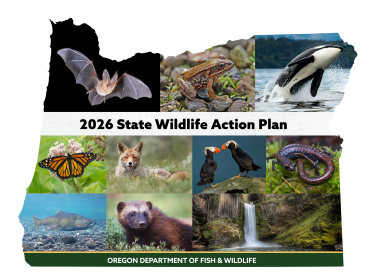
Oregon's State Wildlife Action Plan approved New funding for SWAP species represents historic advancement for conservation
General News
News
Contact
Michelle Dennehy, (503) 931-2748, Michelle.N.Dennehy@odfw.oregon.gov
SALEM, Ore.—ODFW is excited to announce that Oregon's State Wildlife Action Plan (SWAP) has been officially approved by the U.S. Fish and Wildlife Service. This milestone marks the final step in adopting the 2026 SWAP, a science‑based roadmap to maintain healthy fish and wildlife populations, prevent further declines of at‑risk species, and reverse existing declines where possible.
ODFW has also updated the user‑friendly SWAP website, designed to be a one-stop location for information about species, habitats and key conservation issues. Visit the 2026 SWAP website at: https://swap.oregon.gov/
"Oregon is home to some of the most remarkable wildlife in the nation—from secretive desert reptiles to colorful ocean invertebrates. But more than 300 species in the state are at risk," said ODFW Director Debbie Colbert. "Oregon's SWAP is a roadmap to help us focus investments to get the best return for at-risk species.
"Preventing future threatened and endangered species listings and maintaining Oregon's biodiversity has immense social, cultural, and economic benefits," she added.
With the new SWAP officially approved, ODFW is excited to keep the momentum going. Staff and partners across Oregon have already been working hard to protect wildlife and habitats, and the updated SWAP gives everyone a clearer roadmap to tackle the challenges ahead.
Those challenges include habitat loss, climate change, invasive species, and pollution that threaten the state's biodiversity. These threats pose risks to iconic species such as salmon and golden eagles, along with lesser-known Oregon-only species such as the Oregon slender salamander and Leona's little blue butterfly. The 2026 SWAP helps guide efforts to make sure these species, and many others, have a fighting chance.
One of the biggest strengths of the updated plan is the technical work behind it. The SWAP now includes a revised list of Species of Greatest Conservation Need (SGCN), updated habitat descriptions, and clearer identification of key conservation issues (KCIs) including threats from pollution. It also puts a stronger focus on climate resilience, invasive species, and how land use is changing across the state.
The plan also opens more doors for collaboration. It expands opportunities to work closely with tribes, landowners, and local communities to build solutions that make sense on the ground. With an updated and expanded Conservation Toolbox, ODFW and partners have more practical resources than ever to turn ideas into action.
Overall, the approved SWAP marks an exciting step forward. It blends science, collaboration, and on‑the‑ground experience to protect Oregon's wildlife.
Funding for vulnerable species
Federal approval also means that Oregon's SWAP will continue to be eligible for federal funding. And for the first time, Oregon's vulnerable species will have a dedicated source of state funding, thanks to the passage of HB 4134 which was signed by Governor Kotek on April 9.
Passed with bipartisan legislative support, HB 4134 adjusted the state's transient tax by 1.25%, with a portion of the revenue directed to wildlife and habitat conservation work throughout the state.
Oregon has never had a stable, dedicated source of funding to support the conservation of vulnerable species. The state's fish and wildlife management has largely been funded through hunting and angling licenses and associated revenues.
The bill was advanced by a broad coalition including more than 85 organizations such as Oregon Wild, Western Environmental Law Center, Oregon Hunters Association, Defenders of Wildlife, Oregon Cattlemen's Association, Oregon Conservation Network, Association of Northwest Steelheaders, The Nature Conservancy, Bird Alliance of Oregon, Oregon Ocean Alliance, Oregon Farm Bureau, NW Guides and Anglers Association, Theodore Roosevelt Conservation Partnership, Think Wild, Wallowa Resources, and many more.
"Passage of this legislation represents a historic advancement for conservation of at-risk species in Oregon," said Director Colbert. "We are grateful to everyone who came out to support this bill."
The bill is effective on January 1, 2027. The department will be working actively with its partners over the next few months to develop budget proposals for next biennium's budget (2027-29), including for this funding.

Check out the Latest Recreation Report
Current conditions and opportunities to fish, hunt and see wildlife. Updated weekly by fish and wildlife biologists throughout the state.