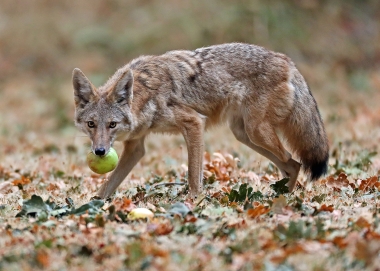
Coyotes are a native species that is well-adapted to Oregon's urban and natural landscapes. It is not unusual to see them in the daytime, even in developed areas. Understanding coyote behavior and how to avoid problems is key to coexistence.
Understanding coyotes
Coyotes are present in many large cities across the United States, including Portland, Chicago, and Los Angeles. While most urban coyote sightings don't need to be reported, you should contact ODFW if a coyote acts aggressively toward people, pets, or livestock.
Coyotes are skilled hunters and will eat rodents, birds, snakes, deer, insects, fruits and berries. They are opportunistic feeders and will also take advantage of pet food, bird seed, and compost/garbage. These food sources may also attract squirrels, feral cats, rabbits, rodents, and birds, which could attract coyotes.
Urban environments provide plentiful food resources, making them ideal for coyotes and supporting robust populations. In rural areas, coyotes often rely on natural prey, but they can still be drawn to food provided by people if it's available—especially near homes, barns, or livestock areas.
Coyotes are opportunistic feeders and will eat pet food, bird seed, and compost/garbage in addition to natural foods like rodents, berries, deer, and insects.
Coyotes are solitary animals. In the winter, a male and female will form a breeding pair to mate. In the spring and summer, females raise a litter of dependent pups. Pups will either disperse in early fall or will establish overlapping home ranges with coyotes already occupying the area. Large, roaming packs are rare and not typically seen in the same area year after year. Coyotes are territorial and tend to stay within defined ranges.
Seeing a coyote during the day doesn't mean it's sick or diseased. Coyotes are active at all hours, especially when they're raising pups or foraging in human-dense areas where food is more accessible.
Preventing conflict: What you can do
The best way to prevent issues with coyotes is to remove food sources and avoid feeding them, whether on purpose or by accident. Feeding coyotes is not only dangerous, it's illegal in Oregon (ORS 496.730).
Clean up fallen fruit on your property to avoid attracting coyotes.
Feeding wildlife, including coyotes, often does more harm than good. When coyotes begin to associate people with food, they can become bold or aggressive, approach people, and pose safety risks to people, pets and poultry. This can lead to the coyotes being killed. Although rare, coyote attacks on people are often linked to feeding. Coyotes drawn to populated areas are also at greater risk of being hit by vehicles or spreading disease to wildlife, pets, or people.
Notify ODFW or the Oregon State Police Fish and Wildlife Division (*677) of anyone feeding coyotes on purpose.
Follow these tips:
Remove food sources and never feed coyotes
Secure your garbage: Use bins with tight-fitting lids. Store them in garages or sheds if possible until pick-up.
Don't feed pets outside: Any leftover food becomes a buffet for coyotes and other wildlife.
Clean up fallen fruit and birdseed regularly.
Never feed coyotes on purpose. If a coyote starts associating people with food, it may become bold and start to approach people, increasing the risk of conflict.
Keep coyotes away from your property and livestock
Use motion-sensor deterrents (e.g., lights within city limits, noisemakers in rural areas) to passively haze coyotes.
Install coyote-proof fencing to keep coyotes out. Read up on coyote-proof fencing methods. After installation, check frequently for gaps.
Reinforce chicken/duck coops.
Pen animals at dawn, dusk and night when coyotes and other predators are most active.
Consider using livestock guardian dogs.
Protect your pets
Walk your dog on a leash when outdoors.
Keep cats indoors or in a catio (a secure outdoor enclosure) when outdoors.
Check your yard for wildlife before letting pets outside.
If coyotes are regularly seen nearby, choose a different area for walks or playtime temporarily.
Scare away bold coyotes
Haze coyotes: If you encounter a coyote, make loud noises by yelling or shaking a can with coins/rocks inside. Hazing discourages coyotes from getting close to people. A community-wide effort is most effective.
How do I scare away or haze coyotes?
Hazing, or scaring coyotes off, discourages them from approaching people. It can be an effective way to keep coyotes at a safe distance, but it should always be done carefully and responsibly. The goal is to make the coyote feel threatened enough to leave, not to injure it or put it in a position where it feels cornered.
Make loud noises such as yelling, air-horns, homemade clappers, banging pots and pans, stomping feet, blowing a whistle, etc.
Throw rocks, sticks, or other objects toward the animal.
Use a paintball gun, hose, or high-pressure water gun. Any projectiles must be labeled as "non-lethal" to be used for hazing.
What if a coyote approaches me?
Most coyotes will run away when they encounter a person. However, coyotes can be curious and may approach a person, especially if a dog is present or during certain times of the year like spring when pups are born.
If a coyote doesn't run away or approaches you:
Haze it until it leaves by making loud noises (such as yelling, banging pots and pans, using an airhorn), throwing rocks or other objects.
Report aggressive behaviors (such as snarling, barking, or not retreating when hazed) to ODFW. Call 911 immediately in the event of an attack on a person.
Use pepper spray if a coyote approaches close enough and you believe it will attack you or your pet.
Concerns for human safety should always be reported to ODFW or Oregon State Police. Serious safety incidents are rare, but when they do happen it's often linked to the feeding of coyotes.
Can coyotes be relocated or killed?
Coyotes are not relocated in Oregon. Relocation of coyotes does not have good outcomes and is generally considered inhumane. Coyotes are territorial and when a coyote is relocated, it is often killed by the existing coyotes in an area. Relocated animals are also more likely to die of diseases, starvation, or be struck by a vehicle in the place they are released.
On private property in Oregon, coyotes can legally be killed by landowners or an authorized agent without a permit any time of the year. Lethal removal in city limits presents legal and safety issues – use of firearms and trapping are highly regulated, limiting this option in metro areas. Trapping in urban areas also poses dangers to pets and other wildlife.
Generally, ODFW recommends resolving coyote conflict through hazing, removing attractants, and non-lethal deterrents. Studies have shown that coyotes quickly recolonize areas following lethal removal and removing coyotes generally does not address the underlying issues causing the conflict.
Coyote behavior through the seasons
Coyotes follow predictable seasonal patterns:
Winter: Mating season.
Spring: Pups are born. Coyotes stay close to their den to raise their young.
Summer: Pup-rearing season. Coyotes are more visible as they hunt for food for their young.
Fall: Older pups may be "kicked out" of the family unit and begin to disperse.
You may notice coyotes acting more defensive in the spring, especially when you're walking your dog near a den site. This "escorting" behavior—where a coyote follows you at a distance—is protective, not predatory. If this happens, change your route. The coyote can't move its den; you can move your walk.
Coyote sightings in and around Portland have been reported since at least the 1980s. Now, coyotes are regularly spotted across the Portland metro area. The Portland Urban Coyote Project studies how humans and coyotes interact in the Portland metro area. You can help with their research by reporting any time you see or hear a coyote.
Share your wildlife sightings through the Oregon Wildlife Conservation project
Join the community scientists who have shared their wildlife observations in Oregon throughout the iNaturalist app. Record your sightings of mammals, birds...