

East Region
Nick Myatt, Region Manager
ODFW WHART in Redmond
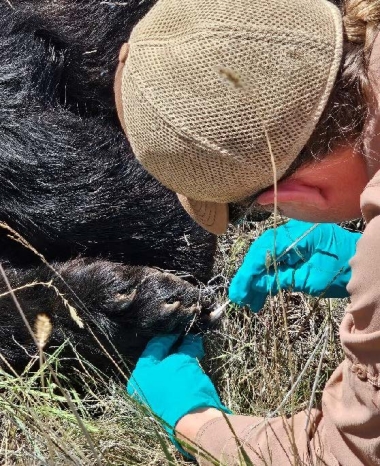
Wildlife-Human Attack Response Training (WHART) for East Region wildlife staff was held during the last week of May 2025 in Redmond at the Biak Training Center. Participants included 20 ODFW staff, six Oregon State Police officers, and four USDA APHIS (Wildlife Services) staff.
The first day of training was classroom style with presentations and discussions of the WHART Response Plan, phases of an incident (ICS), media relations and Oregon case studies. The second day consisted of evidence collection, public communication, and wildlife capture. The training concluded with participants working through a mock attack scene.
In 2024, ODFW and OSP officially formed the WHART work group to prepare staff in responding to wildlife attacks in Oregon. The group developed training based on the British Columbia Conservation Officer Service's (BCCOS) 5-day WHART course which many ODFW and OSP staff attended. The WHART work group completed training for West Region staff at E.E. Wilson Wildlife Area in 2024. To date, more than 60 ODFW staff have trained to respond to a wildlife-human attack, as well as 17 OSP and 11 USDA staff.
Walla Walla spring Chinook returns
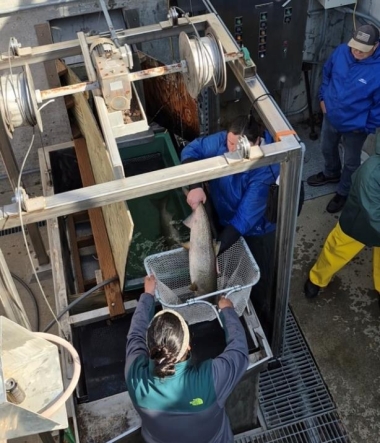
The ˀImtwaha Fish Hatchery, a Confederated Tribes of the Umatilla Indian Reservation (CTIUR)-owned and operated hatchery, released their full production of 500,000 smolts into the Walla Walla watershed in 2022. High returns in 2025 are from those releases. While this year's return was not sufficient to provide a fishery, managers from ODFW, Washington Department of Fish and Wildlife (WDFW) and CTUIR are optimistic that a harvestable run could be just a few years away.
The spring Chinook population in the Walla Walla was extirpated in the early 1900s and after nearly a century of absence, spring Chinook has made a strong comeback on the Walla Walla River— recording the second-highest return since reintroduction efforts began nearly 25 years ago. This achievement is the product of collaborative efforts between ODFW, WDFW and CTUIR, who worked tirelessly to bring spring Chinook back to a severely over appropriated system.
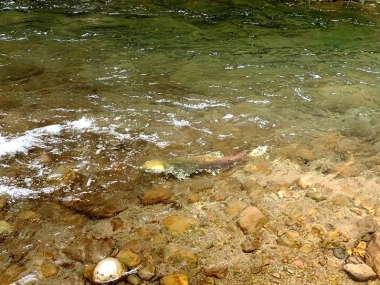
This work is in conjunction with a major partnership, the Walla Walla Basin Advisory Committee (WWBAC), that aims to increase flows in the Walla Walla and repair the watershed health to benefit fish, irrigators and other user groups that rely on the water in the Walla Walla watershed.
These recent efforts have significantly improved conditions for not only the spring Chinook, but also the other species like ESA-listed summer steelhead and bull trout, redband trout, pacific lamprey and suckers. Both Oregon and Washington have now passed legislation that for the first time in the Walla Walla basin now protects water across the state line all the way to the mouth of Walla Walla River. Also, the WWBAC has worked to fund projects such as protecting instream water rights; the removal and improvement of multiple fish passage barriers; and the restoration of multiple properties that include floodplain habitat.
Bighorn surveys on the John Day and Deschutes rivers
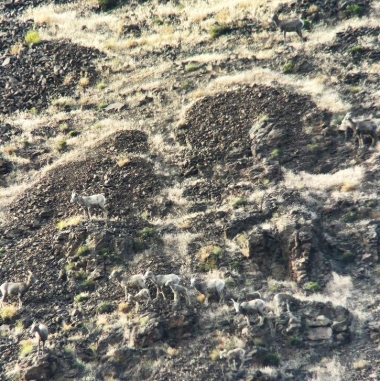
Annual California bighorn sheep surveys took place in the John Day River and Deschutes River watersheds this summer as part of early detection efforts for disease in wild sheep and to collect data population trends. Pendleton staff completed a bighorn sheep ground survey along the North Fork John Day River and Camas Creek in Umatilla County on June 17 and 18. The ground surveys are part of a larger monitoring effort that includes spring and fall helicopter flights of the Bridge Creek population.
Since their release on Bridge Creek Wildlife Area in 2018, the bighorn population there has expanded in size. During ODFW's June survey, 51 bighorn sheep were observed, the highest count since monitoring began in 2018. The herd composition included 28 ewes, 14 lambs, and nine rams. The release of 20 California bighorn sheep to Bridge Creek Wildlife Area was part of a larger effort to restore sheep to suitable habitat throughout Oregon. The source population for the release was the Lower John Day River herd, Oregon's largest and healthiest bighorn sheep population.
Deschutes district staff also completed their annual bighorn lamb recruitment surveys. The Lower John Day River survey took place on a 44-mile stretch of the river from Thirtymile Creek to Cottonwood State Park and spanned three days. In total, 343 sheep were counted consisting of 236 ewes, 86 lambs, and 21 rams. This resulted in a ratio of 36 lambs per 100 ewes which is within the range observed in previous years but lies within the lower portion of that range. Staff also conducted a lamb recruitment survey along the Lower Deschutes, a 39.5-mile trip from Pine Tree boat launch to Heritage Landing boat ramp. A total of 296 sheep were counted, with 160 ewes, 91 lambs, 41 rams which resulted in a ratio of 56 lambs per 100 ewes for the survey area.
West Region
Mike Gauvin, Acting Region Manager
Spawning gravel added to the Rogue River
Construction of William Jess Dam/Lost Creek Reservoir that began in 1967 blocked spawning habitat that supported about one-third of the spawning population of Rogue River spring Chinook salmon.
The construction removed many miles of cold-water habitat that had once been available to produce spring Chinook. It also blocked the river's natural ability to move new spawning substrate downstream where spring Chinook, winter steelhead, and Pacific lamprey spawn.
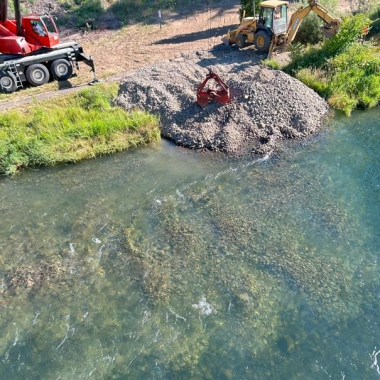
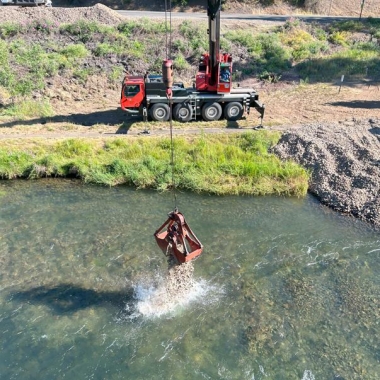
The Army Corps of Engineers and ODFW have been working jointly to begin adding spawning gravel back into the Rogue River below the dam. After four years of planning and permitting, approximately 450 cubic yards of spawning gravel were placed into the Rogue River below the dam in July. This is the first sizeable amount of spawning gravel put into the Rogue River since the dam closed in 1977.
The Rogue Fish District understands the Corps will be able to continue to add similar amounts of spawning gravel in the future. We will continue to be a partner in this project that will certainly benefit native fish in the upper Rogue River.
Umpqua fish monitoring projects: wild summer steelhead and Diamond Lake
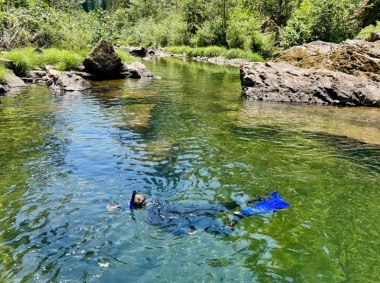
For well over two decades, the Umpqua Fish District staff conduct yearly snorkel surveys in nine index pools in the Steamboat Basin. Typically, each pool is snorkeled four times over July and August.
During the first survey on July 9, staff counted 355 wild summer steelhead. This is a welcome sign as it is above the average of about 220 wild summer steelhead counted at this time of year. Staff then evaluated the run over Winchester Dam through early June, and we are predicting the run will exceed the critical threshold of 1,200 total wild steelhead for the season.
Annual Diamond Lake monitoring and sampling is in full swing. The sampling season begins in mid-May and by July 7, the crew removed approximately 19,000 golden shiners and 450 tui chub. While this is about on par with the previous season, just a week later the number of tui chub captured rose to over 2,000 which exceeded last year's total by nearly double.
Typically, tui chub and shiner catch rates drop as the summer progresses, but staff will pay close attention to the count. Despite the increase in tui chub, as of early July anglers are doing well with good numbers of trout being caught.
Exploring the use of UAVs for tufted puffin surveys
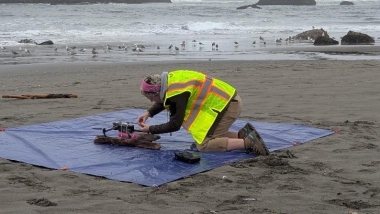
ODFW staff are assisting the National Audubon Society with a project to explore the use of Unmanned Aircraft (UAVs) and UAV-collected imagery for tufted puffin monitoring, bird counts and habitat surveys. The project currently focuses on two offshore islands near Pacific City and four near Brookings. Early results are encouraging, and the team hopes to expand the project to more sites next year.
In addition to the images collected, ODFW and partner agencies (U.S. Fish and Wildlife and Oregon State Parks) are working together to observe avian responses to the UAV's presence in the hopes of developing more tailored guidance for UAV flights in the future.
Forest thinning project benefits SWAP species and helps lessen wildfire severity
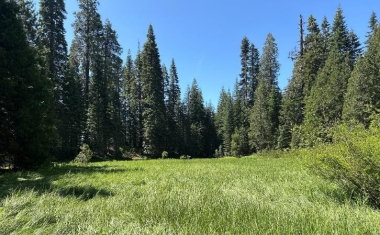
The Rogue District Wildlife Habitat Program finished a 228-acre project in June on Rogue River-Siskiyou National Forest (RRSNF) managed lands near the Rogue-Umpqua Watershed Divide. The project was a vegetative treatment to remove small conifers (up to eight-inches DBH - diameter at breast height) to create more early seral vegetation on federal lands.
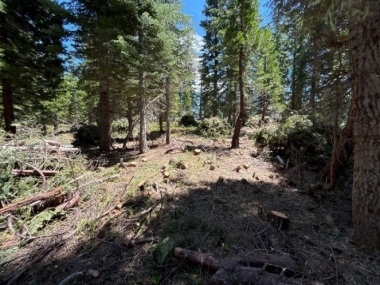
Reducing forest density can help lessen wildfire severity, helping to protect larger carbon sequestering trees. The project also reduces conifer encroachment in the many wet and dry meadows of this unique area. Mountain huckleberries surround the meadows and are in the understory of the treated stands and should increase with less conifers. Care was taken to avoid piling slash on the mountain huckleberries as this significant first food has been used by local tribes including the Cow Creek Band of Umpqua Tribe of Indians and the Klamath Tribes since time immemorial.
There were some magnificent old growth Douglas-fir trees – the largest measured nearly 28 feet DBH – and incense cedar that are directly adjacent to meadows, creating excellent habitat for State Wildlife Action Plan (SWAP) species such as great grey owls. Other SWAP species documented here to date are Pacific fisher, pine martin, and western gray wolf. This area is suspected habitat for special status pollinators including Franklin's Bumblebee (federally endangered and SWAP) and western bumblebee (SWAP). It also has suitable habitat for red tree voles (SWAP) and spotted owls (federally threatened and SWAP), California king snakes (SWAP) and the fringed myotis bat (SWAP).
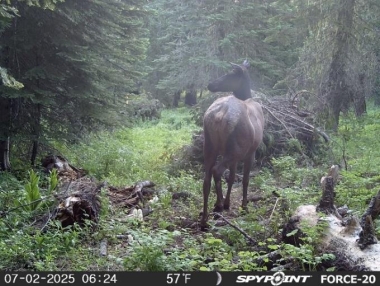
Within the first week of contractors leaving the project area, ODFW game cameras documented use by black bear, cow elk, numerous blacktail deer bucks in velvet, and newborn fawns and their mothers. Monitoring is ongoing via cameras and photo points.
This project, valued at $174,430 is one of thousands of acres slated for treatment under the U.S. Forest Service's (USFS) Stella Landscape Restoration Project and is a great example of ODFW working with partners like the USFS. The Mule Deer Foundation and Oregon Wildlife Foundation generously donated private cash-match funding. Funding also came from an existing Good Neighbor Authority Special Project Agreement with the RRSNF and from the U.S. Fish and Wildlife's Pittman-Robertson grant.
The Rogue district habitat biologist administered this project from start to finish and worked with a Central Point contractor. More acreage is planned for thinning in the coming year.
Oregon State Police
Captain Casey Thomas, Fish & Wildlife Division
Unlawful salmon seized during OSP boat patrol
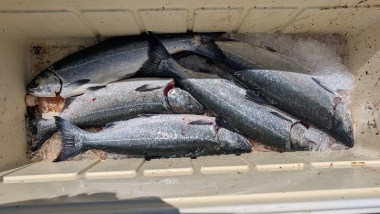
Fish and Wildlife Troopers conducted an ocean patrol during the 4th of July weekend. Hundreds of boats were angling just in the area of the CR Buoy, and numerous salmon and rockfish anglers were contacted. Multiple citations and warnings were issued for Taking Wild Coho Salmon, Exceed the Daily Limit of Salmon, Continue to Angle After Retaining Daily Limit, Fail to Immediately Validate Harvest Card, Fail to Allow Inspection of Catch, Angling Prohibited Method – Barbed Hooks For Salmon, Angling Prohibited Method – Number of Hooks, No Angling License, and No Harvest Card. On one contact, the Troopers approached a boat with two (2) subjects on board, actively trolling for salmon with two (2) rods. As the Troopers approached the subjects were landing a wild coho. The Troopers contacted the subjects who said that they had four (4) salmon on board and had caught and released 7) additional salmon, but they were exhibiting indicators of deception. The subjects said they were continuing to angle for salmon for fun, even though they already had their daily limit of 4 salmon on board. The subjects did not have any of those four (4) salmon tagged, and while Troopers were speaking with one of the subjects, the other took the barbed hooks he was using and threw them into the ocean. A consent search of the boat revealed the subjects had hidden a bag with 5 additional salmon. Three of those salmon were wild coho, and two (2) of them were hatchery salmon. Both subjects were cited and released criminally for numerous offenses, and five (5) salmon were seized.
OSP Fish and Wildlife Trooper assists ODFW staff
A Fish and Wildlife Trooper assisted the Oregon Department of Fish and Wildlife with the sort and transfer of spring Chinook Salmon to their hatchery at Leaburg Dam. ODFW employees value this operation as an annual highlight, and they appreciated Trooper assistance.
Rifle seized by OSP as evidence in deer case
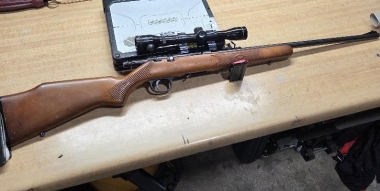
South Coast Troopers interviewed two subjects who were rumored to have been involved with the unlawful take of a doe deer several months earlier. Both subjects ultimately admitted to the unlawful harvest of the doe. A bolt action .22 Mag Rifle was seized as evidence. Both subjects have been cited criminally, and additional crimes will be referred to the District Attorney.
OSP boat patrol on Brownlee Reservoir
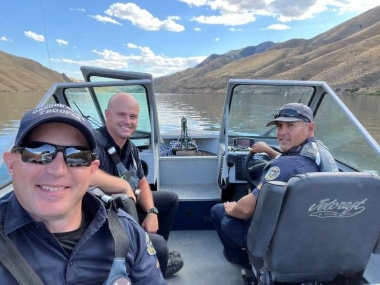
Fish and Wildlife Division members conducted a boat patrol on Brownlee Reservoir, which resulted in 67 contacts/42 angler checks/13 Boat Inspections. 10 citations were issued for angling offenses, one (1) citation was issued for a boating offense and numerous warnings were also issued.
Ocean Salmon and Columbia River Program
Tucker Jones, Ocean Salmon and Columbia River Program Manager
Habitat use of adult White Sturgeon in the John Day Reservoir
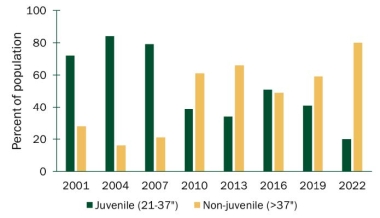
ODFW biologists have wrapped up a large research project looking at behavior and movements of adult-sized White Sturgeon (larger than six feet in length) in the John Day Reservoir of the Columbia River. ODFW started this work after seeing a decade long recruitment failure in this reservoir, coupled with a decline in the percentage of the population comprised of juvenile sturgeon (Figure 1), both of which are concerning for long-term population health. To help us start to understand what might be impacting spawning and recruitment success, we looked at reservoir wide habitat use and movement, with a focus on the spawning season, as well as more fine-scale movements in the McNary Dam tailrace.
This project first started in 2018 with funding from Bonneville Power Administration and a grant in 2023 from Oregon Conservation and Recreation Fund provided additional focus and momentum to answer additional questions related to the spawning area in the tailrace of McNary Dam.
Adult White Sturgeon were caught and implanted with acoustic transmitter tags. Receivers, which record transmissions from tags, were placed along the 122 km length of the reservoir. Data was collected from 2018 to 2021, and again from 2022 to 2024. In total, 58 White Sturgeon were tracked with acoustic tags.
When looking at reservoir wide habitat use, three main types of behaviors were identified using complex modelling. These were: "holding" in which sturgeon exhibited no noticeable change in location or movement, "transitory" where sturgeon made large one-direction movements either upstream or downstream, and "exploratory" comprised of smaller, frequent, multi-direction movements.
Although behavior varied for individual sturgeon, results from the study indicated that holding was generally the dominant behavior across all years sampled. The majority of the population exhibited holding behavior in the area near McNary Dam, which was also identified as the primary overwintering habitat. Presence in the McNary Dam tailrace area was variable during the spawning season, which occurs between April and June.
Exploratory behavior was common for male White Sturgeon, which consumes a lot of energy. Transitory behavior was more common for females, indicating deliberate, one-directional travel between two points. Reproductive females may be conserving energy for the high demands of egg production.
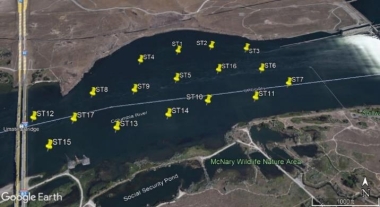
To focus more closely on the spawning habitat, 17 receivers were placed in a smaller area (between the I-82 bridge and McNary Dam; Figure 2) to determine fine-scale movement and habitat use. A total of 26 sturgeon were present during this portion of the study, occurring from 2023 to 2024. All 26-sturgeon returned frequently to the habitat included in this part of the study.
Male White Sturgeon activity covered larger areas and included more space downstream towards the I-82 bridge. In contrast, female White Sturgeon frequented smaller areas, which were generally oriented more upstream toward McNary Dam. Of note, for each individual female, the activity area recorded overlapped with at least one male during the spawning season, indicating that White Sturgeon may be exhibiting spawning behavior in John Day Reservoir. Given this information, the next steps will involve exploring other factors that may be limiting successful recruitment in this population.
-End of field reports for August 15, 2025-

Check out the Latest Recreation Report
Current conditions and opportunities to fish, hunt and see wildlife. Updated weekly by fish and wildlife biologists throughout the state.