
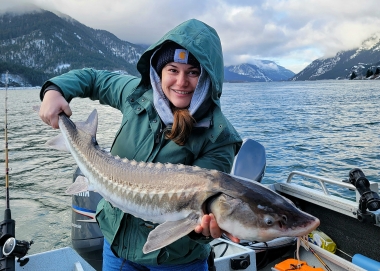
Sturgeon fishing
The white sturgeon is one of Oregon's most iconic and distinctive fish species with a lineage dating back to the age of the dinosaurs. Due to population concerns, the sturgeon fishery is highly regulated in terms of retention opportunity and size limits. The structure of retention seasons is likely to change in 2026 with no New Year's Day opener in Bonneville and The Dalles pools, as quotas have been met in just a few days in recent years. Oregon and Washington will hold a joint state hearing Nov. 13, 2025 at 2 p.m. to discuss and lay out a new approach for sturgeon retention season for 2026.
Reaching a length of 8 feet or more, white sturgeon are a great challenge for Oregon anglers of all experience levels. They relocate unexpectedly, change their bait preferences and fight hard regardless of whether you hook them in a deep pool or a tidal flat. They are even more challenging for the public agencies that manage them.
The law of supply and demand applies to the delicious meat of these prehistoric fish, not the ability to legally pursue them purely for sport. If you just want to catch a sturgeon and perhaps snap a quick pic of it in the water before you release it, opportunity is abundant.
The white sturgeon is widespread in Oregon, ranging from the ocean to the Willamette River and up the Columbia and Snake River. Lots of places in the Willamette and Columbia offer year-round catch-and-release fishing. Always check the regulations to make sure you have the right paperwork (license, combined angling tag and Columbia River Endorsement) and which locations are open.
As with much fishing, a boat comes in handy for pursuing these giants. As they are often found in deep swirling waters, safety is paramount. When in doubt, go with a more experienced captain before you take your own boat out.
Bank anglers also catch their share, using heavy line and weights big enough to hold bait on the bottom. You need stout gear just to cast and manage your bait, let alone fight a fish bigger than you are.
Bait can be almost anything you could find on the bottom of the river, estuary or bay: herring, smelt, clams, sand shrimp and squid have tempted many a sturgeon to bite. It is not difficult to find good bait and a spot open to catch and release.
If you want to eat one of these delicious fish, the plot thickens considerably. This is where supply and demand come into play for fishery managers. The word has been out for many, many years, sturgeon meat is excellent when smoked or prepared any number of other ways for the table. So, the supply of people wanting to eat them has long outstripped the supply.
But why would the meat of such a widespread fish be in short supply? For starters, they are slow to mature. A sturgeon can live to be 100 years old, which is great. However, they reach sexual maturity as late as about 25 years old or about 6 feet long. They spawn every 2-8 years. Many other gamefish begin to reproduce far younger, spawning annually, leading to more juvenile fish and higher bag limits.
Even sturgeon that have reached the age of reproduction don't always find favorable spawning conditions. As broadcast spawners, they depend on the right water velocity, temperature and turbidity, which doesn't always occur. If females are too stressed, they may fail to spawn, reabsorb the eggs and then wait 3-5 years before attempting again.
Sea lions have had an impact too, by taking advantage of manmade pinch points. These marine mammals are known to target salmon and steelhead near fish ladders on the Willamette and Columbia rivers. They are also known to eat sturgeon. And while ODFW has lethally removed some of these predators from the rivers, federal law keeps that limited.
Fishery managers in Oregon have long used "retention" seasons to offer some opportunity for anglers to take a sturgeon home. These include limited days, low bag limits and restrictive size categories for keepers. This is all in the name of conserving the species while allowing some level of harvest for the table. In recent years, due to population issues, the only retention opportunity in the Columbia has been early in the year and in areas upstream of Bonneville Dam.
Even with all the caveats, the high demand to retain sturgeon has led to seasons stopping unexpectedly when quotas are reached early. This in turn has led to frustration for some sturgeon anglers who missed out completely because they were not on the water early enough in the season. Retention seasons on the Columbia upstream of Bonneville have traditionally opened on January 1, which means many sturgeon anglers have the day off and can help bring in the catch quota swiftly.
Because Oregon and Washington share the Columbia River, the states are meeting in November to align sturgeon regulations for 2026. ODFW and WDFW fishery managers are developing new approaches to season structures to spread out retention opportunity beyond the people who can get there closest to opening day. Starting in 2026, sturgeon anglers should not expect the traditional New Years Day opener in all sections of the Columbia upstream of Bonneville.
Challenging to catch and even more challenging to manage, the white sturgeon is one of the iconic fish of the Pacific Northwest. Every angler owes it to themselves to fight one of these behemoths at least once. Eating one is just a bonus on top of the memories of a fight that will last a lifetime.

Check out the Latest Recreation Report
Current conditions and opportunities to fish, hunt and see wildlife. Updated weekly by fish and wildlife biologists throughout the state.