Search myodfw.com
Showing 701 - 720 of 1673 results
Features: Plankton eaters, the American shad is the biggest of the herring species and averages 3 to 5 pounds. They are silver on the sides, and green to blue on top, with green shading on their fins. Habitat: Like other anadromous fish species, they spend most of their lives at sea and return to fresh water to spawn. Females release free-floating eggs that will be fertilized by later-arriving male, called buck shad, in a spawning frenzy. Eggs hatch in eight days and fry spend four to five years in salt water before returning to spawn. Shad often survive to spawn…

Features: These blue-green, silvery or light brown fish are a schooling fish and an important food source for larger fishes, sea birds and marine mammals. Habitat: Anchovy are frequently offshore, but can be caught inshore in harbors and large estuaries during spawning. Technique: Anchovy are usually targeted in bays with multiple-hook herring jigs.

Features: Cabezon are a dark green to dark brown with mottling along their sides and with smooth, scaleless skin. The largest cabezon caught was over 20 pounds, but on average they weigh approximately 4 pounds. Habitat: Cabezon live around kelp beds and rocky headlands over hard bottoms. Technique: Cabezon are best caught using rubber tailed jigs tipped with bait. Make sure you are fishing within just a foot or two of the bottom as Cabezon like to hold tight to cover. CAUTION: While Cabezon meat can be safely consumed, its roe is poisonous to humans. Photo credit: Brandon Ford
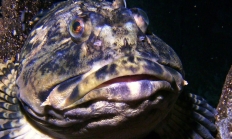

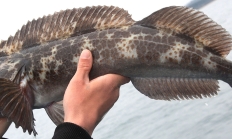
Features: Bullheads present in Oregon (brown, yellow and black) are distinguished from channel catfish by their square or rounded tails and lack of spotting. They seldom exceed two pounds and 18-inches long. Black bullheads have a square tail with a light vertical bar at its base and chin barbels that are all dark. Habitat: Bullheads are found on the bottom in the shallows of mud-bottomed ponds, lakes, reservoirs and backwaters of rivers. The black bullhead is primarily in reservoirs and streams tributary to the Snake River. Bullheads feed on almost any type of plant or animal material; insect larvae and…
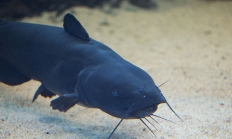
Features: Channel catfish are pale bluish-olive above and bluish-white below with a deeply forked tail, dorsal and pectoral spines, and an adipose fin. Like all other catfish, channel catfish have “whiskers” or barbels extending from the chin and upper jaw. Young fish have a varying number of small black spots over much of the body, while older fish may be partially or entirely without spots. Maximum size in Oregon approaches 40 pounds, but most are less than 10 pounds. Habitat: Channel catfish in western Oregon are limited to the Columbia River, lower Willamette River, and a few ponds in the…
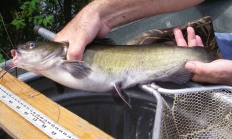
Features: Bullheads present in Oregon are distinguished from channel catfish by their square or rounded tails and lack of spotting. They seldom exceed 18 inches in length and a weight of 2 pounds. Yellow bullheads are a more uniform yellow color with white or cream chin barbels and a rounded tail. Habitat: Bullheads are found on the bottom in the shallows of mud-bottomed ponds, lakes, reservoirs and backwaters of rivers. The yellow bullhead is found mainly in the Willamette basin. Technique: Bullheads can be caught any month of the year, but fishing is best from the first warm days of…


Features: Black crappie are silvery in color with numerous black or dark green blotches and no distinct vertical bars. This results in a darker overall color than seen in white crappie. The forehead is dished, but not as much as in the white crappie. The dorsal fin usually has seven or eight spines and its length is equal to or greater than the distance between the dorsal fin and eye. Habitat: Black crappie do best in clear waters of medium-sized lakes, reservoirs and large slow moving streams. They are less tolerant of flowing and muddy water than white crappie and…
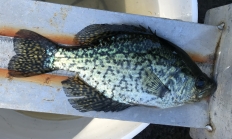
Features: White crappie are often confused with black crappie. White crappie have silvery bodies with blackish-green mottling forming narrow vertical bars on the sides. The forehead is more dished than in the black crappie. The dorsal fin has five or six spines and its length is less than the distance between the dorsal fin and eye. Habitat: White crappie do best in larger lakes and reservoirs and are more tolerant of turbidity and less dependent on aquatic vegetation than black crappie. They congregate around pilings, sunken logs, underwater brush, weed beds and rocks. White crappie begin life feeding primarily on…
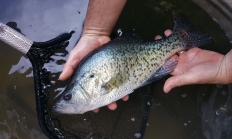
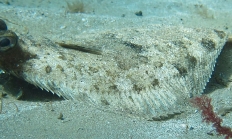
Features: California halibut are usually solid brown to black or mottled with light and dark patches on the eyed side and white underneath. They have the ability to change skin color patterns to blend in with the ocean floor. The eyes on a California halibut are most commonly on the left side but may be on the right side as they are on a Pacific halibut. The upper jaw in a California halibut extends to the rear of the lower eye, while on a Pacific halibut the upper jaw only extends to the front of the lower eye. In both…

Features: Starry flounder are a flatfish with both eyes on the "top" side of their heads. They are dark on the eyed side with very rough scales, and alternating yellow/orange and black bands in the dorsal, anal, and tail fins. Habitat: Flounder tend to stay near the bottom, looking for food above. Technique: Drift a small jig or bait (such as shrimp, marine worm or mussel) on a #2 hook with 2-ounce sinker rigged on a 10- to 15-pound line over a sandy or muddy bottom. Header photo by Sam Grover, Flickr

Features: Their eyed-side is greenish-brown to dark brown or black with lighter blotches. Their blind side is white to milky-white. They have a large, stout but flat body, shaped like an elongated diamond . Pacific halibut have been known to reach 500 pounds, but on average are 40 pounds. Habitat: Halibut are a large flatfish and so they spend much time near the bottom of the ocean looking above for food. They prefer chilly water and are primarily found in the Gulf of Alaska. Technique: Boat anglers use heavy rods to fish on or near gravel bottoms in water 150-500…

Features: The Pacific sanddab is left-eyed, meaning both eyes are on the left side of the body. The eyed-side is dull light brown, mottled with brown or black, and sometimes yellow or orange. The blind-side is off-white to tan. They have an oval shaped body with large scales. They can grow to be 16-inches long and up to 2 pounds, though most weigh less than 1/3 pound. Habitat: As you probably guessed, sanddabs like to hang out on sandy bottoms. They are most abundant at depths of 20-50 fathoms, and are common in shallow coastal waters from British Columbia to…
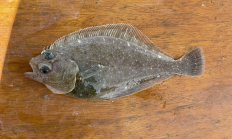
Features: Soles have flattened, oval bodies with both eyes on one side of their head. They are dark on top and light underneath. Habitat: They are commonly found on mud or sand bottoms from 5- to 750-fathoms deep. Techniques: Soles and other flatfish are best targeted by fishing with smaller hooks (less than 2/0) tipped with bait such as clam necks, sand shrimp, or chunks of herring or anchovy on a sandy or gravel bottom.


Features: The females are freckled all over with small reddish-brown to golden spots on gray to brownish background. Their fins are mostly yellowish-orange. The males are gray to brownish-olive, with irregular blue spots on the front of their bodies; each spot is surrounded by a ring of small reddish-brown spots. The inside of this species' mouths are yellowish. Habitat: Kelp greelings can be found to depths of 150 feet. They prefer rocky inshore areas and are common in kelp beds and on sand bottoms. Technique: It is best to target kelp greenlings by placing a line near the base of…

Features: Usually greenish to brown with darker mottling, but most fish have bright red blotches on their sides. They tend to have dark bars or blotches on their fins, and the inside of their mouths are bluish. Habitat: Their habitat is subtidal algal beds and rocky reefs from the Bering Sea to southern California. Technique: Try fishing for rock greenlings from the shore as they are often captured in shallow, rocky areas. These fish have small mouths, so try a #4 or #6 hook to catch these daytime feeders.

Features: Lingcod have an elongated body with a large mouth and sharp, canine-like teeth. They are generally mottled gray or brown but sometimes green or blue. A green-colored “ling” should not be confused with a greenling. Lingcod can get 5-feet long, but those caught in Oregon average between 2- and 3-feet. Habitat: Adults like to be near rocks, inshore and to 230-fathoms deep. Young lingcod prefer the sand or mud bottoms of bays and inshore areas. Technique: Bounce some bait along the bottom with 5/0 or 6/0 hooks, a 4- to 6-ounce sinker, and 20-pound line on a stout rod…