
Search myodfw.com
Showing 81 - 100 of 1673 results
This small white goose is similar in plumage to the snow goose in all ages. In mixed flocks, the Ross's smaller size, shorter neck, head and bill profile and more rapid wing-beat may be apparent. They are a common spring and fall migrant through Klamath and Harney basins. During migration and on wintering grounds, the Ross's goose uses lakes and shallow marshes for roosting and agricultural crops and irrigated hay meadows for feeding. They arrive in Oregon around mid-October and leave around mid-November to continue their migration. They are a common spring and fall migrant through Klamath and Harney basins…

With four wing-beats each second pushing them to 62 miles per hour, brant are the fastest and strongest geese in flight and among the swiftest of all large birds. Black brant comprise the vast majority of brant occurring in Oregon. These small geese have smoky black backs and bellies, and dissected white collars and white around the tails provide striking contrast. The black brant can live up to 20 years and are resilient enough to ride out storms on the open ocean. In Oregon, wintering numbers along the coast have seen a 50 percent reduction from previous years due to…

Canada geese, with their distinctive black neck and head and white cheek patches, need little description because they are one of Oregon's most familiar and conspicuous birds. There are 11 subspecies of the Canada goose. As a whole, the species is widely distributed throughout Oregon, with the exception of mountainous and desert areas lacking reservoirs, lakes, or large rivers. Concentrations of wintering and breeding Canada geese occur wherever agriculture and other human developments provide green forage or small grains and water bodies provide sanctuary. Hear the call of the Canada goose Photo by Leise Wease

Pheasants, grouse, quail and turkey are all upland game birds that are chicken-like and ground-dwelling. Wild turkeys are the largest upland game bird in Oregon.
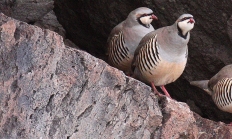
Chukars are ground-loving birds that quickly run uphill or burst from cover with rapid wing-beats and a characteristic whitoo call if alarmed. Introduced by managers wishing to increase hunting opportunities in arid western North America, the chukar is a very successful exotic species that occupies habitats where few other gamebirds exist. It is the most harvested upland bird in Oregon. It is a common permanent resident of eastern Oregon. Populations are distributed in steppe habitats along the breaks of the Columbia, John Day, Snake, Owyhee, Deschutes, Malheur, Burnt and Grand Ronde rivers and lesser watercourses or reservoirs. Hear the call…

The gray partridge was released in North America as early as 1790 from its native range in Europe and Asia, but it was not until the 1900s that this stocky gamebird became well established in many states. It is also called the Hungarian partridge (or Hun) by hunters. The gray partridge currently thrives mainly in the valleys of the northeast and Columbia Basin counties of Oregon. Photo by Dave Miller, Flickr

Oregon hosted the first successful introduction of the ring-necked pheasant in North America. This exotic game bird, released for sport hunting from China is now widely introduced and distributed throughout North America. Although more likely to run than fly, the ring-necked pheasant will explode into the air if startled, producing a distinctive sound from rapid wing-beats. It inhabits open areas such as grasslands, agricultural fields, and brushy areas, and avoids forested habitats. Hear the call of the ring-necked pheasant Photo by Charlotte Ganskopp

Ruffed grouse are named for a series of black iridescent feathers on the sides of the neck called the ruff, which is erected by males to form an ring around the neck during courtship displays. This forest-dwelling species, favored by upland game-bird hunters, is well known for the drumming of the males during courtship displays in the spring. It is a common resident throughout most forested regions of the state. It occupies most forests at low to moderate elevations east of the Cascade crest, primarily the east slope of the Cascades from Ft. Klamath and upper Klamath Lake and Blue…

Greater sage-grouse are best known for their elaborate courtship displays that occur on traditional strutting grounds, known as leks, where males gather each spring. At all seasons, both sexes are readily identified by large size and chicken-like build. Adults are mottled dark gray, black and buff, with black bellies and pointed tails. Males have specializations used in display. Their tail feathers are long and pointed with white spots. They have yellow combs over each eye and a chest sac with two bare, yellow patches of skin which are inflated during display. The display lasts only a few seconds and is…

This northern grouse reaches Oregon only in the forests of the Wallowa Mountains in the northeastern part of the state. It is dusky and slightly smaller than the ruffed grouse. Sexes are different in coloration; males have a black breast with white spotting on the sides, white spots at the base of a black tail, and a red comb above the eye. Females are heavily barred with dark brown and white and have a dark tail. Hear the call of the spruce grouse Spruce grouse observation form Photo by Dave Budeau, ODFW

This popular upland game bird is the largest of Oregon's three forest grouse. It is well known for the distinctive hooting call emitted by courting males in the spring. This call is accompanied by an extravagant courtship display involving exposure of blood-engorged, featherless shoulder spots and eye combs, which are reddish to orange. It is a common resident in coniferous forests. Hear the call of the dusky grouse Photo by Jim Dollar, Flickr
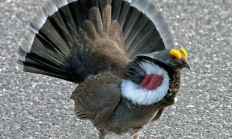
An Oregon native, sooty grouse occupy the coniferous forests of western Oregon, the eastern slopes of the Cascades, the Blue Mountains of northeastern Oregon, and the Klamath Basin and South Warner Mountains. Preferred habitat includes timber edges, open timbered slopes and mountain meadows, often adjacent to springs or other sources of water. They are often associated with berry producing areas such as chokecherry thickets. Hear the call of the sooty grouse Photo by ©Keith Kohl, ODFW

Columbian sharp-tailed grouse, commonly called "prairie chickens" by early Oregon residents, were abundant in the grasslands and foothills of Oregon east of the Cascade Mountains prior to the late 1800s but were considered extirpated from the state by the 1970s. Recent reintroduction programs give a glimmer of hope that sharp-tails may once again hold their own in northeast Oregon. Males congregate on leks or dancing grounds in the spring and perform elaborate social displays. The Columbian sharp-tailed grouse is an Oregon Conservation Strategy Species in the Blue Mountains ecoregion. Hear the call of the Columbian sharp-tailed grouse Photo by Mike…

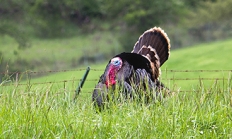
The wild turkey is the largest game bird in North American with mature males weighing upwards of 20 pounds and standing 40 inches tall. These large terrestrial birds are generally dark brown to black in appearance but iridescent color in feathers ranging from gold and copper to green and black gives a metallic appearance, particularly in full sunlight. Males and about 10 percent of females sport a unique beard of keratinous filament that protrudes from the junction of the breast and neck. Beards grow continuously but rarely exceed 10 inches in length. Females are smaller and duller in appearance. Densities…
This is the largest native quail in North America and one of the least understood. Males and females have identical plumage characterized by distinctive white flank barring and prominent vertical head plumes. Their eastern Oregon range appears reduced from historical accounts. Mountain quail are considered occasional in Union and Wallowa counties. They have also been observed along many of the tributaries of the John Day River in Wheeler and Grant counties and some in Wasco, Jefferson, Deschutes and Crook counties. In western Oregon, they are found in most forested mountainous areas generally above 1,640 feet, but may move to valley…

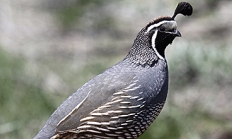
California quail are the most widely distributed upland game birds in Oregon. Most easily recognized by the comma-shaped, black, plume, or "topknot," which bends forward and is larger on the male. It has been a resident statewide since the early 1900s, except for most forests of the north Coast Range and west Cascades; it is generally absent along the coast north of Coos Bay. California quail is also absent from high-elevation areas of the east Cascade range. They are common residents in rural and even some suburban areas, particularly in eastern Oregon where many coveys gather at feeding stations during…
These diving birds are built for living on the water, floating low on the surface with legs farther to the rear to help propel them underwater. Loons have webbed feet, grebes have lobed toes.

A small loon holding its slender head erect and narrow, upswept bill upward is most always a red-throated. A quick flyer, it can be identified by rapid deep wing-beats, humpbacked body with head and neck extending below the body, and wings appearing far to the rear due to the usual invisibility of the small feet. Often feeding near the surf, it may be spotted by beachcombing humans. It can take flight from a small water area, and can also, if pressed, take flight from land. It is an abundant Oregon nearshore transient from fall through spring. Hear the call of…

The flight of Pacific loons by the thousands along the coast each spring and fall is one of Oregon's most dramatic bird migrations. Stunning plumage often clothes these fast-flying travelers. The straight bill, distinguishing Pacific from red-throated and yellow-billed, is less robust than that of common loons. The Pacific's head is larger and its neck thicker than those of the red-throated. In flight, Pacific's wing-beats are faster than those of common, loons the feet appear larger, the forecrown is rounder, and the hindcrown more sloped than those of red-throated loons. This is the most abundant loon off the Oregon coast…

This largest of the commonly encountered loons is perfectly built for underwater prey pursuit. Ungainly on land, this may be the price it pays for being a great diver. Large and blocky-headed, with a straight, robust bill, the common loon is separated from the yellow-billed by its straight bill and winter face pattern, and from smaller loons by its more angular head and often-retracted robust neck. Black head, white "necklace," incomplete black-and-white neckband, and white-checkered black back define breeding adults. Dark gray upperparts of winter adults shade to white underparts. Take-off is impossible by land and labored on water, but…
