Search myodfw.com
Showing 841 - 860 of 1673 results
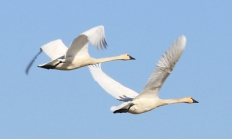
The majestic trumpeter swan is the largest of our native waterfowl and one of the heaviest flying birds in the world with males sometimes exceeding 30 pounds. Historically hunted to the brink of extinction, it was recognized as an endangered species long before there was an Endangered Species Act, and its recovery is a conservation success story. The adult's snow-white plumage with contrasting black bill and feet and 8-foot wingspan define this magnificent bird. Their neck is as long as their body and is used to reach food at the marsh bottom. In spring, the trumpeter swan is a locally…

Of several swans found in Oregon, the tundra swan is by far the most common during the non-breeding season. It is most readily distinguished from the similar-appearing trumpeter swan by voice, although subtle differences in physical appearance and behavior can separate the two with difficulty. It is a fairly common transient throughout the state but most abundant at large bodies of water and wetland complexes east of the Cascades including the Malheur National Wildlife Refuge and the surrounding Harney Basin, Summer Lake Wildlife Area and the Klamath Basin. Hear the call of the tundra swan Photo by Kathy Munsel, ODFW
The drake wood duck is the most colorful of North American ducks. The brown hen has similar features including a crest, distinctive white eye-ring, white belly and purplish-blue iridescence on wing coverts and speculum. Both sexes have a prominent tail that can be a field mark in flight. As their name implies, they are associated with timbered wetlands, nesting in cavities and sometimes even feeding in trees. Hens utter a fairly wide range of un-duck like sounds, but most common is a loud wee-e-e-e-k, wee-e-e-e-k. It is a regular breeder in the Willamette Valley, along slow reaches and backwaters of…

The drake gadwall is a large mostly gray dabbling duck. Adult drakes have a black bill, buff head, gray body, and black upper and lower tail coverts. Hens are nondescript brown ducks with a spotted, yellowish-orange bill with black edges. Gadwalls are unique among dabbling ducks in having a partly white speculum which can be observed in flight. Common vocalizations include the deep, reed-like sounds of the male and the female's quacking, similar to but more nasal and higher pitched than the mallard hen. It is an abundant breeder locally in eastern Oregon and an uncommon breeder in western Oregon…

This foreign visitor is regularly found in Oregon among wintering flocks of American widgeon. Drakes are easily distinguished from American wigeon drakes by reddish brown head, gray flank, and lack of green eye stripe. Hens are similar to American Wigeon hens and difficult to distinguish. The call of the male is a shrill whistling, whe'e you; the female's voice a low purr or croak. It is a rare to uncommon visitant east of the Cascades. Hear the call of the eurasian wigeon Photo by ©Greg Gilson

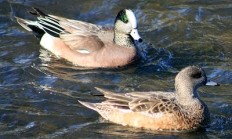
Wigeon drakes are beautifully marked with white pate, green eye stripe, purplish breast and flanks, white belly and wing covert patch, and iridescent black/green speculum. The grayish hen shows white on the wing covert patch. Drakes give a three-note whistle and get progressively noisier as spring approaches and courting flights begin. Medium sized flocks are common in fall and winter, and like geese, will be found grazing pastures, park lawns, and golf courses. It is a rare to locally common breeder in eastern Oregon and rare in summer in western Oregon. It is a common to abundant migrant and wintering…
When mention is made of ducks, many people first think of the mallard. Its ability to tolerate human disturbance and adapt to urban as well as rural habitats make it the Northern Hemisphere's most abundant and widespread waterfowl. Females are mottled-brown, with dark brown stripe through the eye, orange bill with black splotching and have yellowish-orange legs. Immatures resemble adult females until males acquire nuptial plumage usually by mid-November. Males enter the eclipse molt in June and resemble hens until mid-September. Wings of both sexes have a violet-blue speculum bordered in front and behind by a pronounced white stripe. They…

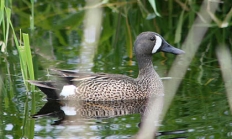
The blue-winged teal is one of Oregon's least common ducks. It is a small, warm-weather duck usually found in Oregon only from late spring until the weather cools in early fall. Except for adult drakes in alternate plumage, blue-wings are difficult to distinguish from cinnamon teal. For that reason its status in Oregon is less clear than that of other ducks. Adult blue-wing drakes have a gray head with white crescent between the eye and bill. Hens and young of both species are nondescript small brown ducks, but show the prominent blue wing-covert patch in flight. It is an uncommon…
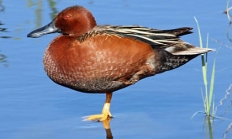
The bright rusty plumage of the male cinnamon teal, a bird of western North America, is a visual delight. In flight, both males and females show powder blue in the wings as they fly fast and low, timed at nearly 60 miles per hour. They weigh only about one pound. They are a common breeder throughout the state except in western Oregon and the high Cascades. They are most common east of the Cascades. Hear the call of the cinnamon teal Photo by Maxine Wyatt
The Northern shoveler's specialized bill earned it in the nickname "spoonbill" among waterfowl hunters. The drake is strikingly handsome with a dark head, white breast, reddish belly, blue wing coverts and an iridescent green speculum. Brown hens also have blue wing patches similar to that of the cinnamon and blue-wing teal. This duck is locally common in summer in eastern Oregon and uncommon in western Oregon. It is a common spring and fall migrant statewide. Hear the call of the Northern shoveler Photo by Kathy Munsel, ODFW

The pintail is a large, long-necked duck of open spaces. The long-tailed, full-plumaged drake is striking with a chestnut head, gray back and flanks, bright white breast and front of neck, and iridescent green bronze speculum. The brown hen is nondescript, but shares the long neck and graceful shape of the drake. Common vocalizations are the two-note flute-like whistle of the drake and harsh gaak, either single or in a series, of the hen. In fall and winter, pintails travel in medium to large flocks. In Oregon, flocks seem to fly exceptional distances in daily foraging and can be seen…

The green-winged teal is the smallest North American dabbling duck. In alternate plumage, green-wing drakes have a cinnamon-colored head with a green eye-stripe, gray back, flanks, and wing with a iridescent green speculum. Hens are brown with a green speculum. This duck is mainly a migrant and winter visitor. It is an uncommon summer resident and breeder in northeastern Oregon and a rare summer resident west of the Cascades. Hear the call of the green-winged teal Photo by Kathy Munsel, ODFW

Canvasbacks are large; adults in good condition are as heavy as mallards and second in size only to the white-winged scoter among common Oregon ducks. Drakes have a reddish head and neck; black breast, lower back and tail coverts; nearly white back, flank, and belly, and dark gray tail. The hen is grayish brown with a darker brown head, neck, breast and tailcoverts. It is an occasional summer resident in northeast Oregon, nesting locally only at Ladd Marsh in Union County. It is an uncommon spring and fall migrant in northeastern Oregon and regular in winter and spring on the…

Although not as imposing as the Canvasback, the redhead is a large, handsome, fast-flying diver. The drake has a red head, black breast and tail coverts, and steel gray back, flanks and tail. Hens are a medium brown. During courtship, the drake utters a very un-duck-like meow. Known for nest parasitism - laying eggs in the nests of other birds, usually other diving ducks - redhead eggs have also been found in the nests of a variety of species. It is an uncommon summer resident in northeast Oregon, but commonly breeds at Batch and Bogus lakes and locally elsewhere in…

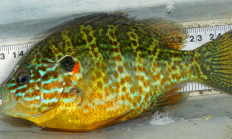
Features: Pumpkinseeds may be identified by the orange or red spot on the ear flap and the orange cheeks with wavy blue or turquoise stripes. Color is exceedingly brilliant and somewhat variable; olive to brassy-green above, the back finely dusted with gold or emerald. Habitat: Pumpkinseeds are found in the same habitats and often in association with bluegills. Adults often congregate beneath old deadheads and trees that have fallen into the water. Food habits are also similar to bluegill. They consume large numbers of snails by browsing on the stalks of aquatic vegetation. Techniques: Pumpkinseed are found in many of…
Features: Oregon is home to an estimated 25,000-30,000 black bears, which is North America’s most common bear species. They are the only type of bear found in Oregon. Despite their name, black bears are often brown in color. Habitat: Black bears are found statewide, with concentrations in the Coast and Cascade ranges and the Blue Mountains. Techniques: Oregon offers a controlled spring season (apply by Feb. 10) and a general fall season. Glassing open areas where bears are feeding on grass and shrubs works early spring season. Later in the season, some hunters turn to predator calls. Most fall bears…

Features: The pronghorn is deer-sized (up to 150 lbs) with relatively long and thin legs and feet, only two digits on each foot (no "dew claws"), a relatively small tail, and unique horns. Bright white sides, underside and rear end help hunters spot them in the field. Habitat: Pronghorn are found in the High Desert sagebrush of eastern Oregon and the Columbia Plateau. Techniques: Most pronghorn hunts happen in August, before other big game seasons, so be ready for the High Desert’s warm summer temperatures. All pronghorn hunting is limited entry (apply by May 15) and it can take several…

Features: Oregon is home to more than 6,000 cougars, or mountain lions. Cougars are the largest members of the cat family found in the state and tend to be solitary, except for females raising young. Males in particular are very territorial. Habitat: Cougars are throughout Oregon, with concentrations in the Cascade Range and Blue Mountains. Lately, more cougars are being seen in northwest Oregon including the suburbs of Portland. Techniques: Hunting is open statewide under a general season all year, or until zone quotas are met. Most cougars in Oregon are taken while hunters are out pursuing other species like…

Features: The mountain goat is stockily built with black scimitar-shaped horns, large black hooves and prominent dewclaws, and an entirely white, woolly coat. Habitat: Rocky Mountain goats are found in steep and rugged habitat in eastern Oregon, including the Wallowa, Elkhorn and Strawberry mountains, and the central Cascades near Mt Jefferson. Techniques: Rocky Mountain goat tags are “once-in-a-lifetime” and less than 25 are available each year. Be prepared to hunt their steep, rugged habitat if you are lucky enough to draw a tag.