
Search myodfw.com
Showing 1481 - 1500 of 1668 results
These large-bodied salamanders have solid brown skin that is smooth and moist. Adults can grow to almost 10 inches in total length. Northwestern salamanders live in moist forests or partly wooded areas. Though common in Oregon, adult salamanders are rarely seen because they live underground. Terrestrial adults require moist crevices in logs or rodent burrows in the ground for shelter from weather and predators.

Appropriately named, adult long-toed salamanders have extremely long toes on their hind feet. Adults have black or brown skin that is smooth and moist with a yellow ragged-edged stripe running from its head to the tip of its tail. It is speckled with white or silver dots along its sides and underside. Adults may grow up to more than six inches in total length. Adult long-toed salamanders are seen infrequently, as they spend most of the year in the ground. They find cover in a variety of habitats including grasslands, dry shrub-steppe, pastures, lowland forests, high elevation lakes and ponds…
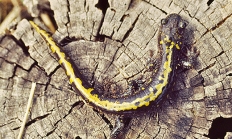
These large salamanders are marbled brown and tan in color when in their rare terrestrial (land-living) adult form. They are brown with yellowish-tan patches on These large salamanders have an aquatic adult stage that is brown with yellowish-tan patches and short gills. The rare terrestrial adult is marbled brown and tan. Larvae of Cope’s giant salamander are smaller with a more narrow head and shorter legs than the coastal giant salamander. Both terrestrial and aquatic adults can grow up to eight inches in total length. Most adult salamanders live in cold, fast-flowing, clear and permanent streams in coniferous forests. Adult…

Coastal giant salamanders are the largest salamanders in Oregon. Terrestrial adults are marbled with tan and brown and are mostly tan on their undersides. Larvae are brown with a large head, frilled gills, and a tail fin. Adults can grow to a total length of 14 inches. This species lives in dense wet forests near cold and clear streams, lakes, and ponds. Terrestrial adults are rarely seen because they spend most of their time in burrows. Occasionally, during times of heavy rain, adults are active on the forest floor. Photo by Steve Krause, NPS

These small salamanders have solid green- brown- or gray-colored sides and backs with bright yellow or orange undersides. Adults can grow to four inches in total length. Columbia torrent salamanders spend their lives in and near cold and clear water bodies including mountain streams, springheads, waterfalls and seeps in older forests. They need loose gravel stream beds for hiding and foraging. They are highly connected to their water sources, but in times of heavy rainfall, they may venture into a nearby forest. The Columbia torrent salamander is an Oregon Conservation Strategy Species in the Coast Range and Willamette Valley ecoregions…

This small salamander is evenly speckled with dark flecks and has a brown head, back and tail with a bright yellow belly. Southern torrent salamanders spend their lives in and near permanent, cold and clear water bodies including mountain streams, springs and seeps in older coastal coniferous forests. For a salamander, they are able to tolerate relatively dry forest conditions. Southern torrent salamanders are Oregon Conservation Strategy Species in the Coast Range, Klamath Mountains and Willamette Valley ecoregions. Photo by John Clare, Flickr

The Cascade torrent salamander generally has numerous medium-sized black spots and white-gray flecking along its tan back and sides and a bright yellow belly that has fewer spots. Adults can grow to just over four inches in total length. Cascade torrent salamanders spend their lives in and near permanent, cold, fast-flowing and clear water including headwater streams, waterfall splash zones and seeps in older coniferous forests. Adults need gravel streambeds or other gravel areas with constant and shallow water flow for foraging and cover. The Cascade torrent salamander is an Oregon Conservation Strategy Species in the West Cascades and Willamette…

Rough-skinned newts were named for their dry granular skin―most other salamander species have moist smooth skin. A terrestrial adult newt has a brown head and back with a bright orange belly and can grow to almost eight inches in total length. Rough-skinned newts have a powerful neurological poison in their skin and eggs to protect them from predators. A milky white substance is released from glands when disturbed. Avoid hand-to-mouth contact after handling a Rough-skinned newt. Through the non-breeding season, terrestrial adults live in forested areas along the coast and through to the eastern foothills of the Cascades. They find…

This large woodland salamander is dark colored with a green- or tan- colored This large woodland salamander is dark colored with a green- or tan- colored stripe along its back. Dunn’s salamanders have no lungs and breathe entirely through their skin. Adults can grow to six inches in total length. Dunn’s salamanders live in the shaded rocky edges of highly humid forested streams and moist talus (rock fragment piles). They prefer areas that are permanently moist but not in flowing water. Adults often hide under rocks, in splash zones near streams and occasionally under woody debris. The rainy season of…

The Larch Mountain salamander is one of the rarest amphibians in the Pacific Northwest. This small woodland salamander has a reddish-brown or yellow black-spotted stripe along its back and has a pink belly. The Larch Mountain salamander is one of the lungless salamanders that has to breathe through its skin. Mature adults can grow to four inches in total length. This salamander like’s steep basalt talus (piles of volcanic rock fragments). Forested areas are also important because trees block out sunlight, allowing moss to grow on rock piles which keeps the ground damp all year. Larch Mountain salamanders prefer slopes…

The Western red-backed salamander is a woodland species and is small and slender. It has a wide stripe running from the head to the tip of the tail that can be yellow, orange, green or brown. Mature adults can grow up to just over four inches in total length. Western red-backed salamanders live in humid coniferous forests with mild winters. They find cover in rocky substrates, including talus (rock fragment piles), boulders and rock outcroppings. They may also hide under or in rotting logs, leaf litter and other forest debris. Like other woodland salamanders, this species breaths through its skin…
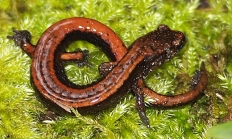
Del Norte salamanders are solid brown or black in color. Some individuals, especially younger salamanders, have a reddish-orange to red stripe along their backs, but it generally fades as they mature. As the species’ scientific name suggests, individuals have long bodies in relation to their short limbs. The Del Norte salamander is one of the lungless salamander species that breathes through it’s skin. They can grow to six inches in total length. Del Norte salamanders live in older redwood or Douglas-fir forests and commonly use rocky substrates rubble, talus (rock fragment piles) and rock outcroppings for cover. During hot and…

Siskiyou Mountains salamanders are similar to Del Norte salamanders, except they are a little shorter, growing to about five-and-a-half inches in total length. An adult salamander is brown with a light brown stripe along the back and a grayish-purple belly. It has light scattered flecks along the body. The Siskiyou Mountains salamander is a lungless salamander and breathes through its skin. Siskiyou Mountains salamanders require talus (rock fragment piles) or rock outcrops in older forests. This salamander retreats deep within rocky crevices that remain cool and moist during the dry summer. Even during the rainy season, Siskiyou Mountains salamanders typically…

Ensatina salamanders are a lungless species with a short body and yellow or orange legs. There are two sub-species in Oregon: the Oregon ensatina ( E. e. oregonensis) is solid red, orange, brown or tan, while the painted ensatina ( E. e. picta) has small yellow, black or white spots on the back and tail. Ensatinas grow to just over four inches in total length. Ensatinas live in humid forests, woodlands and other areas with woody debris. They hide under logs, bark piles at the base of snags (standing dead trees), stumps and even woodpiles in residential areas for cover…

Adult clouded salamanders are generally brown with brassy patches on their backs and gray bellies. As salamanders age, the brassy color fades. The clouded salamander is one of the lungless salamander species; they breathe through their moist skin. Mature adults can grow to just over five inches in total length. Clouded salamanders prefer forest habitats or burned areas that provide large decaying logs or stumps. They are often found in Douglas fir trees where they can find burrows in the wood, or spaces just under the bark to hide. They may also hide deep in rock crevices during dry and…
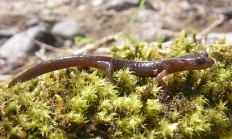
Adult Klamath black salamanders that live in Oregon are fully black with a smattering of bronze or green specks across the top of their heads, backs, tails and legs. The black salamander is one of the lungless salamander species and it breathes through its skin. Female black salamanders are generally larger than males and grow up to five-and-a-half inches in total length. Black salamanders live in forest, open woodland, moist talus (rock fragment piles) and streamside habitats. They use crevices in moist decaying logs or stumps, wet talus slopes or just under surface debris for cover during warm wet weather…

This dark colored salamander has a reddish-brown ragged edged stripe that runs along the top of the head to the tip of the tail with black or dark brown sides. It has a long body and tail and the belly is black with large white flecks. The Oregon slender salamander is a lungless salamander species, relying on its skin to breathe. Mature adults can grow to just under four inches in total length, with females about 12 percent larger than males. Oregon slender salamanders are most common in stable, moist old-growth (late successional and second-growth) forests where there are abundant…

California slender salamanders are a lungless species that has an especially long and slender worm-like body. They have reddish-brown stripes along their backs from head to tail. This stripe fades as the animal ages. Mature adults can grow to five-and-a-half inches in total length. In Oregon, this salamander usually lives in humid coastal conifer forests. In redwood forests, this salamander easily blends in with bark and other debris. During warm wet weather, California slender salamanders take cover just beneath the surface; if conditions are especially dry, salamanders may retreat deep into crevices, logs, stumps, or insect and worm burrows underground…

Worldwide, frogs and toads are in trouble because of habitat loss, pollution, pesticides, climate change, diseases, the pet trade and competition from invasive species. Many of Oregon's 12 native species of frogs and toads are listed as Oregon Conservation Strategy Species of concern. Frogs and toads belong to the same animal group but are very different. Toads have dry, rough and bumpy skin covering a wide body while frogs are slender with smooth, moist skin. Frog eyes are higher on the head than toads and are rounder and bulging. And there's a reason we play "leap frog" - frogs take…

The coloring of adult coastal tailed frogs often matches the color of local rocks ranging from brown or reddish-brown to gray with little flecks of yellow or gray. They have grainy textured skin that further enhances their camouflage. Male coastal tailed frogs have a short tail, the signature for tailed frogs. Adult males grow to one and three-quarter inches long and adult females to two inches long. They live in very shallow and heavily shaded water of fast running, small, permanent mountain streams with cold and clear water, rocky substrates and little silt in older forests. These streams are often…
