Search myodfw.com
Showing 1381 - 1400 of 1650 results
Features: The coloration tends to be golden-brownish with dark brown or black spots on the body, and on the dorsal and adipose fins. Usually few or no spots appear on the tail fin. Many body spots, especially those below the lateral line, are edged with pink, red, or orange, forming rings or halos. Breeding males develop strong teeth and a hooked snout. Size can range from 11-inches long in small streams to over 30-inches in large rivers or lakes. Habitat: Although brown trout can adapt themselves to sluggish streams and warmer temperatures than other trout, cold, spring-fed tributary streams with…

Features: While their coloration can be variable, bull trout are generally gray infused with green. The body is covered with small white or pale yellow spots. Some spots along the side may be deep orange to red. The leading edges of the fins along their bellies are white. Bull trout, despite the common name, is not actually a trout but a member of the closely related char group. Habitat: Bull trout require cold, clean water to survive and are typically found in the headwaters of Oregon rivers. Spawning occurs in the fall when water temperatures drop below 50F. Techniques: Anglers…

Click here to learn about the different kinds of cutthroat trout

Features: Coastal cutthroat trout are typically are blue/green on top, red along the lateral line, and white on the belly. They are lightly or heavily spotted and adults have a red slash mark on the throat. Habitat: The most common variety of trout in Oregon is the coastal cutthroat, found in the streams and beaver ponds in coastal drainages. They also are stocked in high mountain hike-in lakes where the water stays cool throughout the summer. Techniques: Cutthroats that are year-round residents of small streams may not get any bigger than 8- or 9-inches, but can reward the angler with…
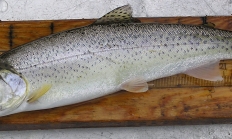
Features: The name “cutthroat” is derived from the two red slash marks or streaks on the underside of the lower jaw. Lahontans don't develop the intense crimson or gold coloration that other subspecies do, but the males can develop some red on their sides. Spots on the head can help distinguish this subspecies from other inland cutthroat subspecies. Habitat: This variety has adapted to the dry, highly alkaline waters and was once widespread throughout the Lahontan Basin of California, Nevada and southeast Oregon. Today, native populations can be found in the Whitehorse and Willow creek basins in the far southeastern…

Features: While in the sea, sea-run cutthroat feed on crustaceans and small fish and can grow up to one inch a month. By the time they return to fresh water to spawn, these fish can be up to 18-inches long and are bright silver, much like a small steelhead. Habitat: This is a sea-run strain of the coastal cutthroat that travels into the saltwater estuaries for a few months of the year. Unlike salmon and steelhead, sea-run trout don’t migrate far from their home river and return to freshwater in late summer – July and August. Technique: Sea-run cutthroat trout…
Features: Like all cutthroat trout, this species boasts bright red streaks on either side of its “throat.” You can tell it’s a westslope cutthroat by its spot pattern – the majority of the black spots are found on the back end of the fish with rather few ahead of the dorsal fin. Habitat: While westslope cutthroat trout was once the most widely distributed cutthroat in North America, its home in Oregon has always been limited to the John Day Basin. During the cooler months of summer you can find them in places like Strawberry Creek and upper Canyon Creek. As…

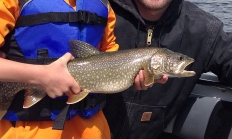
Features: The lake trout is not particularly colorful – usually gray with large pale spots – and can be distinguished from other trout by its deeply-forked tail. Lake trout, despite the common name, is not actually a trout but a member of the closely related char group. They can reach weights of 20 pounds. Habitat: These aggressive, fish-eating char are popular sport fish found in deep, cold water with plenty of oxygen and proper spawning areas. There also must be abundant forage fishes for them to eat. Techniques: Many anglers target lake trout in the spring, when they hang out…
Click here to learn about the different kinds of rainbow trout

Features: Coastal rainbow trout are often residualized steelhead that spend their entire life cycle in fresh water, never migrating to sea. They are a silvery color with black spots on their backs and fins, and a pink band running down their sides. Often their gill covers are pink as well. The pelvic anal, and dorsal fins have a white edge to them. Habitat: They can be found in cold rivers, creeks, and inland lakes. However, they require streams with clean gravel, complex habitat, and cool temperatures for spawning and rearing. Techniques: Trout in stillwaters tend to be on the move…

Features: The color of all trout varies with environment. In general, the rainbow is bluish-green on the back, silvery on the sides and belly, and has a white edge to the dorsal, anal, and pelvic fins. A generous sprinkling of black spots appear along the back, and on the dorsal, adipose and caudal fins. A pinkish band usually extends along the sides. Habitat: Rainbow trout are the most widely stocked and distributed trout in Oregon. They occur naturally in many rivers and streams, and each year ODFW stocks millions more in ponds, lakes and streams. Prime trout waters are clear…
Features: As the name suggests, these fish have rosy red strip along their sides. Other identification clues include large, profuse black spots on the body and orange and yellow tints along the belly. Habitat: Redband trout are a subspecies of native rainbow trout that have adapted to the arid, desert conditions of eastern Oregon. During drought years distribution constricts as streams dry and become uninhabitable. Trout re-colonize these streams during wet cycles, expanding the distribution. Prime trout waters are clear, clean and cold. Good trout stream habitat is complex, consisting of an array of riffles and pools, submerged wood, boulders…
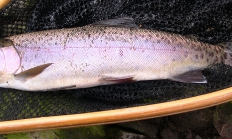
Features: Tiger trout are a hybrid between a female brown trout and a male brook trout. They are greenish yellow to brown with dark patches along their sides creating a maze-like pattern. Their belly is yellowish orange and the tail fin is square. Habitat: These sterile fish have been introduced to Diamond and Fish lakes to help combat several invasive bait fish species. Since they do not reproduce, tiger trout are catch-and-release only. Techniques: Tiger trout will go for flies, spoons, spinners and bait. Because tiger trout are piscivorous (they eat other fish), fishing a minnow imitation can be effective.

Features: Steelhead are rainbow or redband trout ( O. mykiss) that migrate to the ocean during their first or second year, returning one to three years later to spawn. While in the ocean, steelhead are silvery in color and typically grow significantly larger than their siblings who never leave fresh water. Once back in fresh water, they usually turn dark-olive in color, with silvery-white undersides, heavily speckled bodies and a pink to red stripe running along their sides. Habitat: Summer-run steelhead return to freshwater between May and October and require several months to mature and spawn. Winter-run steelhead return to…


Features: While in the ocean, Chinook salmon often have a purple hue to their backs with silvery sides and bellies, large oblong black spots on the back, and round black spots on both lobes of the tail (note that tail spotting may be obscured in ocean fish by “silver” in the tail). Upon returning to freshwater to spawn, Chinook darken in color and develop red on their bellies and fins. A key identifier is the black gum line on the lower jaw with dark colors both inside and outside of the gum line. Spawning generally occurs from August to early…
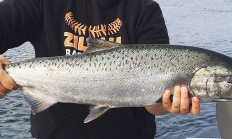
Features: When in the ocean chum salmon are bluish green on their backs. Their tails lack spots but tend to have silver streaks like the coho. Their lower jaw will be dark at the gum line and white or pink both inside and outside of the gum line. Once in freshwater, chums become dark green to brown with red to purple marks going vertically down their sides. Habitat: Like other salmon species, chum spend most of their lives at sea and return to their natal streams to spawn. Most spawning runs are over a short distance. Adults are strong swimmers…

Features: When in the ocean coho salmon can look very similar to Chinook salmon . However, coho will have a white gum line on the lower jaw with darker color both inside and outside of the gum line, and will only have spots on the upper lobe of their tails. When coho return to freshwater they become red on their sides and dark greenish on their backs, heads, and fins. Coho adults may reach 25 pounds or more, but rarely exceed 15 pounds. Habitat: Small, relatively low-gradient tributary streams with pea to orange-sized gravel for spawning and juvenile rearing. Coho…

Features: Kokanee are silvery in color until they are ready to spawn, at which time they become reddish. They do not grow as large as sockeye- their ocean traversing siblings. They can vary significantly in size depending on how densely populated the waterbody is. Since they are filter feeders, their populations can quickly expand and contract with the availability of food. Habitat: Kokanee can be found at all depths of cold, clear lakes and reservoirs in several parts of the state. They will change which depth they are at depending on water temperature. Technique: They are a challenging fish to…

Features: These fish are silver when young, but darken and develop black spots on their tails and backs as they age. In fresh water, the males are red on their sides and develop a hump on their backs earning this species the common name humpback salmon. Females in fresh water are green on the sides with dark bars. Pink salmon are an average of 20- to 25-inches long and rarely weigh over 5 pounds. Habitat: Pink salmon spawn on odd numbered years and do so very close to saltwater, never going very far upriver. In fact, some pink salmon will…