
Search myodfw.com
Showing 21 - 40 of 220 results
The red tree vole is a medium-sized vole. It is uniquely colored among North American voles: bright orangish-red to cinnamon on the dorsum, silvery gray (often with some light orangish hairs) on the venter, and a tail pale orangish on the venter grading to black on the dorsum. This vole is endemic to western Oregon. It occurs at moderate elevations on the west slope of the Cascade Range southward as far as the Douglas-Jackson county line and in the Coast Range to the Oregon-California border. It is largely arboreal and builds nests on suitable foundations (commonly nests of birds or…

One of the most familiar sights along the roads of Oregon is a Red-tailed hawk soaring high on the sky over a field, or perched on a utility pole, waiting patiently for prey. Red-tailed hawks are large-bodied raptors with relatively broad wings. The back is mottled brown, and the tail of mature birds is orangish red with a thin, dark subterminal band. Perched birds can be identified from behind even when the tail is concealed by the white mottling on the scapulars forming a faint 'V'. Most individuals can be assigned to one of two color morphs, light or dark…

Lines of neatly drilled holes in even the smallest strand of aspen east of the Cascade summit are likely the work of the Red-naped sapsucker. The Red-naped sapsucker is a common summer resident throughout forested mountains east of the crest of the Cascades and a spring and fall migrant through the same mountains and lower elevations, preferring areas with trees. Hear the call of the Red-naped sapsucker Photo by Tom Koerner, USFWS
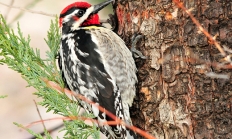
The only sapsucker regularly found in western Oregon, the Red-breasted sapsucker, with its raspberry-red head and breast, is unmistakable. It is found in moist coniferous coastal forest and mixed deciduous-coniferous coastal forest west of the Cascade crest, and in aspen-ponderosa pine forests east of the Cascades. Nest cavities are typically in large snags or live trees with decayed interiors. It is a fairly common breeder in the northern part of the state from the coast to the Cascades and south to the southern Cascades. Hear the call of the Red-breasted sapsucker Photo by Darla Marie Prater

The Red-breasted nuthatch is a happy, jolly little bird, quick and agile in its motions and seemingly always in a hurry to scramble over the branches. It is distinguished from other nuthatches by white eyebrows, black eyelines and cap, reddish breast, and nasal yank yank song. Although males have a blacker cap and redder breast than females, distinguishing sexes in the field is difficult. During winter, is can be observed foraging in mixed-species flocks with Chickadees, Brown creepers, Kinglets, Townsend's carblers, and Dark-eyed junkos. The Red-breasted nuthatch breeds and winters throughout Oregon where conifer or mixed conifer-hardwood forests are present…
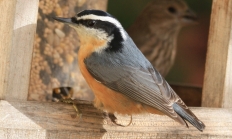
When walking through riparian areas in certain parts of Oregon in summer, one can often hear a song which suggests the Robin's but with less volume and energy, and with a greater variety of phrase. Yet, when one looks up, the bird is often hidden within the canopy foliage. The Red-eyed vireo is a fairly common summer breeder in Wallowa County and an uncommon to rare breeder in Union County, Baker County, and eastern Grant and Umatilla counties, and northern Malheur County. Hear the song of the Red-eyed vireo Photo by John Sutton, Flickr

A small loon holding its slender head erect and narrow, upswept bill upward is most always a red-throated. A quick flyer, it can be identified by rapid deep wing-beats, humpbacked body with head and neck extending below the body, and wings appearing far to the rear due to the usual invisibility of the small feet. Often feeding near the surf, it may be spotted by beachcombing humans. It can take flight from a small water area, and can also, if pressed, take flight from land. It is an abundant Oregon nearshore transient from fall through spring. Hear the call of…

A medium-sized hawk, the Red-shouldered hawk has bold black-and-white flight feathers and rusty shoulder patches. Seen in flight from underneath, especially when lit from the sun, its wings show a translucent 'window' near the tips. It relies on perches for hunting and is closely affiliated with wooded wetlands and riparian bottomlands. In the breeding season this hawk is found in moist woodlands with at least a few deciduous trees. It prefers riparian bottoms, especially those near shallow wetlands or open meadows. In winter, it may use more open lands such as found in the Rogue and Willamette valleys, depending on…
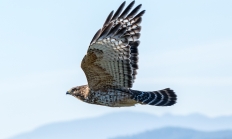
The thick, dense feathering on its underparts allows this dainty shorebird to float high on the water. Its lobbed toes give it considerable maneuverability while swimming. It is equally at home on the roughest seas and the smallest farm pond. A highly sociable bird and extremely trusting. Smaller size and slender bill separate this species from the Wilson's and Red phalaropes. Offshore it concentrates along tide rips and over upwellings. In shallow waters it stirs the bottom with its feet or spins rapidly to expose the tiny organisms that it picks up with its needlelike bill. An opportunistic forager of…

Features: Males have a ragged-crested, dark green head, a reddish-brown breast, a dark back and gray sides. Females share the ragged crest; their rufous heads and gray bodies may make it hard to tell them from female common mergansers. Their bills, however, are noticeably slimmer. Habitat: Red-breasted mergansers are common from fall through spring, mostly in coastal bays and estuaries but occasionally on the open ocean. Techniques: Their preferred habitat within dangerous ocean waters makes them inaccessible to hunters.

SW WILDLIFE VIEWING July 30, 2026 Coos and Curry counties Coquille Valley Wildlife Area (CVWA) Coquille Valley Wildlife Area (CVWA) in Coos County is open to public access. Permits for access are required and are available, free of charge, at the kiosk located in the parking lot along North Bank Road. You must access CVWA through this point. Please fill out the upper half ("A" half) of the permit and deposit it in the slot located on the post of the kiosk. Sign and carry the lower half ("B" half) with you while you enjoy CVWA. At the end of your visit please fill out the B…
Adults have smooth, moist skin that is brown or reddish-brown in color with black flecks on their backs, sides and legs. They may also have a dark colored mask. Adults have red underlegs, hence their name. Females, growing to four inches in length, are almost twice the size of males. Adult red-legged frogs like cool damp coniferous or deciduous forests and forested wetlands. During the non-breeding season, adult frogs spend most of their time on land in woodlands along streams, in moist sedge or brush, along shaded pond edges or under logs and other forest debris. Damp weather permits them…

The Western red-backed salamander is a woodland species and is small and slender. It has a wide stripe running from the head to the tip of the tail that can be yellow, orange, green or brown. Mature adults can grow up to just over four inches in total length. Western red-backed salamanders live in humid coniferous forests with mild winters. They find cover in rocky substrates, including talus (rock fragment piles), boulders and rock outcroppings. They may also hide under or in rotting logs, leaf litter and other forest debris. Like other woodland salamanders, this species breaths through its skin…
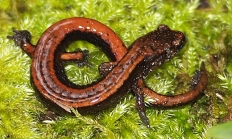
The Southern red-backed vole is among the smaller voles in Oregon. The pelage is silvery on the venter and grayish with ocherous on the sides, and with a rusty or reddish stripe on the dorsum; the tail is dark brown or black above and whitish or grayish below. In Oregon it occurs in the Ochoco, Blue, and Wallowa Mountains southwestward to central Crook County and northern Harney County. Photo by D. Gordon Robertson, Wikipedia
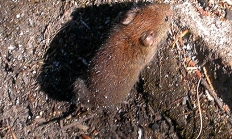
The Western red-backed vole is among the smaller of the voles in Oregon. The pelage consists of a vaguely demarked reddish-brown or chestnut-brown stripe on the dorsum grading to buffy gray to dark gray on the sides and venter; the tail is indistinctly bi-colored, light grayish-brown above and whitish below. This vole occurs from the Columbia River south through the Coast Range. It does not occur in the Willamette Valley or other interior valleys west of the Cascade Mountains. It is a denizen of forest habitats, but tends to be most abundant in closed canopy old-growth forests containing an abundance…

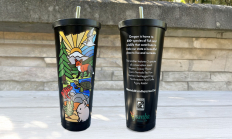
SALEM, Ore.—Head to a participating Jamba location for a new limited edition Wildlife Conservation tumbler that benefits wildlife. The colorful tumbler features five species: Sierra Nevada red fox, Northern red-legged frog, Western snowy plover, Northwestern pond turtle and Pygmy rabbit. All are native species facing population declines due to challenges…

Features: The name “cutthroat” is derived from the two red slash marks or streaks on the underside of the lower jaw. Lahontans don't develop the intense crimson or gold coloration that other subspecies do, but the males can develop some red on their sides. Spots on the head can help distinguish this subspecies from other inland cutthroat subspecies. Habitat: This variety has adapted to the dry, highly alkaline waters and was once widespread throughout the Lahontan Basin of California, Nevada and southeast Oregon. Today, native populations can be found in the Whitehorse and Willow creek basins in the far southeastern…


Find maps, boundary descriptions and hunts available in the new Trout Creek Hunt Area. Download printable PDF map