
Search myodfw.com
Showing 421 - 440 of 665 results
NEWPORT, Ore. – The Oregon Department of Fish and Wildlife recommends people avoid harvesting and consuming softshell and bay clams from Alsea Bay estuary after the Oregon Health Authority issued a recreational use advisory for Eckman Lake in Lincoln County. The OHA issued a July 31 advisory due to the…

SALEM, Ore. – The Private Forest Accord Mitigation Advisory Committee will hold its regularly occurring meeting, virtually on Tuesday, June 10, 2025. For a full agenda and virtual login information about the meeting, please visit: https://www.dfw.state.or.us/habitat/PFA/meetings.html The public is welcome to attend virtually. The Private Forest Accord Mitigation Fund was established…
SALEM, Ore. – The Oregon Conservation and Recreation Advisory Committee will meet online Tuesday March 3, from 1 p.m. to 3:30 p.m. The Conservation and Recreation Advisory Committee will be hearing project presentations and discussing the Round 10 grant cycle review process. Meetings are open to the public. For more…
The Dalles, Ore.—The lower Deschutes River will be open for spring Chinook salmon from May 5-20. "This is exciting news for anglers as the last spring Chinook season on the Deschutes was in 2018," said Jason Seals, Deschutes District Fish Biologist. "We're expecting a return of more than 2,000 hatchery…
This majestically crested bird is often heard before being seen due to its conspicuous harsh rattling call. Kingfishers are most frequently associated with lake and pond shorelines and islands, as well as coastal dunes with ponds and widely scattered shrubs and trees. They hunt from a vantage point above water such as an overhead branch, telephone wires along shore lines or pilings of piers. This is a common permanent resident throughout most of the state except in the north Lake and east Deschutes counties where open water is generally absent Hear the call of the belted kingfisher Photo from ODFW

In Oregon, the opossum is considered an invasive species. The Virginia opossum is a cat-sized mammal with a pointed nose, unfurred, black, leathery ears with white edges; beady eyes; a hind foot with an opposable hallux (big toe); and a naked scaly tail. It was introduced in Oregon between 1910 and 1921. Populations were established in northwestern Oregon apparently from releases of animals brought to the state as pets or novelties. Small streams, forest communities, and agricultural lands planted to a variety of crops are typical of many habitats occupied by Virginia opossums in Oregon. They are active nocturnally and…

SALEM, Ore. – The Oregon Conservation and Recreation Fund (OCRF) Advisory Committee is excited to announce that its next grant cycle will begin accepting applications on Monday, Dec. 15, with the application window open through Feb. 9, 2026. Visit the Online Application System and enter access code "OCRF" to begin…
Find maps, boundary descriptions and the percent public land for the Dixon Unit.
Find maps, boundary information and the percent public land in the Rogue Unit.

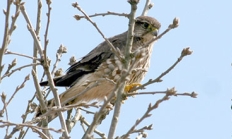
One of the most impressive sights in the unforested regions east of the Cascades is a Prairie falcon strafing a Belding's ground squirrel colony repeatedly at full speed in hopes of catching one emerging from its burrow at just the wrong moment. Prairie falcons are most common in rimrock country where they nest, but may travel great distances in search of prey. Prairie falcons are large, sandy brown above and off-white with variable amounts of streaking below. The face has a vertical stripe below the eye, as do many falcons. In flight, the long, pointed wings and long tail identify…
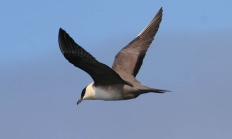
Graceful and buoyant fliers, adults are light gray-brown above with black caps, have dark flight feathers contrasting with grayer mantles and light underparts. Breeding adults have a central pair of tail feathers extremely long and pointed, extending up to eight inches past the rest of the tail. They are not usually as aggressive as other jaegers and rely as much on food they pick from the ocean's surface as they do from food they steal from other small seabirds. The Long-tailed jaeger is a rare to fairly common fall transient offshore. They are usually detected when Arctic terns and Sabine's…
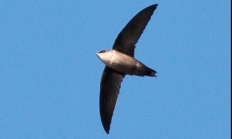
This small swift is best known for its quick flight and dazzling aerial agility, perching only when nesting or roosting. It is aerodynamically designed for fast speeds with long, pointed wings, short stout legs, and a compact body. The Vaux's swift is a transient and summer resident nesting in older forests and brick chimneys statewide except the southeast part of Oregon. Hear the call of the Vaux's swift Photo by Julio Mulero, Flickr
Features: Blue sharks are named for their brilliant blue color. They are slender with a long, pointed nose. They can grow to be 12-feet long, though they rarely get over 10-feet. Habitat: Blue sharks are found in all the world’s temperate and tropical oceans. They have been spotted as far north as Norway and as far south as Chile. They roam both open and coastal waters in search of octopuses, squid, cuttlefish, and fish. Technique: Typically chumming the water will attract blue sharks. You will need a wire leader to protect your line from the blue shark's saber-shaped teeth. Fins…

Features: Female pheasants are brown on top and paler underneath. They have black spots on their sides and black bars throughout their tails. The males are much more conspicuous with bright red on their head, a white band around their necks, and an iridescent copper color on their sides and backs. Their tails are long and pointed with barring. Habitat: The ringneck is a farmland species, heavily dependent on cereal grains and other seeds. They also like taller vegetation for cover. Technique: Because pheasants are tied so closely to agriculture, the majority of hunting opportunity occurs on private lands. State…
