
Search myodfw.com
Showing 441 - 460 of 694 results
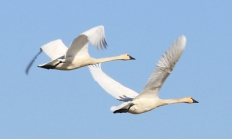
Of several swans found in Oregon, the tundra swan is by far the most common during the non-breeding season. It is most readily distinguished from the similar-appearing trumpeter swan by voice, although subtle differences in physical appearance and behavior can separate the two with difficulty. It is a fairly common transient throughout the state but most abundant at large bodies of water and wetland complexes east of the Cascades including the Malheur National Wildlife Refuge and the surrounding Harney Basin, Summer Lake Wildlife Area and the Klamath Basin. Hear the call of the tundra swan Photo by Kathy Munsel, ODFW
CLACKAMAS, Ore.—Fishery managers from Oregon and Washington expanded recreational spring Chinook days and retention on the mainstem Columbia River during a joint state hearing yesterday. There is remaining harvest allocation available for increased spring Chinook opportunity while staying within allowed ESA-impact rates and other management limits. The following changes were…
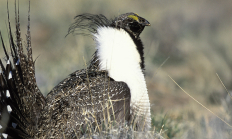
SALEM, Ore. – ODFW staff will host a webinar on July 17 at 2 p.m., to introduce the public to the updated ODFW sage-grouse management plan. The Oregon Greater Sage-grouse Conservation Assessment and Strategy was last updated in 2011. The public is invited to learn about proposed changes to the…
Canvasbacks are large; adults in good condition are as heavy as mallards and second in size only to the white-winged scoter among common Oregon ducks. Drakes have a reddish head and neck; black breast, lower back and tail coverts; nearly white back, flank, and belly, and dark gray tail. The hen is grayish brown with a darker brown head, neck, breast and tailcoverts. It is an occasional summer resident in northeast Oregon, nesting locally only at Ladd Marsh in Union County. It is an uncommon spring and fall migrant in northeastern Oregon and regular in winter and spring on the…

Although not as imposing as the Canvasback, the redhead is a large, handsome, fast-flying diver. The drake has a red head, black breast and tail coverts, and steel gray back, flanks and tail. Hens are a medium brown. During courtship, the drake utters a very un-duck-like meow. Known for nest parasitism - laying eggs in the nests of other birds, usually other diving ducks - redhead eggs have also been found in the nests of a variety of species. It is an uncommon summer resident in northeast Oregon, but commonly breeds at Batch and Bogus lakes and locally elsewhere in…

Swimming and diving with grace and energy, red-breasted mergansers arrive in fall but save their complex, contorting courtship display for early spring. A ragged-crested dark green head and reddish brown breast mark the male, along with a dark back and gray sides. Females share the ragged crest; their rufous heads and gray bodies may make separation from common merganser females difficult. Their bills, however, are noticeably slimmer. Red-breasted mergansers are common from fall through spring, mostly in coastal bays and estuaries but occasionally on the open ocean. Hear the call of the red-breasted merganser Photo by ©Greg Gilson

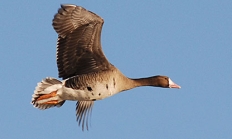
While not as abundant or conspicuous as the more familiar Canada and snow geese, the great white-fronted goose represents one of the first signs of fall. The greater white-fronted goose is gray-brown in body color and has orange feet. Adults have the namesake white forehead, pinkish-orange bill, and black speckled/barred breast and belly. Laugh-like calls from small skeins of these birds are heard high overhead in August through September in the north Willamette Valley and across the Cascades to south central Oregon and northeast California. Hear the call of the greater white-fronted goose Photo by Dave Budeau, ODFW
The drake gadwall is a large mostly gray dabbling duck. Adult drakes have a black bill, buff head, gray body, and black upper and lower tail coverts. Hens are nondescript brown ducks with a spotted, yellowish-orange bill with black edges. Gadwalls are unique among dabbling ducks in having a partly white speculum which can be observed in flight. Common vocalizations include the deep, reed-like sounds of the male and the female's quacking, similar to but more nasal and higher pitched than the mallard hen. It is an abundant breeder locally in eastern Oregon and an uncommon breeder in western Oregon…

Known as "bluebill" to most hunters, this species is one of the most abundant and widespread of North American ducks. The lesser scaup is similar to the greater scaup in appearance and habits, but is smaller and lacks the white on the primaries. In the field, however, the black-and-white drakes and brown hens are very similar to greater scaups. The common vocalization is the purr call of the female; drakes are usually silent, but utter a low single-note whistle in courtship. In general, the lesser scaup is more apt to be found in interior or freshwater habitats while the greater…

Medium-sized diving ducks, Barrow's goldeneyes are the expected of the two goldeneye species in Oregon in the summer, but are typically less numerous in the winter. Drakes show graceful patterns of black and white, purple glossed head, white crescent-shaped patch between the eye and bill, steep forehead, and short bill. Females and juveniles have a chocolate-brown head, slate-gray back, wings and tail; adult females have a golden bill. They are the only waterfowl species known to defend winter territories different from breeding territories. It is uncommon from the Cascades eastward in both breeding season and winter, but it may concentrate…

The emperor is a medium-sized stocky goose with a white head and metallic blue-gray body reminiscent of a blue-morph snow goose. Dark throat and undertail coverts as well as yellow feet distinguish it from the latter. Juveniles are brown with a gray-black head and neck that becomes white with black flecking in late fall. Vocalizations include in-flight kla-ha, kla-ha, kla-ha, and an alarm call a deep ringing u-lugh, u-lugh, u-lugh. The emperor is a rare but regular visitor in Oregon during migration and in winter, most commonly on the coast. Hear the call of the emperor goose Photo from USFWS

This small white goose is similar in plumage to the snow goose in all ages. In mixed flocks, the Ross's smaller size, shorter neck, head and bill profile and more rapid wing-beat may be apparent. They are a common spring and fall migrant through Klamath and Harney basins. During migration and on wintering grounds, the Ross's goose uses lakes and shallow marshes for roosting and agricultural crops and irrigated hay meadows for feeding. They arrive in Oregon around mid-October and leave around mid-November to continue their migration. They are a common spring and fall migrant through Klamath and Harney basins…

The drake wood duck is the most colorful of North American ducks. The brown hen has similar features including a crest, distinctive white eye-ring, white belly and purplish-blue iridescence on wing coverts and speculum. Both sexes have a prominent tail that can be a field mark in flight. As their name implies, they are associated with timbered wetlands, nesting in cavities and sometimes even feeding in trees. Hens utter a fairly wide range of un-duck like sounds, but most common is a loud wee-e-e-e-k, wee-e-e-e-k. It is a regular breeder in the Willamette Valley, along slow reaches and backwaters of…

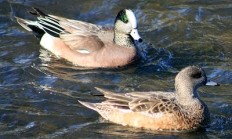
Wigeon drakes are beautifully marked with white pate, green eye stripe, purplish breast and flanks, white belly and wing covert patch, and iridescent black/green speculum. The grayish hen shows white on the wing covert patch. Drakes give a three-note whistle and get progressively noisier as spring approaches and courting flights begin. Medium sized flocks are common in fall and winter, and like geese, will be found grazing pastures, park lawns, and golf courses. It is a rare to locally common breeder in eastern Oregon and rare in summer in western Oregon. It is a common to abundant migrant and wintering…
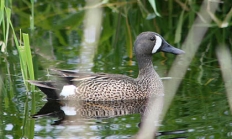
The blue-winged teal is one of Oregon's least common ducks. It is a small, warm-weather duck usually found in Oregon only from late spring until the weather cools in early fall. Except for adult drakes in alternate plumage, blue-wings are difficult to distinguish from cinnamon teal. For that reason its status in Oregon is less clear than that of other ducks. Adult blue-wing drakes have a gray head with white crescent between the eye and bill. Hens and young of both species are nondescript small brown ducks, but show the prominent blue wing-covert patch in flight. It is an uncommon…
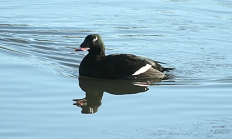
The white secondaries of the white-winged scoter in all plumages form a conspicuous square wing patch during flight but are often hidden during rest. Other than the secondaries, males' plumage is entirely black except for a small white teardrop around each eye. Females and immatures are dark brown above and pale below with diffuse white patches in front of and behind the eyes. A black knob graces the males' swollen, white-ridged, orange bills, while females' and immatures' bills are dark; the feathering of all extends almost to the nostril. Abundant along the coast from fall through spring, white-winged scoters are…
Adult male scoters of all species are black, but black scoters are the blackest; their shiny black plumage bears no white. The swollen bright orange-yellow knob on the otherwise black bill is smaller than that of other scoters. Males are distinguished in flight by the flashing silver-gray of underwing flight feathers against black wing linings and the all-black body. Females' uniform soot upperparts and dark head cap are clearly delineated from paler cheeks; their bills are usually dark. Immatures resemble females, but most males acquire some black feathering the first fall. This scoter can be uncommon to locally common along…

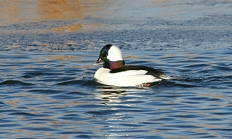
The bufflehead is North America's smallest diving duck, giving it the advantage of being able to nest in abandoned holes of northern flickers, a plentiful resource off limits to larger cavity-nesting ducks. It is a swift flyer and takes wing from water more easily and neatly than other diving ducks. Widely distributed throughout the state in winter, males attract attention with their striking white body, black back, and iridescent black head with a large notch of white; females and juveniles are dark charcoal-gray with a conspicuous white patch behind and below the eye. It is a local, uncommon breeder in…
A white form on the distant water may be the sides and breast of an adult male, whose deep green head and dark back are less visable when far away. The pearl gray bodies and white breasts of females, subadults, and eclipse males are starkly delineated from their full-crested chestnut heads. Long, slender, saw-tooth bills are held horizontally during surface swimming and grip squirming prey after an underwater chase. From coastal bays to the high Cascades, in all corners of Oregon and far beyond, common mergansers ply the rivers and peer into still waters in their efficient pursuit of fish…

Following droughts in the 1930s that affected most of North America, major conservation efforts, by both private and governmental entities, were enacted to reverse trends of degrading and disappearing wetlands. During this time period there was a major creation and expansion of federal wildlife refuges and state wildlife areas. As the concept of waterfowl flyway management was endorsed and developed, wildlife areas were acquired and managed as part of a larger plan focused on migratory waterfowl needs. LMWA was one of several wetland-focused wildlife areas established in Oregon. Ladd Marsh Wildlife Area was established in 1949, with primary objectives of…