Search myodfw.com
Showing 441 - 460 of 1416 results
Features: Drakes show graceful patterns of black and white plumage, glossy purple heads, white crescent-shaped patches between the eye and bill, steep forehead, and short bill. Females and juveniles have a chocolate-brown head, slate-gray back, wings and tail; adult females have a golden bill. Habitat: Not common, but usually scattered on lakes, reservoirs and coastal estuaries. They share Snake River habitat with the common goldeneye. Techniques: Not usually targeted, they are a rare part of a mixed duck bag.


Features: Males have white sides and breasts, deep green heads and dark backs. The pearl gray bodies and white breasts of females, subadults, and eclipse males are sharply delineated from their full-crested chestnut heads. Habitat: During the winter, these ducks are wide-spread in rivers, lakes and marshes across the state. Techniques: Not usually sought for table fare.

Features: Males have a ragged-crested, dark green head, a reddish-brown breast, a dark back and gray sides. Females share the ragged crest; their rufous heads and gray bodies may make it hard to tell them from female common mergansers. Their bills, however, are noticeably slimmer. Habitat: Red-breasted mergansers are common from fall through spring, mostly in coastal bays and estuaries but occasionally on the open ocean. Techniques: Their preferred habitat within dangerous ocean waters makes them inaccessible to hunters.

Features: The black back, white crescent on the side just in front of the wing, and white-ringed bill separate the drake ring-neck from the scaups. The brownish neck ring of the male in alternate plumage is not prominent. The hen is a small dark brown duck with a buff face. Drakes in courtship give a head-throw accompanied by a wow note while hens utter a growling purr. The ring-necked duck can resemble a scaup, so hunters need to know what they are shooting at. Habitat: These ducks are pretty widespread during the winter months. They generally prefer fresh water, from…

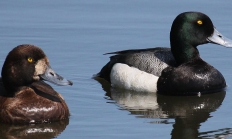
Features: Greater scaup are almost the size of redheads. In hand, they are easily distinguishable from lesser scaup by size and by the white wing stripe extending beyond the secondaries into the primaries. In the field, the two species can be difficult to separate. Drakes are black on both ends and white in the middle. Although not extremely reliable, in good light, generally the black head of drake grater scaup have a green sheen, while the head of a drake lesser scaup have a purple sheen. Hens are dark brown with a white mask around the base of the bill…

Features: Black scoters‘ plumage is pure black uninterrupted by any white. The swollen bright orange-yellow knob on the otherwise black bill is smaller than that of other scoters. Females' uniform soot upperparts and dark head cap are clearly delineated from paler cheeks. Habitat: This scoter can be uncommon to locally common along the coast fall through spring, usually on the ocean. Techniques: Like other scoters, black scoters are ducks of the open ocean, and inaccessible to most hunters.

Features: Males' plumage is entirely black except for a small white teardrop around each eye, and white secondaries that form a conspicuous square wing patch during flight. A black knob graces the males' swollen, white-ridged, orange bills. Females and immatures are dark brown above and pale below with diffuse white patches in front of and behind the eyes. Their bills are dark. Habitat: Abundant along the coast from fall through spring. Techniques: Rarely taken as part of a mixed duck bag, their habit of resting and feeding on open ocean waters makes them inaccessible to most hunters.



Find the weekly statistics for waterfowl and upland game birds at Ladd Marsh Wildlife Area. More information about Ladd Marsh Wildlife Area
HINES, Ore. – ODFW biologists confirmed that a natural mixing event, or "turnover," likely caused the death of stocked rainbow trout recently observed at Burns Gravel Pond on Hwy 78. The pond is located two miles east of Burns, Ore., on Hwy 78 on property owned by ODFW. The pond's…

Find the weekly statistics for waterfowl and upland game birds at Summer Lake Wildlife Area. More information about Summer Lake Wildlife Area Bird counts at Summer Lake WA
Begin your hunting journey or as an experienced hunter seek to refine your skills. The ODFW Hunter Recruitment Program offers resources and training to help you learn to hunt successfully. Connect with Oregon's outdoor traditions, enhance your skills, and contribute to a culture of safe, ethical, and conservation-minded hunting and shooting sports. More information about ODFW Hunter Recruitment Program Classes and workshops are designed for adults 18+.
Year round opportunities
Statewide