Search myodfw.com
Showing 461 - 480 of 694 results
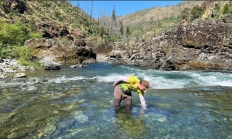
Each year ODFW assesses the freshwater escapement of Rogue River coho, fall Chinook, late run summer steelhead, and "half-pounder" steelhead by beach seining the waters near Huntley Park three times a week from Mid July thru October.
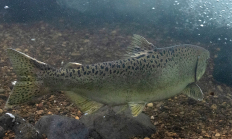
ROSEBURG, Ore. – Fishing for fall Chinook salmon (hatchery and wild) closes at 12:01 a.m., Aug. 19 on the Umpqua, Smith, and North Fork Smith rivers because the quota of 500 wild fall Chinook has been reached. With forecasted low returns of wild fall Chinook salmon in the Umpqua, Smith…
The pintail is a large, long-necked duck of open spaces. The long-tailed, full-plumaged drake is striking with a chestnut head, gray back and flanks, bright white breast and front of neck, and iridescent green bronze speculum. The brown hen is nondescript, but shares the long neck and graceful shape of the drake. Common vocalizations are the two-note flute-like whistle of the drake and harsh gaak, either single or in a series, of the hen. In fall and winter, pintails travel in medium to large flocks. In Oregon, flocks seem to fly exceptional distances in daily foraging and can be seen…

Greater scaup are almost the size of redheads. In hand, they are easily distinguishable from lesser scaup by size and by the white wing stripe extending beyond the secondaries into the primaries. In the field the two species are sometimes difficult to separate. Drakes are black on both ends and white in the middle. Hens are dark brown with a white mask around the base of the bill. The common vocalizations are the discordant scaup and purring pbbbrr of the female. Greater scaups form large flocks, sometimes mingling with lesser scaups in fall and winter. They are an abundant migrant…

The common goldeneye drake is a strikingly handsome black-and-white diver about the size of a greater scaup. Goldeneyes are strong, fast flyers nicknamed "Whistlers" for the sound of their primaries as they zoom past on a still day. Drakes have a black head with a white spot below and in front of the eye, white neck, breast and flanks and a black back and tail. Hens have a brown head, light neck, breast and belly, brown backs and flanks. They are fairly silent and usually alone or in small groups. They tend to remain apart from other ducks. It is…

In quiet backwaters and wooded wetlands, these stunning ducks can occasionally be seen skulking near the shoreline as they search for fish. The male with a striking black head and extensible white crest, white breast, black back, and chestnut sides is truly a sight to behold. Females and immatures are quite plain by comparison: dull grayish-brown except for a reddish brown crest. Hooded mergansers are surprisingly secretive and local during the breeding season. They breed locally throughout the Willamette Valley west to the coast and south to Coos County. They are casual from April to early October in the Umpqua…

Canada geese, with their distinctive black neck and head and white cheek patches, need little description because they are one of Oregon's most familiar and conspicuous birds. There are 11 subspecies of the Canada goose. As a whole, the species is widely distributed throughout Oregon, with the exception of mountainous and desert areas lacking reservoirs, lakes, or large rivers. Concentrations of wintering and breeding Canada geese occur wherever agriculture and other human developments provide green forage or small grains and water bodies provide sanctuary. Hear the call of the Canada goose Photo by Leise Wease

The ring-necked duck, which would have been better named "ring-billed duck" and is called "blackjack" in the southeastern United States, frequents different habits than the scaups with which is is often confused. The black back, white crescent on the side just in front of the wing, and white-ringed bill separate the drake ring-neck from the scaups. The brownish neck ring of the male in alternate plumage is not prominent. The hen is a small dark brown duck with a buff face. Drakes in courtship give a head-throw accompanied by a wow note while hens utter a growling purr. Ring-necks are…

This restless diver of cold oceans and bays is one of the prize waterfowl to see on a coastal winter day. Although the loud, musical call of males is seldom heard in Oregon, we can still be cheered on a chilly day by this energetic visitor from the north. The winter males' body is mostly white except for a black breast and central back; the wings are dark, scapulars long and gray, and the dark central tail feathers elongate. Winter females are darker above with a light head; scapulars and tail feathers are short and dark. Dark areas mark females'…

SALEM, Ore. – The winning artwork has been selected for the 2026 Oregon Waterfowl, Upland Game Bird, and Habitat Conservation Stamp Art Contests. In the Waterfowl Stamp category, first place went to Richard Clifton of Milford, Del., for his artwork featuring a blue-winged teal. For the Upland Game Bird category…

This small, boldly-patterned duck can be found in Oregon throughout the year, either around rocky headlands on the coast or inland on mountain streams. No other breeding duck in Oregon feeds almost exclusively on benthic invertebrates, often swimming underwater and upstream against swift current in search of prey. Though males are striking in appearance, these and the drab brown females can be difficult to see when at rest on a mid-stream rock or dodging behind rocks as they evade observers. Broods have been observed or nests located on tributaries in the river basins of the west Cascades. They are found…

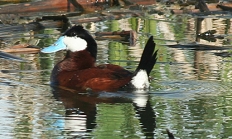
Small in size and displaying a showy, almost comical alternate plumage, the male ruddy duck is an unforgettable sight. Breeding males are unmistakable with their rich chestnut back, black crown, white cheek, sky-blue bill, and proportionately long stiff tail. Female plumage is drab in comparison, being dusky dark brown with a dark facial strip across the mostly white cheek, quite similar to the male's basic plumage. Known for their peculiar courtship display in which the male draws his head down and slaps his bill against his breast repeatedly in increasing tempo, creating a bubbling in the water and a hollow…
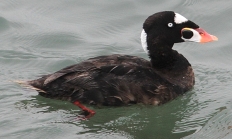
Although the least numerous scoter on the continent, it is the most common scoter along the Pacific coast south of Alaska and winters by the thousands off Oregon. Adult males' plumage, black except for white patches on the forehead and nape, yields attention to the bill, a swollen white, red-orange, yellow, and black wedge feathered squarely along its base. The highly visible standard advertises male's presence for up to a mile. Dark-billed adult females and subadults are dark brown above and paler brown below, with two indistinct light patches on the cheeks and sometimes on the nape. A flattened head…
With four wing-beats each second pushing them to 62 miles per hour, brant are the fastest and strongest geese in flight and among the swiftest of all large birds. Black brant comprise the vast majority of brant occurring in Oregon. These small geese have smoky black backs and bellies, and dissected white collars and white around the tails provide striking contrast. The black brant can live up to 20 years and are resilient enough to ride out storms on the open ocean. In Oregon, wintering numbers along the coast have seen a 50 percent reduction from previous years due to…

Oregon hosted the first successful introduction of the ring-necked pheasant in North America. This exotic game bird, released for sport hunting from China is now widely introduced and distributed throughout North America. Although more likely to run than fly, the ring-necked pheasant will explode into the air if startled, producing a distinctive sound from rapid wing-beats. It inhabits open areas such as grasslands, agricultural fields, and brushy areas, and avoids forested habitats. Hear the call of the ring-necked pheasant Photo by Charlotte Ganskopp

The skies near favored stopover locations are filled twice annually with the sights and sounds of these geese as they migrate between Arctic breeding grounds and wintering areas farther south. Snow geese share very similar all-white plumage and black wing tips with the less common Ross's goose. These are Oregon's only wild white geese. It is predominantly a spring and fall migrant, especially abundant in large wetland and agricultural complexes such as Malheur National Wildlife Refuge, Silvies River floodplain in Harney County, Lower Klamath National Wildlife Refuge and Klamath Wildlife Area. Wintering snow geese in Oregon are found primarily along…