
Search myodfw.com
Showing 981 - 1000 of 1204 results
Highly adaptable, this ubiquitous species may be found in habitats as diverse as coastal marshes, sagebrush, shrub-steppe, and urban supermarket parking lots. The adult male is blackish, showing a purplish sheen on the head and a greenish sheen on his back. Its eyes are yellowish to creamy white. Females and juveniles are dusky brown above and grayish brown below, with paler throat and eyebrows, and brown eyes. The Brewer's blackbird is a common permanent resident along the coast. West of the Cascades it is common to abundant in inland valleys. Within the Cascades, they are a migrant and summer resident…

The Brown-headed cowbird was referred to in early literature as the "buffalo bird" presumably because it commonly foraged on insects flushed under the feet of ungulates. It is a brood parasite, laying its eggs in nests of other species and leaving the rearing of young to surrogate parents. This has had serious consequences for many host species within the cowbirds' range. In Oregon, the Brown-headed cowbird is a common migrant and breeder in open habitats and woodland edges in all parts of the state. It is most abundant in agricultural land, sagebrush and juniper steppe, coastal scrub, riparian zones, and…

A boldly colored medium-sized bird, the Bullock's oriole builds its characteristic hanging nest in broadleafed trees and tall shrubs, especially when the trees or shrubs are spaced widely and situated along the edges of streams and fields. In Oregon, the Bullock's oriole is a rare to fairly common breeder, especially along major rivers and around farmsteads. It is most widespread in southwest and northeast Oregon. In particular, on the Derby Road in Jackson County. It nests primarily in open spaced cottonwoods, maples, and other tall, forking broadleaf trees. The nest is constructed of plant fibers, hairs, fine grass, and moss…
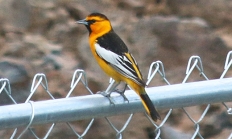
Small to medium-sized, finches have relatively pointed wings and sparrowlike bills. They have notched, short tails and and constantly give calls in flight.
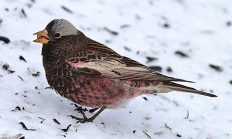
Rosy-finches are the highest-altitude breeding birds throughout most of their range. They are long-winged and generally dull-looking unless seen at close range, when the pinkish hues and combinations of brown, gray, and black can be seen. Their conical bill is usually dark, during spring and early summer and yellowish especially in fall and winter. These birds usually perch on the ground, but occasionally alight on buildings, trees, bushes, phone, and fence wires. They typically walk rather than hop, but do the latter occasionally. They also swipe with their bill rather than digging with feet as some sparrows and finches do…

This dark, medium-sized finch with gray and pink highlights is the darkest of the rosy-finches and one of Oregon's rarest breeding birds. It is found in summer in montane areas above timberline, where loose swarms of these birds seem to blow like leaves among isolated cirques, cliffs, and hanging snowfields. In Oregon it breeds on Steens Mountain and may breed occasionally in the Wallowa Mountains. Winter distribution is poorly known, but birds have been found on the lower east side of Steens Mountain and in the Alvord Desert in winter and rarely in central Wallowa County. Hear the song of…
While in Oregon, the Pine grosbeak is tame and not suspicious, usually allowing a close approach as it feeds on buds or dried fruits. The soft-gray females and young males, the latter more or less washed with yellow on the head, far outnumber the rosy males, and observers should look carefully for these duller-colored birds. The song of the Pine grosbeak is often described as similar to the Purple finch, but fuller and with lower pitch. The flight is typically finch-like, but with broad, bounding undulations. The Pine grosbeak breeds in the Wallowas and is suspected to breed in the…
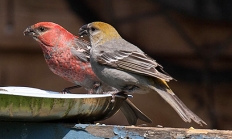
The bubbly warble of this finch is common in western Oregon conifer forests in summer, while its Crossbill-like - but more delicate - pik call is heard in lowland valleys in the winter. Adult males have a distinctly reddish-colored head, face, rump, throat, and breast, broadly but very faintly streaked brownish-pink sides, and a diffused brownish-red nape, back, and wings. Females and immature males have brownish-olive upperparts, wings, and tail, with contrasting streaking. Underparts are buffy-white to off-white with fuzzy, brownish streaking; a dingy pale gray stripe is present above the eye. In Oregon, the Purple finch breeds west of…
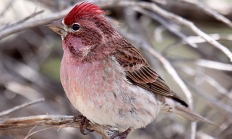
The bubbly warble of this finch is common in western Oregon conifer forests in summer, while its Crossbill-like - but more delicate - pik call is heard in lowland valleys in the winter. Adult males have a distinctly reddish-colored head, face, rump, throat, and breast, broadly but very faintly streaked brownish-pink sides, and a diffused brownish-red nape, back, and wings. Females and immature males have brownish-olive upperparts, wings, and tail, with contrasting streaking. Underparts are buffy-white to off-white with fuzzy, brownish streaking; a dingy pale gray stripe is present above the eye. In Oregon, the Purple finch breeds west of…

The House finch is the most widespread of Oregon's "red finches." It is a congenial, cheerful singer from urban areas to desert plateaus. The male has a red forehead, throat, eyebrow, rump and varying amounts of red in the breast. It may have small amounts of reddish wash in its otherwise brownish cheek, hindcrown, nape,and streaked back. In some males, red is replaced with red-orange, orange, yellow-orange or yellow. The female is drab grayish-brown, overall, with indistinct streaking above and no red. The House finch is a fairly common resident in lowlands, urban, rural, and agricultural areas throughout Oregon. They…

The Red crossbill is aptly named for its unusual bill configuration of crossed upper and lower tips of the mandibles which it uses to pry seeds primarily from native conifer cones. Degree of bill crossing is variable depending on wear, and it can have a right or left cross. Adaption to varied conifer cone structures and sizes has resulted in a diversity in body size, bill size and shape, and palate configurations in Red crossbills. Juveniles are brown with heavy streaked undersides and faint buff wing bars. Mature males are red with dark brown flight feathers and tail; first-year males…

One of the "winter" finches that appear unpredictably in the state, the White-winged Crossbill wanders in flocks year-round searching for food, and may actually be seen in parts of Oregon in any month of the year. Its peculiar twisted bill, specialized for prying seeds out of conifer cones, is smaller than that of the Red Crossbill, and it prefers smaller, softer cones, mainly spruce. Males are a dull pinkish red, with distinctive broad with bars on black wings. Females are dusty brown and dull yellow with blurry streaks. The White-winged crossbill is a very rare and erratic visitor in Oregon…

These tiny finches brighten the winter landscape of northeastern Oregon in some years. Their tan and ivory streaked with brown is plain enough, but the red forehead, black chin, and breast suffused in pink add a spot of color to snow-covered trees and shrubs. The Common redpoll is an uncommon to rare, irregular winter visitor, mainly in lowlands of the eastern Blue Mountain ecoregion. In peak years, this species can be locally common in Union, Wallowa, and Baker counties but in other years, it is essentially absent. It is an irregular visitant to Umatilla and Grant counties and in all…
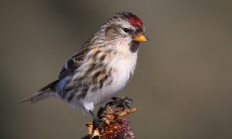
Although a common breeding bird throughout Oregon's mountains, the Pine siskin retains an air of mystery due to its highly nomadic and unpredictable movements and its fondness for the inaccessible conifer canopy. It is most familiar in winter through early spring when flocks descend to foothills and valleys to feed on alder catkin seeds and many mingle with goldfinches in weed patches and at feeders. It is readily identified by its heavily streaked plumage and by the yellow wing and tail bars that are especially prominent in flight. The Pine siskin is a generally common resident in conifer forests throughout…

Formerly known as the Green-backed goldfinch, this species was either not present or overlooked during the 19th century by most Oregon ornithologists. The male's black forecrown contrasts smartly with the greenish back and bright yellow underparts. Females lack the clear contrasting colors of the males, though the tips of the secondary coverts and the base of the primaries are white in both sexes. Often the plaintive tee-yee call reveals the presence of the bird long before it is seen. In the north Willamette Valley the Lesser goldfinch is a fairly common breeder along the western fringe. Scattered and local in…
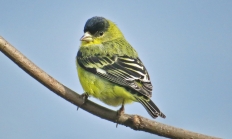
The exuberant bounding flight, musical calls, and flashy yellow and black plumage of the American goldfinch in breeding-season make them one of the most recognized and welcome of Oregon birds. Found in flocks nearly year-round, these goldfinches are a familiar site in riparian woodlands, orchards, weedy fields, and agricultural land. They are among the last of Oregon's songbirds to nest and are highly nomadic in the nonbreeding season. They may form mixed flocks with Lesser goldfinches and Pine siskins at bird feeders and weed patches throughout Oregon, as well as with Common redpolls some years in northeast Oregon. Their diet…
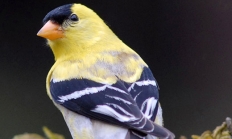
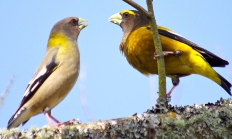
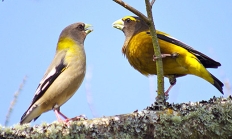
This sturdy-looking bird has a large head, short tail, and massive conical bill adapted for seed eating. The male plumage features bold patches of lemon yellow shading into olive, then brown and black, with white secondaries creating a flashy wing-patch easily seen in flight. The male's bill is chalky white in winter, but changes in early spring to a pale green that matches the new growth at the tips of spruce boughs, where they often nest. Many encounters with this species are of individuals heard flying high overhead, leaving the observer with little else to note. The Evening grosbeak is…
The House sparrow is an invasive species introduced from Europe. No other North American wild bird is so associated with human settlement as this introduced House sparrow. Its foods are nearly all imports, and its nesting and cover requirements are also human-derived. The House sparrow and European starling are the only introduced passerine birds that are thriving in Oregon. These birds can dominate bird feeders and utilize nest boxes that were intended for native species. The House sparrow can be found statewide around buildings at human developments of adequate size ranging from scattered farmsteads in remote and rural areas to…

In Oregon, the opossum is considered an invasive species. The Virginia opossum is a cat-sized mammal with a pointed nose, unfurred, black, leathery ears with white edges; beady eyes; a hind foot with an opposable hallux (big toe); and a naked scaly tail. It was introduced in Oregon between 1910 and 1921. Populations were established in northwestern Oregon apparently from releases of animals brought to the state as pets or novelties. Small streams, forest communities, and agricultural lands planted to a variety of crops are typical of many habitats occupied by Virginia opossums in Oregon. They are active nocturnally and…

Baird's shrew is a medium-sized shrew in which the third unicuspid is smaller than the fourth. This shrew is endemic to Oregon. It occurs in the Coast Range from the Pacific Ocean east to Portland and south of the Columbia River down to Corvallis. It also occurs along the west slope of the Cascade Range from the Columbia River south to central Lane County.