
Search myodfw.com
Showing 1021 - 1040 of 1410 results
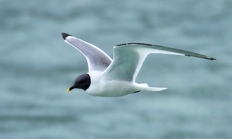
The striking tri-colored upperwing pattern on this graceful little gull is diagnostic in all plumages - a bold white triangle bordered by black outer primaries and gray back and inner wing. The Sabine's gull is most often observed flying in a steady migration over the ocean, and is seen seldomly foraging offshore. When ashore, it is found about coastal estuaries and inland lakes and impoundments picking food from the surface of the water, tidal flats, and along inland mud flats and shore edges. In Oregon, it is is a common to abundant spring and fall transient over the continental shelf…
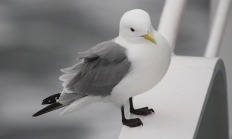
These small agile gulls are predominantly pelagic, but can often be seen from shore and even idling around lower estuaries. It is found primarily on salt water and does not usually forage in dumps and pastures as most gulls do; rather it stays over open ocean, along beaches and in lower estuaries, sometimes resting on the water or on jetties, sand spits and similar bare areas. They are often attracted to feeding swarms of loons, pelicans, tubenoses and other seabirds. The Black-legged kittiwake is a migrant and winter resident in Oregon along the outer coast and offshore. Peak numbers are…
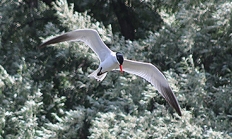
The Caspian tern nests on flat sandy or gravelly areas on islands, or on the margins of lakes, rivers, and marshes. It is always near water, and forages both in nearby water bodies and on prey exposed in nearby open areas. Breeding colonies in recent years have been on islands in the Columbia River east of the Cascades in north central Oregon; Malheur and Harney lakes in southeast Oregon; Summer Lake and lakes in the Warner Valley in south central Oregon. Most colonies have a history of intermittent use. It is a locally common summer resident during breeding season within…
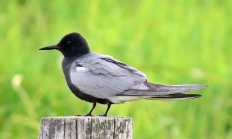
This is Oregon's smallest breeding tern, with black head and body and gray wings during the breeding season. Black terns are delicate, graceful fliers, reminiscent of a nighthawk or swallow. The Black tern breeds in marsh wetland complexes of southeast, south central and central Oregon. In western Oregon, a very small breeding population is found at a few sites in the Willamette Valley. Hear the call of the Black tern Photo by Bob, Flickr
This is a small tern most often seen along the coast flying along the beaches or hovering and diving over a school of fish just offshore. Breeding-plumage adults have sharp black caps, reddish bills, and forked tails, and are pale grayish above and white to pale gray below. They are a common to abundant spring and fall transient over the ocean, usually within 15 miles, irregularly along the coast and in the estuaries. Nearshore and inland flocks are often observed resting in compact flocks on nearby shores or on floating objects, or flying about over the water in search of…
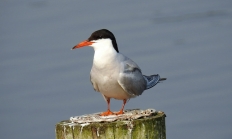
This graceful tern, with its aerodynamic body and streamlined wings, is infrequently seen from land in Oregon. It is most often encountered at sea as it makes one of the most incredible journeys in the animal kingdom, migrating from the Arctic to the Antarctic and back again each year, a journey of nearly 22,000 miles. A medium-sized bird with a reddish bill, it has a black cap and nape, and a white throat and cheek shading to a light gray body. It is a common offshore transient in Oregon waters and an occasional migrant along the coast. The bulk of…
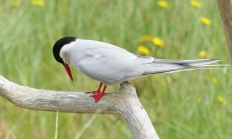
Terns are generally associated with marine environments and salt marshes, but the Forster's tern inhabits freshwater areas. During the breeding season this graceful bird is eastern Oregon's resident small white tern. Typical of terns, the Forster's employs a dramatic hunting method of plunge-diving into shallow waters to capture small fish, the bird sometimes submerging completely. This is an uncommon but highly visible colonial breeder east of the Cascades. Hear the call of the Forster's tern Photo by Dave Budeau, ODFW
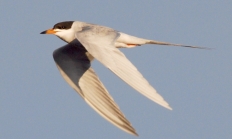
Skuas are the size of a Western gull, dark with a pale nape and large white patches on the bases of the primaries on both the upper and lower surfaces. This is a solitary bird. Its flight is low and direct with heavy flapping and little gliding. It steals food from other seabirds, and is aggressive, bordering on predatory. It may grab a shearwater's head, wing, or tail and shake and kick the bird until it regurgitates its food. Chances of detection are best around flocks of shearwaters feeding behind fishing boats. It is a rare to uncommon fall transient…
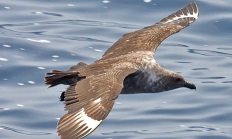
These, the most numerous jaegers off Oregon, are slightly smaller than Herring gulls. Gull-like and graceful, these piratical birds steal food from smaller seabirds. They come in a bewildering array of light and dark individuals, confounded by age and sexual differences. The Pomarine jaeger is an uncommon spring and fairly common fall transient offshore two to 50 miles, following shearwaters. Sightings have been centered near the continental shelf edge. They are occasionally observed from shore in fall. Hear the call of the Pomarine jaeger Photo by Martyne Reesman, ODFW

Parasitic jaegers are strong, fast fliers with a flash of white on the bases of the underwing primaries. This is the most frequently seen jaeger from shore and it sometimes enters estuaries. They are an uncommon fall and rare spring transient offshore. Their flight is low and unlabored with falcon-like wing-beats that alternate with shearwater-like glides. These birds chase terns and small gulls for up to several minutes until they disgorge food. Hear the call of the Parasitic jaeger Photo by Aaron Maizlish, Flickr

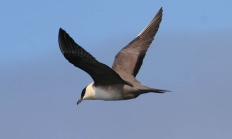
Graceful and buoyant fliers, adults are light gray-brown above with black caps, have dark flight feathers contrasting with grayer mantles and light underparts. Breeding adults have a central pair of tail feathers extremely long and pointed, extending up to eight inches past the rest of the tail. They are not usually as aggressive as other jaegers and rely as much on food they pick from the ocean's surface as they do from food they steal from other small seabirds. The Long-tailed jaeger is a rare to fairly common fall transient offshore. They are usually detected when Arctic terns and Sabine's…
Murres, auklets and puffins are all sea birds that only come ashore to nest. The most unique is the Marbled murrelet which flies inland - sometimes great distances - to nest in coastal coniferous forests.

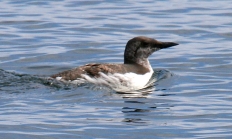
The most common seabirds breeding in Oregon, Common murres are easily recognized by their distinct black and white breeding plumage and their upright stance at colonies. Wing-beats are rapid and like all alcids they can fly underwater. They are often seen over the ocean in long lines of 10-40 or more birds. They nest on rocky islands and cliffs in colonies of tens or hundreds of thousands of birds packed together almost shoulder to shoulder. Major nesting concentrations in Oregon are on the south and north coasts reflecting the availability of suitable nesting habitat. Hear the call of the Common…
During the breeding season Pigeon guillemots are easily seen flying low over the water along rocky coastlines or in estuaries. They have striking red feet, legs, and mouth linings and their large white wing patches contrast markedly with the rest of their black plumage. When standing on land they have a distinctive upright posture and often emit a high-pitched squeal. In the non breeding season they move offshore and look entirely different when their black plumage becomes mottled with white. The Pigeon guillemot occurs during the breeding season all along the Oregon coast wherever offshore islands or rocky cliffs are…

In winter plumage, the crisp black head, white neck patch, and gray back are striking, and when combined with a pale bill this species is readily distinguished from small alcids in Oregon. Wing-propelled divers, they are nonbreeding visitors to Oregon's offshore waters. They are the only seabirds whose young are reared entirely at sea. The Ancient murrelet is an uncommon to common fall migrant and winter visitant in shelf waters near shore; rare to uncommon in spring; absent to rare in summer. Hear the call of the Ancient murrelet Photo by Patty Mcgann, Flickr

Cassin's auklet uses a few offshore lands for breeding in Oregon. It forages in the marine environment and nests in a chamber under rocks or digs its own burrow, two to six feet long, in the soil. This species spends its day at sea and only comes to the burrow at night, perhaps to reduce discovery by predacious Western gulls. Although few Cassin's auklets nest in Oregon, nesting sites are found along the entire coast where offshore rocks provide appropriate habitat. During the non-breeding season this is the most abundant alcid seen at sea in Oregon. They are present offshore…

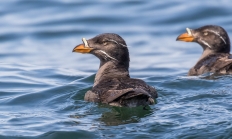
Rhinoceros auklet are one of the rarer breeding alcids in Oregon. Adults are easily recognized during the breeding season by the vertical "horn" at the base of the upper mandible. Birds in breeding plumage have brownish gray backs, a gray-brown chest, and a dirty white belly. Two distinct plumes are present on the head, one above and one below the eye. The bill is orange. In non-breeding plumage the horn is greatly reduced, the plumes absent or reduced, and the bill duller. It nests in small numbers in Oregon with Goat and Hunter Islands having the largest concentrations of breeding…
Horned puffins have an unmistakable black and white plumage and a large, distinct, yellow and orange bill during the breeding season. They are rare in Oregon, and most commonly encountered dead on the beach in winter or spring, or sighted more than 50 miles offshore in spring. Individual birds, or possibly pairs, occasionally stay in Oregon for the breeding season and are seen attending colonies with Tufted puffins, but there are no records of breeding in Oregon. Hear the call of the Horned puffin

The Tufted Puffin is extremely charismatic and the most recognized seabird in Oregon. It is easily identified in the breeding season by the colorful laterally compressed bill, a distinct white face with long cream-colored facial plumes, black body, and reddish-orange feet. In winter it moves offshore and loses most of its colorful plumage and bill plates. Tufted Puffins are burrow-nesters and feed at sea. Along the Oregon coast, they primarily nest on soil-covered islands free of mammalian predators. They also occasionally nest on headlands such as Cape Mears, Cape Lookout, Cape Foulweather, and Yaquina Head. Tufted Puffin populations have…

Pigeons and doves are a familiar sight, daintily walking and bobbing their heads. Rock pigeons and Eurasian collared-doves are natives of Europe while Band-tailed pigeons and Mourning doves are native to Oregon.
