
Search myodfw.com
Showing 1221 - 1240 of 1410 results
The snowshoe hare is the smallest member of the genus in Oregon. Individuals in populations east of the Cascade Range, and some individuals in the Cascade Range, become white in winter and are brown in summer. This hare is associated with dense thickets of young conifers, especially those with lower branches touching the ground and especially firs and western larch interspersed with small clearings vegetated by grasses and forbs. Photo from ODFW

The black-tailed jackrabbit is slightly smaller than the white-tailed jackrabbit but considerably larger than the snowshoe hare. In conformation, it is much like the white-tailed jackrabbit. West of the Cascade Range, the dorsal hairs of this rabbit have gray blending to dark-brown or blackish base followed by a narrow band of buff and a black tip. Hairs on the throat, sides, and rump have gray bases blending to buff with short black tips. On the venter, hairs are white with light pinkish-buff tips. The tail is black on the dorsum and dark buff on the venter. The ears are dark…
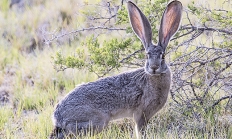
Summer and winter pelages of white-tailed jackrabbit are drastically different. In summer, the overall appearance is grizzled dark grayish with overtones of pinkish buff, blending lighter on the sides. In winter, it is the color of dirty snow, shading lighter on the sides. In Oregon, the white-tailed jackrabbit occurs east and south of a line connecting Rufus, Maupin and Antelope, John Day, Juntura, Fields, Fort Rock, and Fort Klamath and Klamath Falls. It is associated with bunchgrass habitats. The white-tailed jackrabbit is an Oregon Conservation Strategy Species in the Northern Basin and Range ecoregion. Photo by Wickipedia

The mountain beaver is a medium-sized, muskrat-like rodent often lacking a visible tail. It is not related to other beavers or rodents but are called beavers because of their habit of gnawing down young trees. The mountain beaver has an extremely short, fur-covered tail, and otherwise differs from the muskrat by possessing five-toed feet. It is dark brown with a small white spot at the base of each ear. In Oregon, are common in forested areas on the west slope of the Cascade Range west to the Pacific Ocean. They are, however, rarely seen as they spend most of their…
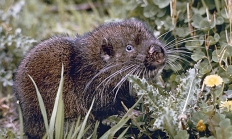
The yellow-pine chipmunk is one of the smallest in Oregon, only slightly larger than the least chipmunk. Its face is marked with a dark stripe, followed laterally by two alternate light and dark stripes. The outermost light strip is nearly white. It occurs on the east slope of the Western Cascades and eastward through most of the remainder of Oregon, except it is absent from most of the Columbia Basin and much of southern Harney, eastern Malheur, and southern Baker counties. Its range also extends westward in the Siskiyou Mountains in southern Jackson and Josephine counties. Ponderosa pine seems to…
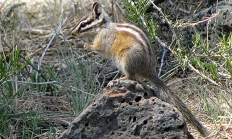
The least chipmunk is the smallest chipmunk in Oregon, but it is only slightly smaller than the yellow-pine chipmunk. As in all chipmunks, the face is marked with a dark stripe through the eye bordered on each side with a light- and a dark-colored stripe. The middorsum is marked with a dark-colored stripe followed on each side by two alternating light- and dark-colored stripes. The least chipmunk has the largest geographic range of any chipmunk. In Oregon, it occurs east of the Cascade Range except in the Columbia Basin and most of the Blue Mountains. In general, it is a…
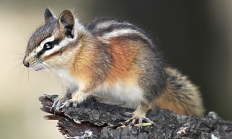
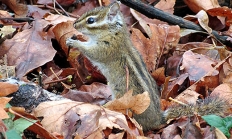
The pelage of this chipmunk is marked with five dark and four light stripes on the dorsum; the middorsal stripe is usually black and nearly always darker than the other four dark stripes. The sides of the face are marked with three brown and two light gray stripes, a patch behind the ear is light gray. The tail is blackish frosted with ochre dorsally and rusty brown ventrally. Allen's chipmunk produces a call of a rapid series of three or four to as many as 10 syllables. In Oregon, it occurs in forested areas along the eastern part of the…
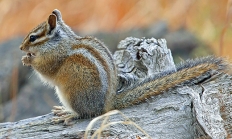
The Siskiyou chipmunk is slightly smaller than the Townsend's chipmunk and slightly larger than the Allen's chipmunk. The pelage is marked with five dark and four light stripes on the dorsum; the middorsal stripe is usually black and nearly always darker than the other four dark stripes. The sides of the face are marked with three brown and two light gray stripes; a patch behind the ear is light gray. It occurs in Curry, Josephine and Jackson counties south of the Rogue River; in extreme western Klamath County; in extreme eastern Douglas and Lane counties; and in extreme southeastern Linn…
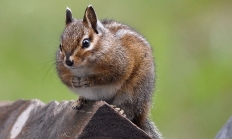
Townsend's chipmunk is the largest member of the genus in Oregon.The pelage of this chipmunk is dark and dull but as in other Oregon chipmunks, there is a dark brown to blackish middorsal stripe with alternate light and dark stripes, laterally, a total of five dark and four light stripes. Alternate dark (three) and light (two) stripes adorn the sides of the face. The throat, belly, and a patch behind the ear are white. The tail is black on the tip and the margins are frosted above with buff or white-tipped hairs. Townsend's chipmunks have been found on the west…
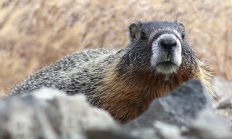
The yellow-bellied marmot is the largest squirrel in Oregon. It has short legs, a short and bushy tail, and ears short and covered with fur. The pelage consists of a dense, wooly underfur covered by long, course guard hairs and is distinctively colored and marked. In Oregon, it occurs in suitable habitats east of a line connecting Mt. Hood, Hood River County, and Mt. Mazama, Klamath County, except for the Columbia Basin. The primary requisites of suitable habitats for the yellow-bellied marmot are boulders or piles of rocks and an abundance of succulent vegetation in close proximity thereto. Occasionally, an…
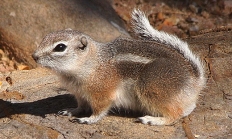
The white-tailed antelope squirrel is the smallest species of ground squirrel in Oregon. Although rather cryptically colored, it is marked distinctively: the grayish-brown dorsum and sides are separated by a white stripe on each side. The stripes are tapered at both ends and extend from behind the ear to near the base of the tail. A white line encircles each eye, the underside of the tail is white grading to grayish near the tip and the venter is white. In Oregon, it occurs south and east of a line connecting Vale, Malheur County; Harney Lake, Harney County and Paisley, Lake…
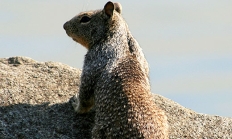
The California ground squirrel is a large, long-tailed gray squirrel with a large, nearly-black, triangular patch between light-gray shoulder patches. The gray dorsal pelage is speckled with buffy white spots. The tail is bushy, but not so full and spreading as those of tree squirrels. In Oregon, it occurs throughout the area west of the Cascade Range and throughout much of Central Oregon. It is considered among the most generalized of the ground squirrels as it inhabits a variety of habitats. Although it is a ground-dwelling squirrel, it has a strong propensity to climb. It is commonly observed sitting on…
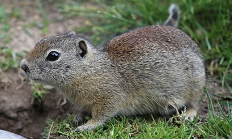
Belding's ground squirrel is a medium-sized ground squirrel without spots, stripes, or splotches. The pelage is smoky gray with some pinkish on the face, feet, and venter, and with a more or less well-defined reddish or brownish band in the middorsal region. The tail is cinnamon on the ventral surface. This squirrel occurs south and east of a line connecting Enterprise, Heppner, Maupin, Wasco Sisters, Diamond Lake, and south to Fish Lake. It may occur in steppe and shrub-steppe area, particularly in meadows; sagebrush flats; and small-grain pasture , and hay-crop fields, and sometimes in openings in woodlands. The Belding's…
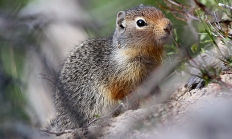
Columbian ground squirrels occur in the Wallowa and Blue Mountains in small openings and meadows in forested areas. Most of these areas flood each spring so the ground squirrels are restricted to the edges of meadows or to mounds within them. Columbian ground squirrels spend an average of 245-255 days in torpor and an average of only 69-94 days active. While above ground, they spend more time alert than in any other activity. This ground squirrel engages in a greeting behavior that resembles kissing, touching mouth and nasal areas usually for one to five seconds before other social behavior. Photo…
The Wyoming ground squirrel is a medium-sized ground squirrel without spots, stripes, or splotches. The dorsal pelage is grayish with a slight buffy wash. In the field, it appears distinctly more yellowish than other ground squirrels that it might be confused with. The tail is usually longer, as well. This ground squirrel is found in southeastern Oregon and emerges from hibernacula in the spring and by late July has again entered torpor. During the active season, individuals usually become active within an hour after sunrise. Photo by Andrew Hoffman, Flickr
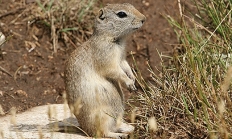
The golden-mantled ground squirrel doubtlessly is the most distinctively marked ground squirrel in Oregon; a white stripe bordered on both sides by a black stripe extends from the shoulder to the hip. From nose to nape above the eye, the head is russet. The back between the stripes is grizzled dark grayish-brown becoming less grizzled on the rump; lateral to the stripes the color grades to a light buffy-gold on the venter. The face, shoulders, front legs, and feet are a bright orangish-gold. This ground squirrel occupies the east slope of the Cascade Range and most of central Oregon, and…
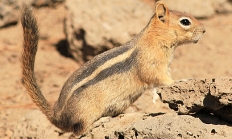
Merriam's ground squirrel is one of the two small gray ground squirrels in Oregon without stripes or spots. Most of the geographic range of this squirrel is in Oregon, where it occurs south and east of a line connecting Huntington, North Powder, Maupin, Warm Springs, Bend, and Fort Rock, Summer Lake, and Plush. This species does not occur south of the North Fork Owyhee River in Malheur County. These ground squirrels emerge in early March, breed, rear their young, become exceedingly fat and go into their hibernacula by early August. Photo by ©John Rakestraw

The Piute ground squirrel is the other of the two small gray ground squirrels without stripes or spots. In Oregon, it occurs south of Sheepshead and Cedar mountains in Malheur County. It is a species of the High Desert and commonly occurs in habitats in which the dominant shrub is big sagebrush, saltbush, or greasewood. It is commonly associated with rocky outcrops, levees, railroad embankments, ditchbanks, and sand dunes. Some occur in fencerows and edges of alfalfa and small-grain fields. These ground squirrels are usually active for three to five months each year. They emerge from their hibernacula in February…
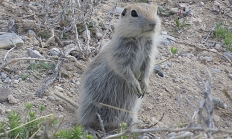
The Washington ground squirrel is the smaller of the two short-tailed, spotted ground squirrels in Oregon. The dorsum has squarish grayish-white spots on a background of pale smoky-gray with a pinkish wash to brownish gray. This squirrel is endemic to the Deschutes-Columbia Plateau Province east and south of the Columbia River and east of the John Day River. A colonial species, it emerges from dormancy in January to early March, males before females. At the approach of a potential threat, the Washington ground squirrel produces a soft, lisping whistle. Other members of the colony respond by standing upright, repeating the…

The Eastern fox squirrel is among the larger of the tree squirrels in Oregon. Its body is the typical squirrel shape. The ears are short, rounded, and without tufts. The tail is flattened and somewhat fluffy. In Oregon, it has been found in Multnomah, Washington, Marion, Lane, Union, Clackamas, Yamhill and Baker counties, all occurring in urban areas or in association with nut orchards. The Eastern fox squirrel is active throughout the year during daylight with its greatest activity in the early morning and late afternoon. During autumn, they are exceptionally active on the ground, scatter-hoarding nuts and acorns as…
