
Search myodfw.com
Showing 181 - 200 of 672 results
CLACKAMAS, Ore.—Fishery managers from Oregon and Washington added more recreational spring Chinook fishing days on the mainstem Columbia during a joint state hearing today. Eleven additional fishing days for the area from the Tongue Point/Rocky Point line in the estuary upstream to the Oregon/Washington border (upstream of McNary Dam) were…
Features: The coloration tends to be golden-brownish with dark brown or black spots on the body, and on the dorsal and adipose fins. Usually few or no spots appear on the tail fin. Many body spots, especially those below the lateral line, are edged with pink, red, or orange, forming rings or halos. Breeding males develop strong teeth and a hooked snout. Size can range from 11-inches long in small streams to over 30-inches in large rivers or lakes. Habitat: Although brown trout can adapt themselves to sluggish streams and warmer temperatures than other trout, cold, spring-fed tributary streams with…

Features: As the name suggests, these fish have rosy red strip along their sides. Other identification clues include large, profuse black spots on the body and orange and yellow tints along the belly. Habitat: Redband trout are a subspecies of native rainbow trout that have adapted to the arid, desert conditions of eastern Oregon. During drought years distribution constricts as streams dry and become uninhabitable. Trout re-colonize these streams during wet cycles, expanding the distribution. Prime trout waters are clear, clean and cold. Good trout stream habitat is complex, consisting of an array of riffles and pools, submerged wood, boulders…
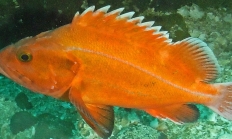
Features: They are orange red to orange yellow with a bright yellow eyes. Their fin tips may be black. On the top of their head they have a pair of rough ridges. Yelloweye, canary and vermilion rockfish can look similar. See this rockfish identification article for distinguishing features of each species Take the "Yelloweye Rockfish or Not?" quiz Habitat: Juveniles and subadults prefer shallower water than adults, and are associated with rocky reefs,and kelp canopies. Adults move into deeper water as they grow, and prefer rocky bottoms. Technique: Yelloweye rockfish are currently prohibited in the catch. Anglers are required to…
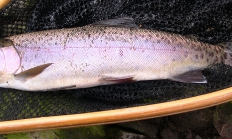
Features: The color of all trout varies with environment. In general, the rainbow is bluish-green on the back, silvery on the sides and belly, and has a white edge to the dorsal, anal, and pelvic fins. A generous sprinkling of black spots appear along the back, and on the dorsal, adipose and caudal fins. A pinkish band usually extends along the sides. Habitat: Rainbow trout are the most widely stocked and distributed trout in Oregon. They occur naturally in many rivers and streams, and each year ODFW stocks millions more in ponds, lakes and streams. Prime trout waters are clear…

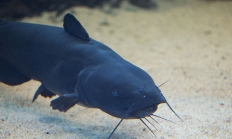
Features: Bullheads present in Oregon (brown, yellow and black) are distinguished from channel catfish by their square or rounded tails and lack of spotting. They seldom exceed two pounds and 18-inches long. Black bullheads have a square tail with a light vertical bar at its base and chin barbels that are all dark. Habitat: Bullheads are found on the bottom in the shallows of mud-bottomed ponds, lakes, reservoirs and backwaters of rivers. The black bullhead is primarily in reservoirs and streams tributary to the Snake River. Bullheads feed on almost any type of plant or animal material; insect larvae and…

Features: Smallmouth bass are golden green to bronze with dark vertical bars and blotches on the side. The upper jaw does not extend beyond the eye. In some locations, it has a red eye. Somewhat smaller than the largemouth, smallmouth bass in Oregon may reach 23-inches and exceed 7 pounds. Habitat: Smallmouth bass are adapted to flowing waters and do well in warm streams with deep holes and rocky ledges. They also prefer lakes and reservoirs with rocky shorelines and limited vegetation. Adult smallmouth feed mostly on fish and crayfish. Technique: Much of what was written about largemouth bass also…

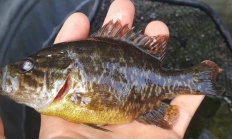
Features: Warmouth have more of a bass-shaped body and a larger mouth than the other sunfishes, other than the green sunfish. Warmouth are yellowish brown in color with three or four brownish bars radiating back from the eye over the gill cover. They can be distinguished from the green sunfish by the absence of turquoise mottling on the gill cover and the lack of a dark spot at the rear base of the dorsal fin. Habitat: In Oregon, warmouth are present in a few coastal lakes and widely distributed in the Columbia basin, but are not commonly caught by anglers…
CLACKAMAS, Ore.— Fishery managers from Oregon and Washington added recreational fishing days for adult hatchery Chinook and sockeye to the on-going hatchery steelhead and hatchery jack Chinook fishery in the mainstem Columbia River downstream of the Highway 395 Bridge at Pasco, WA during a joint state hearing today. Retention of…

ONTARIO, Ore.–The Fish and Wildlife Commission voted 5-1 to open a hatchery Chinook salmon season in the Coquille River, the first Chinook season since 2021, during their meeting today in Ontario. The Coquille River will be open for fall salmon fishing from Sept. 13-Oct. 15 from the Hwy 101 bridge…

CLACKAMAS, Ore.—Fishery managers from Oregon and Washington added several days of recreational spring Chinook fishing on the mainstem Columbia River during a joint state hearing today. With these additional days, and the action taken last week, the Columbia River will be open for spring Chinook for the entire upcoming Memorial…
PENDLETON, Ore. – A $1 million federal investment will jump-start critical engineering and design work on fish passage and alternative solutions at McKay Creek Reservoir Dam, laying the technical groundwork to eventually reconnect more than 100 miles of historic salmon and steelhead habitat. Sens. Jeff Merkley and Ron Wyden helped…
SALEM, Ore.–The Fish and Wildlife Commission meets Sept. 11 and 12 in Ontario for a field tour on Thursday and a regular meeting on Friday. See agenda here. The meeting will also be livestreamed from the Commission page. To testify on an agenda item virtually, register on the agenda page…

Features: This species is relatively thin compared to other rockfish. It is easily recognized by its three to four horizontal green stripes that extend onto the caudal fin membranes. The body color ranges from white to reddish; red or orange areas can be observed on the body after capture. Habitat: Though found between 40 and 1,632 foot depths, these rockfish tend to stay between 300 and 825 feet with older/larger individuals found deeper. They live on muddy, sandy and rocky bottoms. Technique: Rubber tail jigs or shrimp flies are good choices when targeting greenstriped rockfish. Be wary of sharp dorsal…


