
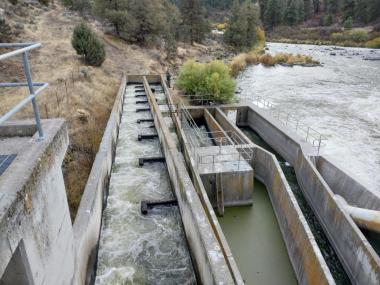
Keno Dam Fish Passage and Klamath River Screening Projects
ODFW, the Bureau of Reclamation (BOR), and the National Oceanic and Atmospheric Administration (NOAA) are working together to improve fish passage at Keno Dam, particularly for native migratory and returning anadromous fish. Short-term improvements are underway while a long-term solution is being developed. Input is being actively sought.
The unscreened diversions from the Klamath River risk entraining or excluding native migratory fish and anadromous fish species which will be present in these reaches now that the four lower river dams have been removed. ODFW and project partners will evaluate fish protection and deterrent devices to modernize infrastructure along with water conservation at priority points of diversion.
Please share your feedback with ODFW and the Work Group here.
Background
The existing fish ladder at Keno Dam does not meet state or federal standards for fish passage. This lack of efficient passage could affect recovery of anadromous fish in the basin. Keno Dam is critical for irrigation, wetland support, and flood management—and these functions will be maintained. ODFW is guiding the development of the work plan and budget based on two grants from BOR.
Keno Dam Fish Passage Alternatives Feasibility Analysis
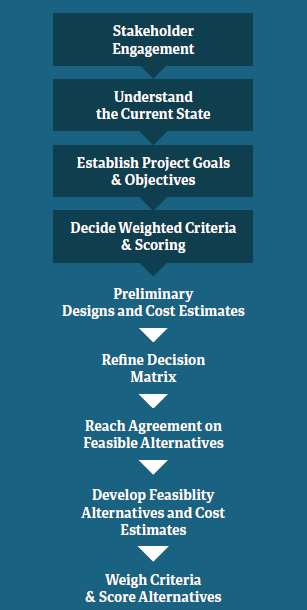
ODFW, Federal and State partners, Tribes, and local partners will engage in a coordinated, transparent approach to feasible fish passage solutions at Keno dam while ensuring dam safety and water level control that provides water needs for the project area. Grant funding provided by NOAA Restoration Center.
At start up, ODFW, Willamette Partnership, and McMillen will facilitate and discuss data collection, existing site conditions, alternatives evaluation and criteria for scoring a subset of approaches that will guide further evaluation and design.
Work Group Members (Keno Dam Fish Passage Alternatives Feasibility Analysis)
ODFW (lead), BOR, NOAA-NMFS, Klamath Tribes, Kurok Tribe, Yurok Tribe, Modoc Nation, Shasta Nation, Oregon Water Resources Department, City of Klamath Falls, Klamath Drainage District, Trout Unlimited.
Project Lead – Philip Milburn, philip.j.milburn@odfw.oregon.gov
News Media inquiries – Adam Baylor, adam.c.baylor@odfw.oregon.gov
Keno Dam Fish Passage Improvement Project
Funded by BOR Aquatic Ecosystem Restoration Program (AERP)
Improvements are needed for both upstream and downstream passage to meet the needs of the diverse suite of species and life histories using this stretch of the Klamath River. Although repairs and modifications will not fully meet fish passage criteria, the work proposed here will increase passage efficiency in the near term while a longer-term solution can be implemented.
The fish species targeted for use of the facilities when they were built was rainbow trout. With anadromous species now reaching the dam, the goal is to assist the development of a strategy for downstream and upstream passage that needs to be done in tandem because of multiple species and life history migration patterns and timing to support fish migration. Additionally, the project will monitor fish passage and support ongoing fish research and study efforts.
Keno Impoundment Fish Screening
Funding by Aquatic Ecosystem Restoration Program (AERP) Klamath River Fish Screening
The primary objective of this project is to develop a workplan that details the study, design, and permitting of 5 to 10 fish screens at priority diversion sites along the mainstem Klamath River between the Keno Impoundment and the Oregon-California state border. Prior to screening turnouts on irrigation canals that may be used to support flow-through or ebb and flow types of projects (e.g.- Tule Lake Flow-Through Project, Lower Klamath Lake Reconnection Project, etc.), ODFW will present and discuss screening alternatives, cost estimates, and public benefits to BOR and project partners.
Fish screens cannot be constructed on BOR owned, operated, managed, or Reclamation reserved works infrastructure and cannot interfere with Klamath Project operation. Therefore, ODFW will partner with Trout Unlimited, Family Water Alliance, and irrigation districts to conduct landowner outreach and assess priority screening opportunities, data collection, surveys, and hydrologic calculations to inform all decisions related to site selection, design, and permitting in collaboration with state and federal agencies.
Another component of the project will be to evaluate fish protection devices for the larger diversions with complex screening issues. Physical screening of these larger diversions presents technical challenges and higher risk.
View Klamath Basin Fish Screens 1-page informational document here.
Latest Updates
- Willamette Partnership was hired for facilitation services.
- A contract with McMillen is in place for engineering support.
- Subawards with key partners have been completed to support cultural and partner engagement.
- Feasible Alternatives will be presented to the public after work group meetings have concluded
Documents
DRAFT Hydraulic Modeling in Support of Flood Control Plan for the Klamath River Basin
Keno Reach Hydrodynamics and WQ Tech Report 2006-09
Modeling the Water-Quality Effects_USGS
Macrophyte and pH Buffering Updates_USGS
Modeling 2-4 Foot Drawdown Keno_USGS 2020-5001
Fish_Passage_Planning_and_Evaluation
KLAMATH HYDROELECTRIC PROJECT-historic context statement
2016-IM11-Act4-RptF(7-18-16) O2 infusion System
KlamathBasinRevisedNFS_SurfaceWaterHydraulicModeling_2025Sept
Sediment Concentration Model Update_KRRC
Simulated Effects of Dam Removal_USGS
FAQs
- What is the purpose of the Keno Dam Fish Passage project?
The purpose of this project is to establish a collaborative forum for meaningful engagement with partners to explore long-term options for Keno Dam that align with state and federal fish passage requirements while maintaining the dam's essential services. This project will support an alternatives analysis, feasibility study, and preliminary design of selected options to bring the facility into compliance with applicable regulations. Through collaboration, we hope to understand the perspectives of different partners, such as local communities, Tribes, irrigators, and environmental groups on the future of Keno Dam.
- Why does the Keno Dam fish ladder need to be modified?
While Keno Dam is meeting many of its requirements and services, it is currently out of compliance with regulations related to fish passage. The current fish ladder, constructed in 1967, was not designed to allow larger bodied adult, migratory fish to pass the dam. Although many salmon made it above Keno dam during the 2025 fall Chinook migration, radio telemetry data from tagged fish have shown that several fish migrated to the dam and turned around, indicating that the dam is affecting upstream migration patterns.
- Why wasn't Keno Dam fish ladder designed to meet fish passage standards?
When the current dam and fish ladder system was built, there were several other dams lower in the system that prevented federally listed fish from migrating up to Keno. In fact, most migratory fish hadn't made their way up to the Klamath basin in over 100 years.
Once those lower Klamath River dams were removed, fish began migrating up the Basin immediately. That means the Keno Dam is now the next partial barrier slowing down migratory fish from reaching the upper Basin. Because of that, the Oregon Department of Fish and Wildlife (ODFW) has it listed as the second highest priority barrier for fish passage in Oregon.
- Is this an effort to remove the Keno Dam, the same way the lower dams were removed?
No. While dam removal will likely end up as one of the studied alternatives, other alternatives will also be studied for feasibility. In all instances, including any removal scenario, Keno Dam will have to provide for its additionally required services, including maintaining water levels in Lake Ewauna for irrigation diversions and providing flood protection services.
- What alternatives are being considered?
The alternatives will be evaluated and discussed through a collaborative workgroup meeting involving Tribes, local partners, state and federal agencies. A preferred solution is one that provides open fish passage as well as the irrigation and flood control requirements of the community.
- How many alternatives will be developed, studied, and engineered?
Engineering feasibility and cost level designs will be developed for up to 4 of the identified alternatives, ultimately resulting in the selection of a preferred alternative that can be moved forward for complete design, permitting and funding.
- When will the public be able to offer comment and input on the project?
The State of Oregon (ODFW) intends to hold public information sessions in Klamath County to facilitate broad stakeholder engagement at key steps in implementation of this project, in addition to convening smaller technical and core stakeholder working groups that represent key interests served by the Keno Dam for more in depth engagement.
- What about the Bureau of Reclamation's (BOR) own feasibility study work? Is this process duplicative?
This process is expected to be integrated with BOR's work on Keno Dam and will complete the initial phases of work required for a traditional BOR feasibility study. Public engagement will be a critical component of any potential alterations to Keno Dam as part of this project or a BOR feasibility analysis.
Since BOR took ownership of the dam in 2024, they're charged with getting the dam's fish passage to a place where it meets basic regulatory requirements as soon as possible. BOR is specifically looking at near-term, temporary solutions (for implementation within the next few years) that will improve passage at the dam, while this separate process is looking to identify long-term solutions for fish passage to bring the facility to full compliance.
- What is Willamette Partnership's role?
Willamette Partnership is contracted by ODFW to provide facilitation support for the project. They will be coordinating working meetings (scheduling, preparing agendas, etc.), providing facilitation support during meetings, supporting ODFW's communications team with communications specific to this project, and developing a final report at the end of this process that will be made available to the public.
- Water is already scarce—won't modifying the dam make water issues worse?
No. Any modifications to the dam will be required to meet existing requirements for maintaining lake levels in Lake Ewauna so water can be provided to irrigation districts, in addition to other required services.
- How does this project relate to other ODFW efforts at Keno Dam?
ODFW has received additional financial support from BOR to conduct evaluations of fish passage limitations and design near term repairs and modifications that can improve passage but will not fully meet standards. By contrast, this project seeks a long-term solution that will likely take more time for implementation.
Meeting Notices
To be updated soon.