

Oregon is Worth Protecting
Conservation is at the heart of what ODFW does, and your support is important in the work to help Oregon's most vulnerable species and precious habitats.
ODFW has partnered with Jamba to release limited-edition tumblers featuring five Oregon marine animal species in need. These unique species are animals in Oregon that are struggling and need more conservation efforts now. Conservation is at the heart of what ODFW does, and your support is important in the work to help Oregon's most vulnerable species and precious habitats. This partnership helps ODFW and Jamba raise awareness about the species in need and celebrate the fish and wildlife that contribute to make Oregon a wonderful place to live and recreate. Grab one for yourself and get another for a friend. $3 of every tumbler and $1 from every Sea Star Smoothie sold is donated to conservation efforts through the Oregon Wildlife Foundation.
Find a participating Jamba location
Donate to conservation efforts through the Oregon Wildlife Foundation
Discover more about the featured marine species

Participate in the Coloring Contest! Download and print the coloring sheet or pick up one at any participating Jamba location (see list of stores) in Oregon or Vancouver, WA and color your heart out. Return your completed coloring sheet to a participating location by July 31, 2026 to enter the contest. Remember to write your full name, age and phone number on the back to enter to win.
Entries may also be mailed to Jamba at: 7800 SW Durham Rd, Suite 900, Tigard, OR 97224.
Five winners will receive a Jamba Prize Pack (worth up to $50) and more. The contest is open to all ages. One winner will be selected in each age category (0-5 yrs, 6-10 yrs, 11-14 yrs, 15 –17 yrs, 18-25 yrs, 26-45 yrs, 46-69 yrs, 70+ yrs.).

The Oregon Department of Fish and Wildlife (ODFW) protects the state's fish and wildlife species, and their habitats. We do this through science-based management. Our mission is to protect and enhance Oregon's fish and wildlife, and the habitats they use, for the use and enjoyment of present and future generations. Conservation is at the heart of what we do, and your support is important in the work to help Oregon's species and habitats thrive.
Featured here are some of Oregon's species of greatest conservation need. These are native species that are imperiled and in need of attention. Conservation efforts today can help prevent these species from disappearing from Oregon. Some of the risks to these animal populations include pollution, climate change, invasive species, and barriers to animal movements. Taking action is key to maintaining Oregon's extraordinary biodiversity.

Learn more about each of these unique marine species and some of the threats they face below.


Learn about the State Wildlife Action Plan (SWAP)
Discover more about the management efforts to conserve these species in ODFW’s SWAP. The SWAP is a plan developed in collaboration with federal, state, and private partners to guide conservation efforts for wildlife.
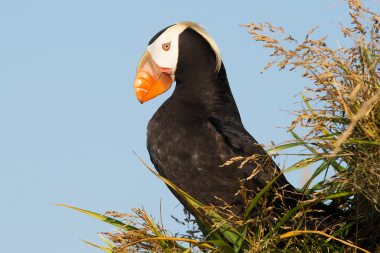
Tufted Puffin
- Tufted puffins are among the most striking and recognizable birds in Oregon. During the summer breeding season, they have a bright orange bill, a white face mask that contrasts with their black body plumage (feathers), tufts of long pale-yellow feathers that extend behind the neck, and eyes highlighted with coral-red rings. They are non-descript and dull gray-black during most of the remainder of the year.
- Tufted puffins live on the open ocean during most of the year, far from the nearshore islands that are typically used for nesting in Oregon. Islands with minimal disturbance by predators are preferred for nesting.
- Tufted puffins are typically burrow-nesters that nest colonially (in groups). They prefer steep slopes with deep soil for burrowing, which they accomplish with their bill and feet. Some burrows can be up to six feet long. They also sometimes nest in crevices on rocky islands. One pair will typically lay only one egg per year.
- Tufted puffin populations have declined significantly in Oregon over the last 40 to 50 years, but they can be commonly seen in many areas along the coast. Major nesting occurs along the north coast, with most nesting birds at Three Arch Rocks. Two great spots for seeing puffins from the shore are Haystack Rock in Cannon Beach and the Coquille Point area in Bandon.
- To carry food to their young, a tufted puffin will load 5 to 20 fish in its grippy, serrated bill.
- Tufted puffins are vulnerable to oil spills, invasive predators, fisheries bycatch, reduced forage availability, changing ocean conditions, and changes to nesting habitats. Recent research has also indicated they may be sensitive to various impacts associated with climate change, including reduced food supply. The tufted puffin is listed as sensitive in Oregon and is a species of greatest conservation need.
- Want to be part of an effort to understand tufted puffin's needs better? OSU Birds with Fish is asking for photos of tufted puffins carrying prey in order to study their diet with minimal disturbance to the bird.
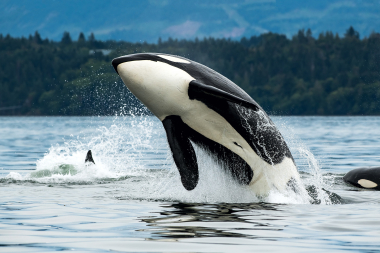
Southern Resident Orca
- Southern Resident orcas have unique black and white markings and dorsal fins that can be used to identify individuals. The first thing you are likely to see when sighting orcas is their dorsal fin. Male orcas have a pointed dorsal fin that can be six feet in height, while juveniles and females have shorter, more curved fins. These large fins can be seen from quite a distance.
- Southern Resident orcas can grow up to 32 feet in length and weigh up to approximately 11 tons. They exhibit sexual dimorphism, with males larger than females.
- Males can live up to 70 years and females for 90 years, although the average is 17 years for males and 29 years for females. Reproduction is somewhat delayed as females usually produce their first calf between 12 and 17 years of age and males reach maturity between 11 and 15 years of age.
- Southern resident orcas live in three pods, each consisting of four to seven family groups led by the oldest female member ("matrilines").
- Vocalizations are critical for communication between individuals, maintaining social bonds, navigation, and foraging.
- Listed as endangered under the federal and Oregon Endangered Species Act, two of the three Southern Resident pods (48 orcas) use Oregon waters.
- The Oregon Coast provides important habitat for Southern Resident orcas. Of the 1,159 km2 identified as habitat, approximately 20 percent of the area is important for foraging. Southern Resident orcas need sufficient quantity and quality of prey, which is primarily salmon. The remaining 80 percent of Oregon's habitat is used as a travel corridor between feeding areas.
- Seeing orcas off the Oregon coast is a rare treat, but whale watchers can usually count on a pod of orcas travelling along the coast in mid-April. The Oregon State Park's Whale Watch Center receives reports of orca sightings each year, most of which are Bigg's orcas that feed on marine mammals. Orcas are most often seen in the ocean off Depoe Bay and Newport but can be spotted coastwide. To catch sight of Oregon's orcas is just like spotting any whale - you need patience and a high vantage point. The Newport area has many of these, such as the lighthouse at Yaquina Bay, the Yaquina Head area, Don Davis Memorial Park in Nye Beach and nearby at Cape Foulweather. The headquarters for the Whale Watch Spoken Here program is at the seawall in Depoe Bay and is another good place to spot orcas.
- The Southern Resident orca is a species of greatest conservation need in Oregon's ocean, and proactive conservation efforts can help prevent their populations from declining further. Threats to this species include prey availability, sound and vessel disturbance, environmental contaminants, and small population size. Oregonians can help the Southern Residents by using environmentally friendly products, participating in beach clean-ups, and volunteering to help with salmon habitat improvement projects.
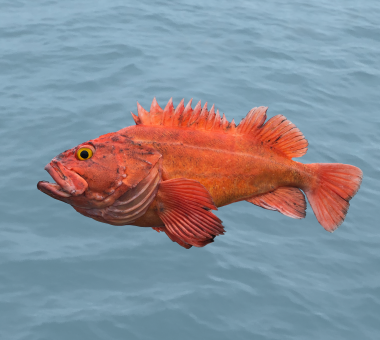
Yelloweye Rockfish
- Yelloweye rockfish have red-orange to orange-brown bodies and, as the name suggests, bright yellow eyes. Juveniles have two white stripes that run the length of their body.
- Growing up to 36 inches long and weighing up to 27.8 pounds, yelloweye rockfish are one of the largest rockfish species off Oregon.
- Records show catch of this species going back to the late 19th century, with the highest catches from the late 1970s to the late 1990s. In 2002, yelloweye rockfish were declared overfished and retention prohibited. Reducing the effects of bycatch (unwanted fish caught while fishing for another species) on this species by using descending devices to release them is one way to further reduce impacts on this species. While recovery has been slow, fishery conservation measures have been effective and the population is growing.
- Living up to 147 years, they are a long-lived species. Roughly half reach maturity by about 20 years. Like all rockfish, larvae are released from their mother's body live and fully formed.
- Females release their larvae from February to September. Little is known about their pelagic (open ocean) juvenile stage, but when they are one to four inches long, they settle to the bottom in high-relief rocky habitat.
- Rocky reefs with high relief, kelp forests, and seamounts (large rocks that extend from the ocean floor to above the waves) provide important habitat and protection to young rockfish as they grow into maturity. Oregon's Marine Reserves protect areas along the coast that provide this habitat and serve as research sites. Want to get involved? Learn more about hook-and-line volunteer opportunities within the Marine Reserves.
- Yelloweye rockfish is a species of greatest conservation need in Oregon's ocean waters, and proactive conservation efforts are in place to prevent their populations from declining further. While overfishing has not occurred since 2002, yelloweye rockfish populations are impacted by changing ocean environmental conditions. Changes in ocean temperature, food supply and upwelling intensity can impact their reproductive success.
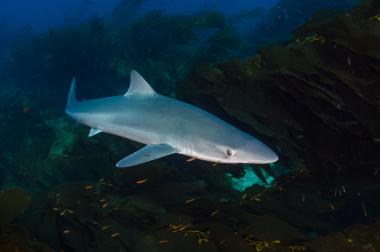
Tope Shark
- Tope shark, also known as soupfin shark, have slender bodies, long snouts, a small second dorsal fin, and a large lobe on the upper part of their caudal fin. They are bluish or gray on the back and sides and white on the underside. Their habitat includes surf to offshore waters as deep as 1,500 ft.
- They can grow up to six feet five inches, weigh up to 100 pounds, and live up to 60 years.
- They mature slowly, with females reaching maturity from 10 to 15 years old and males 12 to 17 years old. They pup in early summer every one to three years and give birth to live young, ranging from 6 to 52 pups.
- Tope shark offspring called pups are born after a year of gestation in their mother's body.
- Tope shark exhibit a triennial migratory and reproductive pattern (a migratory pattern where they return to the same location every three years to reproduce) off Oregon, migrating great distances. They are known to form large schools of up to 50 animals.
- Oregon banned the practice of shark finning (taking the fin of a shark and then releasing the shark to die) in 2012, and the sale of shark fins harvested elsewhere is illegal in Oregon.
- The International Union for Conservation of Nature (IUCN) has listed Tope shark as critically endangered across its range, and it is a candidate for listing under the federal Endangered Species Act.
- The Tope shark is a species of greatest conservation need in Oregon's ocean, and proactive conservation efforts can help prevent their populations from declining further. Tope sharks are vulnerable to overfishing due to slow growth rates, long lives, low productivity and long gestation time. They have been targeted for their liver oil, meat, and fins in the past, but are currently not the target of any recreational or commercial fisheries off Oregon.
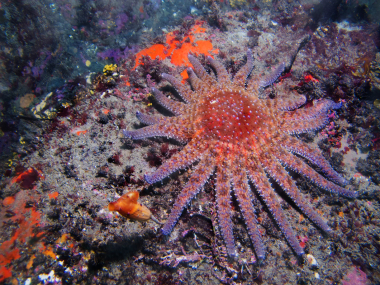
Sunflower Sea Star
- Sunflower sea stars are among the largest sea stars in the world, with a typical ray (arm) length of 15 inches and a maximum span (diameter) of 31 to 40 inches. Adults usually have 16 to 24 rays and a soft body that can vary in color from purple or reddish-orange, to yellow, violet-brown, or slate-blue.
- They generally inhabit low intertidal and subtidal areas, those areas of the shore which are covered at high tide but uncovered during low and extreme low tides, down to a depth of around 1,400 ft. Most individuals, however, occur at depths less than 400 ft. Sunflower sea stars occupy a diversity of habitats, including tidepools and rocky beaches, eelgrass beds, mud, sand, gravel, boulders, and bedrock.
- Sunflower sea stars feed upon a variety of prey items, including sea urchins, sand dollars, sea cucumbers, other sea stars, crab, barnacles, clams, mussels, abalone, snails, chitons, dead or dying squid, fishes, sponges, and other small invertebrates. They are ecosystem engineers that regulate the structure of their underwater communities, primarily through predation upon sea urchins that eat kelp.
- Sunflower sea star larvae can remain in the water column and travel in ocean currents for 2 to 10 weeks. Juveniles begin life on the ocean floor with 5 rays and grow additional rays as they mature. The lifespan of most sunflower sea stars is estimated at 3 to 5 years, and during that period they are preyed upon by sea gulls, fish, crab, and other sea stars.
- Populations of sunflower sea stars (and many other species of sea stars) were decimated throughout their range by sea star wasting syndrome which is a contagious condition that results in body lesions, tissue decay, rapid disintegration, and death. Sea stars along much of the North American Pacific Coast experienced massive mortality from 2013 to 2015 due to this syndrome, and the die-off has persisted at low levels up to the present.
- Sunflower sea star largely disappeared from marine waters off the coast of Oregon from 2014 to 2020, however, numerous small juveniles have been observed in intertidal and shallow subtidal areas starting in 2023. Want to be part of the effort to track intertidal species? Learn more about intertidal survey volunteer opportunities within the Marine Reserves.
- The sunflower sea star is a species of greatest conservation need in Oregon's ocean, and proactive conservation efforts can help prevent their populations from declining further. They are impacted by many factors, including sea star wasting syndrome, low densities which make reproductive success less likely, and availability or prey. Protecting sea stars from harvest by humans starting in March of 2022 is one way that action was taken to preserve populations.
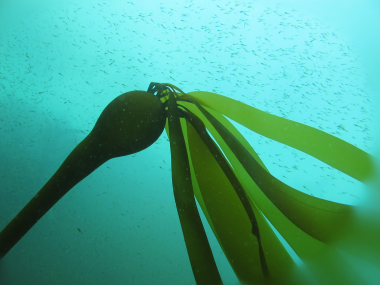
Bull Kelp
- Bull kelp is a brown alga that can grow to about 115 feet tall. A tough root-like structure, called a holdfast, anchors it to the rocky bottom. The long, hollow stem, called a stipe, grows up towards the surface and is buoyed by a single large air bladder bulb, known as a pneumatocyst, from which 30 to 60 leaf-like blades grow.
- Bull kelp absorbs dissolved carbon dioxide, nutrients and water directly from seawater through its blades, unlike plants with true roots that absorb water and nutrients from the soil through their roots. Similar to true plants, bull kelp produces its own food by photosynthesis.
- Bull kelp grows in relatively shallow waters, 10 to 60 feet deep, that have a rocky bottom and often grow in dense patches called kelp forests or kelp beds.
- Bull kelp form spores on patches of their blades called sori. These sori form near the base of the blades and become more mature as they grow further away from the base. The sori fall away from the blade as they release spores. When ready, an average of 1.5 million spores per square inch of sori is released per minute!
- The spores have two whiplike tails, called flagella, that allow them to move. Spores may settle close to the large kelp soon after being released, helping ensure kelp beds appear in the same places the following year, or they may drift with currents and settle elsewhere to establish new kelp beds.
- Bull kelp is an annual alga, living just one year, growing quickly up toward the surface in spring and becoming visible at the surface in Oregon around July. Bull kelp can grow up to 10 inches in one day! Bull kelp drops spores in late summer and fall and are usually torn from the bottom by fall and winter storms, but some individuals survive winter and are visible outside of their growing season.
- Bull kelp are known as a foundation species, which are species that create a habitat that supports other species. Kelp forests slow down the speed of the current and create shelter for many creatures.
- Bull kelp that have been ripped from the ocean floor form into rafts that float on the ocean's surface and provide habitat in open water for many creatures.
- Bull kelp's role in providing habitat, food, and stabilizing coastlines make it a species of greatest conservation need in Oregon's ocean, and proactive conservation efforts can help prevent their populations from declining further.
- Bull kelp are impacted by many factors, including a loss of predators to control populations of kelp grazers (e.g., sea urchins), changing ocean conditions, increased sediment deposits from watersheds that can smother young kelp, and pollution from runoff.
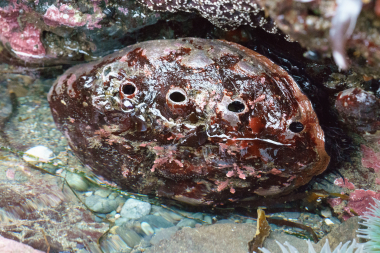
Red Abalone
- Red abalone are large marine snails with an oval shell which is typically dull brick-red and may be covered by barnacles, sponges or other marine organisms that grow on surfaces. There are also three to four raised oval holes on their shell which they breathe through.
- The flesh that you see is called the epipodium. It is black and has several tentacles that allow the abalone to sense its environment.
- The interior surface of a red abalone shell is strongly iridescent with wavey bands of turquoise, greenish-blue, and pink.
- Red abalone live in areas with rocky shores that also support kelp, where they live on or under rocks and in deep crevices. Their depth range extends from the low intertidal zone (that area covered by the tide until low tide) to depths of 590 feet, however, most individuals occur between 20 to 130 feet. In Oregon, they extend from the California border to Coos Bay, with a few reported in Depoe Bay.
- With shells that can reach a length of 12 inches, red abalone is the largest abalone in the world and grows to its largest sizes in Oregon.
- Red abalone have separate sexes and they broadcast their gametes freely into the surrounding seawater when they spawn. The amount of eggs a female releases increases with a larger body size. For example, a small female can release 2,400 eggs per year while a larger female may release 3 to 4 million eggs per year.
- Fertilized eggs develop into embryos and then free-swimming larvae that receive its nourishment from a yolk, allowing it to be non-feeding during this phase. The larvae remain in the water column for about 1 to 3 weeks before settling.
- Red abalone were the targets of a commercial fishery in Oregon for a short time from 1958 to 1962, and the recreational fishery was active over the 1950's to 2018 when it was closed.
- Red abalone are herbivores that feed on algae, their preference in Oregon being bull kelp. They also eat other types of algae and their shell color can differ based on the color of algae they eat. Recent shifts in ocean conditions and declines in the abundance of kelp over the past decade have contributed to the reduction of red abalone along Oregon's rocky shores.
- The red abalone is a species of greatest conservation need in Oregon, and proactive conservation efforts can help prevent their populations from declining further. Red abalone are impacted by loss of food supply, illegal harvest, changing ocean conditions, and sufficient density for successful broadcast spawning.
Learn more about each of these unique species and some of the threats they face below.


Western snowy plover
- The western snowy plover is a small shorebird that is a resident of sandy beaches, salt ponds, and alkaline lakes. These small sand-colored birds often go unnoticed as they feed along sandy beaches or lakeshores.
- Oregon's coastal dunes are the largest coastal dunes in North America with some dunes reaching 500 ft above sea level and are home to the western snowy plover.
- Western snowy plovers are tiny birds that are smaller in size than a robin. Snowy plover chicks are so small that they are roughly the size of a human's thumb when they hatch, looking like tiny fluffy marshmallows on toothpicks.
- Oregon has two breeding populations of western snowy plover: the threatened population that breeds in coastal dunes, and the interior population, which can be found nesting south central Oregon in places like Summer Lake or Lake Abert.
- The coastal population of western snowy plover is listed as threatened under the federal Endangered Species Act, and there are around 500 birds remaining in coastal Oregon.
- Western snowy plovers make their nests directly in the sand, where their eggs are well camouflaged and protected from predators. This often makes them barely visible to even a well-trained eye.
- Western snowy plovers are an indicator species for the coastal dune ecosystem. An indicator species is a plant or animal group that provides information about the health and condition of an ecosystem through their population's presence, size and abundance.
- The western snowy plover is a species of greatest conservation need in Oregon, and proactive conservation efforts can help prevent their populations from declining further. Western snowy plover populations are threatened by factors including habitat loss, the introduction of invasive beachgrass, human disturbance, and climate change.

Sierra Nevada red fox
- The Sierra Nevada red fox is a montane (high elevation mountain-living) subspecies of red fox that is adapted to cold, snowy environments.
- The Sierra Nevada red fox has different physical traits (adaptations) than other foxes to make it capable of living at higher elevations. For example, they have furrier paws that act like snowshoes, have a thick coat to keep them warm, and are smaller-bodied than other subspecies which makes it easier for the Sierra Nevada red fox to walk on top of snow to navigate and find food in winter.
- Sierra Nevada red foxes are limited to high elevation habitat along the crest of the Cascades. This explains why sightings of the Sierra Nevada red fox are most reported to us when people are out recreating (i.e., skiing, backpacking, hiking). We receive a lot of sightings at ski resorts and locations like Mt. Hood Meadows, Hoodoo Ski Area, Timberline, and Mt. Bachelor. Sierra Nevada red fox are also known to live in Crater Lake National Park.
- Although their name says ‘red fox' they come in a variety of color variations (known as morphs) – traditional red, black/silver, and a mix of red with dark brown or black markings called a "cross phase." Sierra Nevada red fox in Oregon are often black and silver, looking almost wolf-like in appearance.
- One of the biggest threats Sierra Nevada red fox face is climate change. Decreasing snowpack makes it easier for other animals to enter the areas that were normally only accessible to Sierra Nevada red fox, forcing them to compete for food sources and often becoming meals for other predators.
- The southern Cascades population of Sierra Nevada red fox has been petitioned for listing under the federal Endangered Species Act.
- The Sierra Nevada red fox is a species of greatest conservation need in Oregon, and proactive conservation efforts can help prevent their populations from declining further. Threats to the species in Oregon include climate change, habitat loss and fragmentation, increasing wildfire severity and frequency, and increased vulnerability to impacts due to their small population size.

Northern red-legged frog
- The northern red-legged frog is a medium size frog with bright red legs found in a variety of aquatic habitats in western Oregon.
- Growing up to four inches in length (not including the legs) northern red-legged frogs are the largest frog species native to Oregon. American bullfrogs are larger (growing up to eight inches!) but are not native to Oregon. On average, female northern red-legged frogs are about 4 inches in length, which is the same as the average width of a person's hand. Males are smaller than females, averaging only about 2-2.5 inches in length.
- Northern red-legged frogs can travel up to 3 miles between their summer and winter habitats. That's quite a feat for a frog that's only a few inches long!
- Northern red-legged frogs can live more than 10 years. Limited information describing the species is available, and more research is needed to better understand their average lifespan as well as other basic life history traits.
- When mating, northern red-legged frogs exclusively make their mating calls or vocalizations underwater to attract their mating partner.
- Red-legged frogs breed in the winter. Their biggest breeding season occurs January - March. The breeding season is a dangerous time for northern red-legged frogs as they often must cross roads to get to their breeding ponds. In some areas around Portland where northern red-legged frogs are still found, volunteers work to help shuttle breeding frogs on their way to and from breeding ponds to help them cross dangerous busy highways and railroad tracks.
- Get involved and learn more about the Harborton Frog Shuttle.
- Completed in 2024, Palensky Wildlife Crossing is the first of its kind in the state, specifically built as an amphibian underpass for northern red-legged frogs to combat some of the threats they face traveling across the landscape.
- Northern red-legged frogs are visual hunters. Once they locate prey, they use their large, sticky tongue to capture a wide variety of invertebrates (an animal without a backbone). Large adults may eat smaller frogs or salamanders, while the tadpoles feed on algae.
- Northern red-legged frogs are impacted by many factors including climate change's impact on their ecosystems, increased pollution in the environment, invasive species like bullfrogs that prey upon adult red-legged frogs, their tadpoles, and their eggs, and lack of safe passage to and from their breeding areas.
- The northern red-legged frog is species of greatest conservation need in Oregon, and proactive conservation efforts can help prevent their populations from declining further.

Pygmy rabbit
- The pygmy rabbit is the smallest species of rabbit in North America and lives in sagebrush habitats in eastern Oregon.
- Weighing in at only 12 ounces fully grown, pygmy rabbits are tiny animals - they are roughly the size of a mango or a can of soda.
- An easy way to distinguish a pygmy rabbit from a cottontail rabbit (that is a very common species to encounter) is that pygmy rabbits do not have white on their tail. Their small size, short ears, and small hind legs are also distinguishing features.
- Pygmy rabbits are the only North American rabbit that dig their own burrows. These complex burrow structures can have as many as 15 different openings. They use burrows to give birth and nurse their babies, warm up during winter, cool down during hot summer temperatures, and hide from predators. They can also dig burrows in the snow (some of the areas where they live get a lot of snow).
- Pygmy rabbits have a lifespan of 1-3 years.
- Pygmy rabbits only breed in the springtime.
- Sagebrush makes up almost the entire diet for pygmy rabbits in winter months. They are a sagebrush obligate, which means they require sagebrush to survive.
- Pygmy rabbits are known to climb sagebrush, especially when foraging for food. They are one of the only rabbit species that can do this. They will climb sagebrush to reach and eat its green leaves.
- The pygmy rabbit is a species of greatest conservation need in Oregon, and proactive conservation efforts can help prevent their populations from declining further. Pygmy rabbits face many threats, including habitat loss and fragmentation, development, invasive species, disease, and wildfire. Their specific habitat requirements, including sagebrush and the soil conditions that allow them to burrow, limit where they can live.

Northwestern pond turtle
- The northwestern pond turtle is one of Oregon's two native turtle species and is closely associated with aquatic habitats.
- The oldest living northwestern pond turtle known is more than 60 years old. We don't know how old they can truly live, but there are long term studies that are underway to help biologists better understand their lifespans.
- Northwestern pond turtles have unique markings on the top (carapace) and bottom (plastron) of their shell that can be used like a fingerprint. Biologists can identify individual turtles by these unique patterns.
- Northwestern pond turtles are known from both sides of the Cascades, though they are primarily found west of the Cascade Mountains in Oregon, with the largest populations in the drainages of the Willamette, Umpqua, Rogue, and Klamath Rivers.
- Some northwestern pond turtles spend months underwater hibernating over winter. When they hibernate like this, they are capable of not eating or coming up to breathe air for months. They can survive long periods of time underwater by absorbing the oxygen that they need through their skin.
- Turtles need to be in the water to swallow their food.
- As hatchlings, northwestern pond turtles are only about the size of a silver dollar. Their small size makes them vulnerable to being eaten by non-native predators like bullfrogs.
- The northwestern pond turtle is a species of greatest conservation need in Oregon, and proactive conservation efforts can help prevent their populations from declining further. Northwestern pond turtles are negatively impacted by threats including the illegal pet trade and trafficking, invasive species (i.e., bullfrogs, red-eared slider turtles, snapping turtles), and habitat loss and degradation.
- The northwestern pond turtle is proposed threatened by the federal government under the federal Endangered Species Act.

Townsend's big-eared bat
- The Townsend's big eared bat is one of Oregon's 15 native bat species, a social species that is most recognizable by their long ears.
- Townsend's big-eared bat can be identified by their big, long ears that are joined at the base and a short snout with two large, fleshy glands on each side. The color of their fur is highly variable and can range from pale cinnamon brown to slate gray to dark brown.
- Adults are 3 to 4.5 inches in length, with a wingspan of 12 inches. They weigh 5 to 13 grams.
- The average lifespan is 4 to 10 years. The oldest known Townsend's big-eared bat lived to be over 21 years old!
- Females give birth to a single pup (baby bat), usually in June to July. Pups are born with closed eyes and no fur, though they develop quickly. The pups can fly after only three weeks and may continue nursing for up to two months. Each pup makes a unique call that its mother recognizes.
- Townsend's big-eared bats are nimble when flying and use their enormous ears to detect prey and help navigate using echolocation. They have large wings in comparison to their body size, allowing them to skillfully maneuver through the air, even hovering during flight!
- They hibernate in large, open areas in mines, caves, and protected areas. While hibernating or roosting, they curl their ears down and back, giving them the characteristic look of ram's horns.
- Townsend's big-eared bats are insectivores (they eat insects) and are moth specialists - they eat mostly moths! They are effective at helping to control moth populations and can help limit environmental and agricultural damage from insects.
- Townsend's big-eared bat is a species of greatest conservation need in Oregon, and proactive conservation efforts can help prevent their populations from declining further. Threats impacting the populations of Townsend's big-eared bat in Oregon include human disturbance, declining populations of insect prey, and vandalism at caves and other roost sites.

Oregon slender salamander
- The Oregon slender salamander is a small terrestrial salamander species found on the west slope of the Oregon Cascades. At first glance, they can be described as worm-like in appearance. They are deep brown to black in color overall, have a long, thin body, and a long tail.
- The Oregon slender salamander is endemic to (only found in) Oregon.
- The number of toes on their hind foot (four) and the characteristic large blueish-white blotches on their sides and belly differentiate Oregon slender salamanders from all other salamander species in Oregon.
- The Oregon slender salamander is small and doesn't move far during its lifetime. Adults average 3.5 to 4.5 inches in length from nose to tail.
- Oregon slender salamanders may be found in younger moist forests where large logs and downed woody debris is available. They typically are found in forested areas, but some individuals have been found in suburban landscapes around Portland.
- They have long tails, which can be 1 to 1.75 times their body length! Individuals are often found with broken or missing tails. It is possible that they lose their tails in order to escape predation. When disturbed, Oregon slender salamanders may coil and uncoil their body rapidly to flip, launching their body dramatically. This behavior is thought to help prevent predation.
- For many years, Oregon slender salamanders were thought only to occur in mature forests in the Cascades. Recently, small remnant populations have been located in suburban areas, even in Forest Park in Portland! Since individual Oregon slender salamanders do not disperse far, it is thought that these remnant populations may have persisted in these small pockets of suitable habitat as the city and suburban areas developed around them.
- The Oregon slender salamander is a species of greatest conservation need in Oregon, and proactive conservation efforts can help prevent their populations from declining further. This salamander is one of the least studied species in the Pacific Northwest, and their life history is poorly described. Learning more about this unique Oregon species can help ensure it is protected.
Learn about the State Wildlife Action Plan (SWAP)
Discover more about the management efforts to conserve these species in ODFW’s SWAP. The SWAP is a plan developed in collaboration with federal, state, and private partners to guide conservation efforts for wildlife.

Check out the Latest Recreation Report
Current conditions and opportunities to fish, hunt and see wildlife. Updated weekly by fish and wildlife biologists throughout the state.