

Shellfish toxins and harvest safety
Razor clams, bay clams, mussels and oysters are filter feeders. They feed on microscopic plants called phytoplankton that naturally occur in ocean and coastal waters.
Some types of phytoplankton produce natural toxins. When shellfish feed on these organisms, the toxins are stored in their flesh, yet the shellfish is not affected. But people who eat contaminated shellfish can become seriously ill.
Always call the ODA Shellfish Safety Hotline at 1-800-448-2474 before you harvest shellfish or check the Recreational Shellfish Biotoxin Closures web page.
Myth busting common beliefs about shellfish toxins
If you harvest shellfish in a month that has the letter "r," it's always safe to eat.
False! Biotoxin accumulations can occur year-round!
A "red tide" means it's not safe to eat shellfish.
False! In fact, "red tides" on the PNW coast are not associated with toxins at all. The myth that red tides are toxic came about because toxic blooms – mostly grey or light brown in color – can happen while there is a ‘red tide.' To confuse the matter, non-toxic blooms can also be grey or light brown in color and toxic blooms can sometimes happen when ocean waters have no color. Better to check the safety hotline than the color of the tide.
Cooking, freezing or canning shellfish kills the toxins.
False! Toxins remain in the shellfish meat after cooking or freezing.
Specific races are immune to shellfish biotoxins.
False! Every person and every warm-blooded animal can get sick from eating toxic shellfish.
In 2024 along the Oregon Coast, over 42 people were sickened and some hospitalized after eating mussels contaminated with paralytic shellfish toxin when the season was open.
True! The toxins developed so quickly the contamination out-paced increased shellfish testing. The commercial oyster harvest and the entire Oregon Coast was shut down for harvest of nearly all shellfish for a period of time.
How shellfish become toxic
Phytoplankton can rapidly grow into "blooms" when conditions are just right (sunlight, abundant nutrients, and warmer surface water.) Some blooms can become toxic and are called Harmful Algal Blooms (HAB).
During a bloom, shellfish may consume large amounts of toxin-producing phytoplankton. When people or warm-blooded animals eat contaminated shellfish, the toxins can affect the digestive system, nervous system, or both.
How shellfish shed the toxins
How slow or fast biotoxins can leave the contaminated shellfish (depuration rates) depends on the biotoxin and level of contamination, the species of shellfish and its age, and time of year.
Razor clams tend to accumulate more domoic acid and retain it longer than bay clams and mussels. Depuration rates depend on the size of the clam. Toxicity in young clams can be reduced with clam growth - juveniles grow rapidly, increasing their body mass while body mass of older clams increases slowly and it takes longer to reduce the toxin level.
Mussels can accumulate paralytic shellfish toxins very fast and to very high levels. They also tend to reduce toxin loads in their tissues much faster than other species that may be impacted.
Crab can accumulate toxins from consuming contaminated mussels or clams. Depending on how contaminated the mussels or clams they eat are and how much they eat determines the amount of accumulation they will have. Since toxin in crab is mostly in the gut (butter), once they stop eating contaminated shellfish, toxin loads can reduce fairly fast.
Types of Shellfish Toxins
Shellfish on the West Coast can be contaminated with domoic acid (DA) and paralytic shellfish toxin (PST). DA causes amnesiac shellfish poisoning (ASP), which is produced by naturally occurring diatoms called Pseudo-nitzchia. PST causes paralytic shellfish poisoning (PSP), produced by the dinoflagellate Alexandrium these saxitoxins affect the nervous system.
Domoic acid
DA can accumulate in the flesh of all shellfish species on the Oregon Coast including Dungeness crab. High levels of DA can produce ASP.
ASP Symptoms usually appear 24–48 hours after eating contaminated shellfish and may include:
• Nausea
• Vomiting
• Diarrhea
• Abdominal cramps
• Headache
• Dizziness
• Confusion
• Short-term memory loss
• Death in severe cases
Paralytic shellfish toxin
PST can occur in mussels, razor clams, bay clams, oysters, crab, and scallops, and produces PSP. Symptoms can appear within hours of eating contaminated shellfish and may include:
• Tingling or numbness
• Loss of coordination
• Disorientation
• Paralysis
• Death in severe cases
Testing shellfish for biotoxins and Safety Closures
The Oregon Department of Agriculture (ODA) tests shellfish for biotoxins every two weeks as tides and weather permit. ODA is responsible for meeting nationally recognized standards for shellfish safety.
Testing focuses on domoic acid and paralytic shellfish toxins.
Since 2005, ODFW has been sampling ocean shore water for the presence of HABs along the Oregon coast. In 2025, the Oregon Legislature provided state funding from the recreational shellfish license that created a larger monitoring project that helps provide an early warning system so shellfish managers know in advance if the threat of a biotoxin closure is possible. This new project, monitoring Oregon coastal harmful algae (MOCHA) is working with state, federal, academic, non-profit and tribal partners.
Shellfish harvest closures
Harvest areas are closed when toxin levels exceed safety thresholds:
Domoic acid: 20 parts per million (ppm)
Paralytic shellfish toxin: 80 micrograms per 100 grams of tissue
These limits give a margin of safety and prevent illness before toxin levels become dangerous. In areas where harvesting is closed, it takes two consecutive tests showing toxins are below the closure limit to reopen the area to harvest.
Check before you dig!
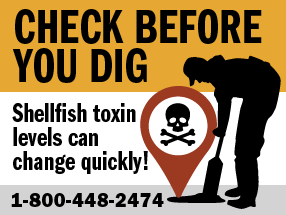
Shellfish toxin levels can change quickly – DA levels in razor clams can double in less than five days; PST in mussels have increased by a factor of 70 in 4 days.
Call the ODA Shellfish Safety Hotline: 1-800-448-2474 or check the Recreational Shellfish Biotoxin Closures web page.
Header photo by ConwaySuz, Flickr

Check out the current Recreation Report
Current conditions and opportunities to crab and clam. Updated weekly by shellfish biologists.