
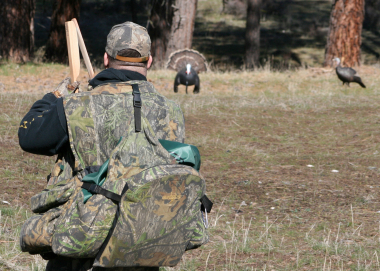
Turkey Hunter's Resources
Hunter's Technique Hunter's Bounty Hunter's Plan Hunter's Guide
"Gobble" up some new skills every spring!
Register to attend a turkey hunting workshop or clinic --> ODFW education offers wild turkey hunting workshops designed for adults and youth turkey clinics before the season starts.
ODFW Hunt by reservation program can also offer an opportunity to reduce turkey damage closer to home - View details here
Adult skills classes and workshops are offered year-round throughout Oregon--Seasonal Schedule
More information on Hunting opportunities for youth
Receive Workshops & Events Updates by E-mail
Choosing your firearm or bow:
To find the right tool for the hunt, first, clearly understand what you need to achieve a successful harvest. Assess the hunt's scale, unique challenges, and environmental considerations to determine the necessary capabilities of the tool.
- Quality and Durability: Choose a tool made from high-quality materials that can withstand the intended use and conditions.
- Ergonomics and Comfort: Select a tool designed for comfort and ease of use, consider eye dominance, fit and good balance.
- Safety Features: Prioritize tools with built-in safety mechanisms.
- Compatibility: Make sure the tool is compatible with the species you intend to hunt.
Go to a local range--Several ranges offer rentals, try before you buy
Practice
- Check out several opportunities for pre-season mentored hunts or take a skills class to become a more confident and successful hunter.
- Make time in the pre-season to warm up and get into shape.
Shotgun selection and ammunition
When choosing a shotgun for turkey hunting, choose a gun that's comfortable to shoot and one that you have confidence in. Check Game Bird regulations for turkey specific weapon and non-lead ammunition restrictions.
The most important features include:
Action choice
- Pump
- Semi-auto
- Break
Gauge
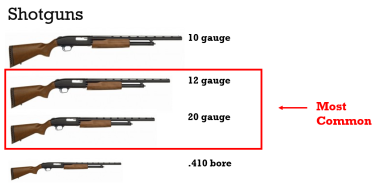
Legal for turkey hunting Barrel length - try different lengths for best fit and mount.
Sights - two popular kinds of sights to help you acquire your target and shoot accurately:
- A fiber optic sight is brighter than a metal bead, making it easier to locate the sight and line it up with the head of a turkey.
- A red dot sight contains an illuminated dot inside a sight housing. In Oregon, a battery-operated sight or scope is legal on a shotgun as long as it doesn't project a beam onto the target.
Consider: Weight, Color, Sling and Cost
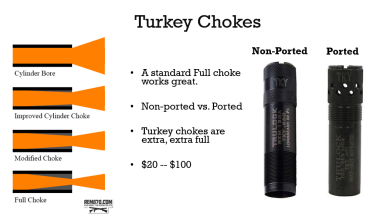
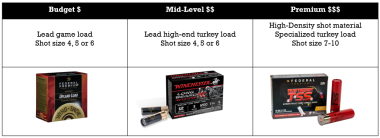
Ammunition: Pick based on budget, your gun/choke combination and hunt area.
Bows, arrows and accessories
The modern compound bow is the most popular choice for turkey hunting, but traditional recurve and longbows are still being used. Hunting with crossbows is illegal in Oregon.
If you already have a bow you use for deer or elk hunting, it will also work for turkey. Many turkey hunters, though, like to reduce the draw weight of their deer/elk hunting bow to 45 pounds or less for turkey. Unlike deer and elk hunting, where you're usually standing or kneeling when you take a shot, you're likely to be sitting when shooting a turkey. In this case, a lighter draw weight may be easier to handle.
A recurve bow, often called a traditional bow, does not require much strength from the shooter. They are simple to shoot and have few working parts – bow limbs, string, arrow rest and riser.
A longbow is the most challenging kind of bow to shoot. These long bows can be almost as tall as the hunter, making them difficult to shoot from a blind. They lack arrow rests and sights, making accuracy tough to master. And they don't have the arrow speed of a compound or recurve bow.
Selecting a compound bow
Modern compound bows come in a variety of sizes and configurations, so it's important to find one that fits you properly. Visit a local archery pro shop or specialty sporting goods store, the experts at these stores will help you select the best bow for you based on the following:
- Eye dominance – selecting a left- or right-hand bow will depend on which is your dominant eye.
- Draw length -- the distance between the bowstring when at rest and at full draw.
- Draw weight -- the amount of weight you feel while pulling the string of the bow into shooting position. Your optimum draw weight will depend on your size and strength. Draw weight and draw length will determine how fast an arrow will travel.
- Let off – is the small percentage of the draw weight that you'll need to hold the bow at full draw longer and with less fatigue.
- Brace height -- the distance from the bowstring to the grip when at rest. A shorter brace height can mean a faster arrow but can be more difficult to master. New or beginning archers will benefit from a longer, more forgiving brace height.
Arrows and broadheads
There are many options when it comes to choosing arrows and broadheads for turkey hunting. If you already hunt big game, you can use the same arrow shafts for hunting turkey.
If you're new to bowhunting and buying arrows for the first time, select an arrow shaft made of a lightweight, fast-moving material like carbon fiber. An arrow that weighs about 6 to 8 grains per pound of draw weight (on a compound bow) is a good guideline. This will maximize kinetic energy, accuracy and penetration.
Three styles of broadheads popular with turkey hunters:
- Expandable, or mechanical, broadheads. These are the most accurate because the blades are tucked tight to the arrow shaft, decreasing air resistance and drag. Upon impact, expandable broadheads open up, creating a large cutting area and resulting in consistently lethal shots.
- Fixed broadheads. The same broadheads used in big game hunting can be used for turkey. The cutting surfaces on fixed broadheads are not as large as those of expandable broadheads. However, fixed blade broadheads are more durability if your arrow hits the shoulder or thigh bone of a turkey.
- Guillotine-style broadheads. With cutting diameters up to four inches, these broadheads are designed to shoot a turkey in the head and neck. This can result in a quick, clean kill – if you connect.
However, the long blades of guillotine broadheads can get caught up in twigs, branches and fingers. And by aiming for the turkey's head, you're picking the smallest available target. These wide-cutting broadheads will not penetrate the body of a turkey.
Whatever broadhead you choose, be sure to practice before the hunt. Designate a practice broadhead so you'll know exactly how it flies and expands the point of impact. The best broadhead for hunting will be the one you can shoot most accurately.
Top accessory tips for the bow hunter
- Rangefinder--turkeys have such a small kill zone, that knowing the exact distance to your target can be critical.
- Camouflage gloves or paint for your hands and fingers can be easy to overlook. Successful turkey hunters go to a lot of trouble to conceal themselves from a keen-eyed turkey – don't let a bare bow hand give you away.

Check out the Recreation Report
Current conditions and opportunities to hunt, fish and see wildlife. Updated weekly by fish and wildlife biologists throughout the state.