
Turkey Hunter's Technique
Hunter's Bounty Hunter's Plan Hunter's Guide Hunter's Resources
The goal in using key elements to spot the bird before it spots you include moving slowly and quietly, maintaining situational awareness, being patient and approaching your hunt area undetected.
Locating turkeys
You can also pinpoint a turkey's location by using a locator call -- an owl, crow or quick whistle or clap -- to elicit a return gobble from a tom. You're not trying to call a bird to you, you're just trying to locate a bird by getting a turkey to gobble back at you. Use the population data and harvest statistic reports when picking hunt units and areas to hunt. View report
Setting up to hunt
Be in place before daylight, select your designated spot and setup at least one hour before legal shooting time. If you're hunting from a ground blind, try to set it up the night before to quietly sneak in and be ready. You'll want to be in place and set up before daylight to avoid spooking the flock.
Stealth
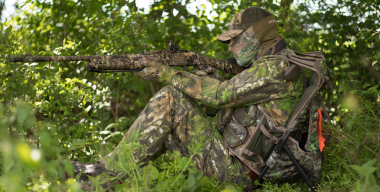
If you accidentally make some noise while getting to your location and setting up, settle into your spot quickly and sit silently. Even if you haven't made noise, letting an area settle down is a good rule. You want to get to your hunting site without being seen by a turkey. Move while it's still dark, avoid crossing open areas and use available cover to hide your movement.
Strategy
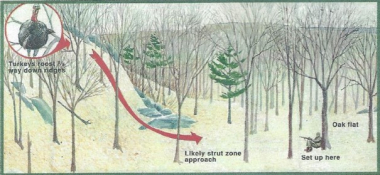
If you're hunting with a shotgun, be sure and set up at the base of a tree that's wider than your shoulders – this will help hide your silhouette. Pick a spot where a turkey has a clear approach lane to your location. Arrange your calls beside you for easy access. A thick seat cushion will help for longer wait times.
If you're hunting from a ground blind, you'll also position it where a turkey has a clear approach lane.
Turkeys like traveling along the path of least resistance, so setting up near trails, around openings with few impediments, or even near fields or meadows, will increase the chances a turkey approaches your calling site. Adding a decoy will also motivate a tom to cover some ground.
If it's windy, set up with the wind at your back so the wind can carry your calls toward the turkey. Turkeys are not sensitive to smell.
Effective and Ethical turkey hunting
Shooting distance
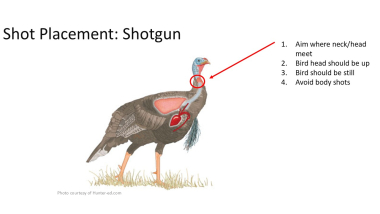
The ideal pattern for turkey hunting is 100 pellets in a 10-inch circle at 40 yards. This density means that there should be plenty of pellets in the small vital area of the turkey's head and neck to kill it ethically. Practice ahead to know your maximum effective range.
Beyond 40 yards, shotgun pellets may not penetrate and only injure the bird. Inside 20 yards and a shot to the body will ruin too much meat from pellet damage.
A good combination of:
Influenced by:
Shotgun
Shot Size
Choke
Shot Material
Ammunition
Speed
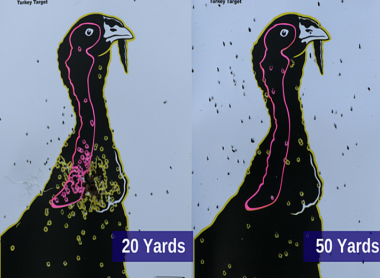
Shotgun hunters should take turkeys with a head and neck shot for a quick, clean kill.
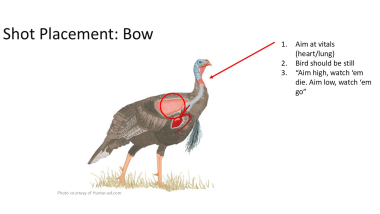
Bowhunters should aim for the body in order to hit vital internal organs. Bow hunters will often wait until a bird has come to within 20 yards before taking a shot.
Let's Talk Turkey
Turkeys make a variety of sounds, many of which are different in spring and fall. Practicing before the hunt will help you bring in the birds.
Using a box call

A box call is the most popular turkey call, and is a good choice for new turkey hunters. Box calls are not only easy to use, but they can sound very realistic. A box call can create a wide range of yelps, clucks, purrs, fighting purrs, cackles and gobbles. If you can get yelps, clucks and purrs to sound good on a box call, you'll routinely bring in birds.
Using a mouth call
Mouth calls, also known as diaphragm calls, can seem intimidating but they have some advantages over other kinds of calls. Mouth calls are popular with Oregon turkey hunters because:
- They're easier to keep dry during wet, spring and fall seasons compared to a box or slate call.
- Since the the call is in your mouth, you can call in a turkey without moving and possibly spooking the bird.
- With practice, they can produce very realistic turkey sounds.
Using a pot call
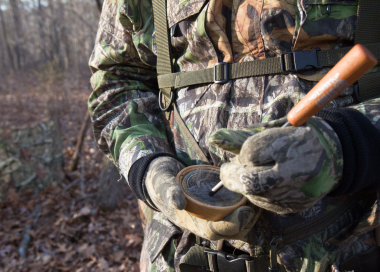
Pot calls, often called slate calls, are friction-style calls that are easy to use and produce a range of turkey sounds. A pot call consists of three parts: a pot, a calling surface and a striker. The pot holds the slate and acts as a sound chamber. There are holes drilled in the bottom for sound to escape. To keep from covering the holes, hold the pot with the tips of your fingers, keeping it away from the palm of your hand. Pot calls can be made to be all-weather, with the right striker.
Using a locator call
These calls have nothing to do with calling in turkeys, but everything to do with finding toms. Owl, crow, whistle or clap can elicit a reactionary gobble from a tom – sometimes called a "shock gobble." These calls are used when birds are on the roost early in the morning or late in the evening.
Decoys as diversions
Turkey decoys can be an important tool for hunters, especially in the spring season. Decoys help lure in tom turkeys and distract their attention away from the hunter.
The key to using a turkey decoy effectively is knowing which decoy will send the message you want to convey. Whatever decoy or decoys you decide to get, make sure you're getting them for a reason based on turkey populations and patterns.
Start with a hen
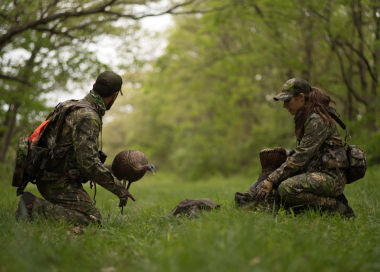
If you're new to turkey hunting, start with a lone hen decoy. A lone hen decoy in an upright standing position has likely accounted for more toms being harvested than all other decoys combined. The purpose is to capture the attention of a tom looking to breed. If he sees her, he'll likely come in range to inspect.
When setting up a hen decoy for bowhunting from a blind, stick her five-yards from the blind. Ten yards at most. If hunting with a shotgun, 25-yards will give your shot pattern time to spread out.
When a mature tom approaches a lone hen decoy, he'll usually break into full-strut to get the hen's attention. Often he'll strut and walk around the hen, sometimes gobbling, spitting, drumming, and pirouetting. You'll want your lone hen decoy facing away from or to the side of you to keep the tom from looking in your direction.
Consider adding a jake decoy
If you're thinking of adding more decoys, your next best purchase might be a jake decoy. A jake is an immature male turkey. A jake decoy set near a hen decoy sends the message to adult toms that there's a hen nearby that might be ready to breed.
If you're using a jake decoy together with a hen, positioning is important, especially for bowhunters. When using a jake decoy – or tom decoy, try to position it so it's facing you or standing broadside to where you're sitting. When a tom turkey approaches, he'll usually step in front of the intruding male (your decoy) to visually impress and intimidate him. For a bowhunter, getting the live tom to stand between you and the decoy will offer the best shot.
When to use a tom decoy
The key to choosing and using a tom decoy comes down to knowing a bit about local turkey populations and bird behavior. In areas with lots of toms, fights throughout the first half of the spring season are common as they vie for hens' attention. During wet, cold, delayed springs, toms often remain in bachelor flocks two to three weeks longer than normal, creating a situation that calls for a full-strut tom decoy.
One thing many hunters do with all strutting tom decoys is replace the factory supplied synthetic tail with a real tail fan they've made. Not only do these real feathers add natural color to your decoy, they also add some movement in the wind.

Check out the Recreation Report
Current conditions and opportunities to hunt, fish and see wildlife. Updated weekly by fish and wildlife biologists throughout the state.