
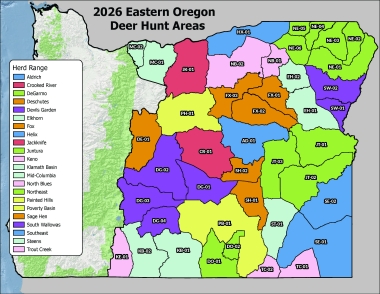
Eastern Oregon Deer Hunts
From WMUs to Deer Hunt Areas in 2026
Starting in 2026, deer hunts in Eastern Oregon will be organized by Deer Hunt Areas instead of traditional Wildlife Management Units (WMUs). This transition is based on new research showing that deer move across multiple WMUs throughout the year, making old systems less effective for population monitoring and harvest management. Learn more below.
Use this map to compare new Deer Herd Ranges vs Wildlife Management Units. Zoom in to see WMU boundaries which are in white.
Introduction
The wildlife management units (WMUs) used to structure Oregon's big game hunts and collect population data were created in the 1950s. Based on conventional wisdom about animal distributions and movements at that time, WMUs were used primarily for managing hunter distribution. Easily recognized landmarks and socio-political boundaries were used as boundaries for ease in identification.

Extensive research using GPS-collared deer has shown that WMUs rarely contain all the resources a deer herd needs in a year. For example, many animals within a herd spend summer/early fall (when they are harvested by hunters) in different WMUs than during winter (when they are counted by ODFW).
Based on the movements from over 1,400 mule deer collared in recent years, ODFW has identified 22 distinct mule deer herd ranges in eastern Oregon. A mule deer "herd range" includes the entire area a herd uses in a year, including summer ranges, winter ranges, and the migration corridors between them. These ranges now form the basis for ODFW's mule deer monitoring and management, including harvest management.
ODFW's improved, stronger population models now integrate multiple data streams, including herd composition (buck and doe ratios) and abundance data. To function properly, these models also require accurate harvest data to be collected within a herd range, which is difficult with the current WMU hunt structure.
To address this misalignment, ODFW will transition mule deer hunting from WMUs to new Deer Hunt Areas within herd ranges in 2026. This change will better align hunting effort and associated harvest with Oregon's mule deer populations and management goals, improve monitoring of population trends, and allow for quicker management responses/accurate evaluation of management actions.
Frequently Asked Questions

What's changing about deer hunts in Eastern Oregon? Starting in 2026, deer hunts will be organized by Deer Hunt Areas instead of WMUs:
- New naming system: Deer Hunt Areas will use a new alphanumeric system to identify hunt areas within herd ranges. For example, hunt area #1 within the Northeast herd range would be NE-01. Note: Some herd range names have been changed since Mule Deer Plan adoption to reduce confusion between WMUs and new herd ranges and hunt areas. See table for recent name changes.
Mule deer herd range names as proposed in the MD Plan and name changes (in bold) and hunt area acronyms.
| MD Plan Herd Range Name | New Herd Range Name | Deer Hunt Area Acronym |
| Murderers Creek | Aldrich | AD |
| Ochoco | Crooked River | CR |
| Warner | DeGarmo | DO |
| Deschutes | Deschutes | DE |
| Crescent | Devils Garden | DG |
| Sumpter | Elkhorn | EH |
| Northside | Fox | FX |
| Columbia Basin | Helix | HX |
| Biggs | Jackknife | JK |
| Beulah-Malheur | Juntura | JT |
| Keno | Keno | KE |
| Klamath Basin | Klamath Basin | KB |
| Mid Columbia | Mid Columbia | MC |
| North Blues | North Blues | NB |
| Northeast | Northeast | NE |
| Fossil-Grizzly | Painted Hills | PH |
| SC Low-Density | Poverty Basin | PB |
| Juniper-Silvies | Sage Hen | SH |
| South Wallowas | South Wallowas | SW |
| Southeast | Southeast | SE |
| Steens Mtn | Steens | ST |
| Trout Creek | Trout Creek | TC |
- Larger hunt areas: Expect new hunting areas that are different and often larger than traditional WMUs. These larger hunt areas will be less impacted by emergency closures and allow hunters more flexibility in response to wildfire or hunting pressure.
- Tag adjustments: There is a 9% overall reduction in eastern Oregon deer tags across the 100 Series Buck Deer and 600 Series Antlerless. Tag numbers could fluctuate over the next few years as hunters and ODFW adapt to these new hunt areas.
- Fewer total hunts: Larger hunt areas mean fewer individual hunts overall.
- Preference points: There are no changes to the preference point system. An individual hunter's buck deer preference points will be the same number as they are after the 2025 drawing and will apply to the new buck hunt areas. But like all new hunts, there will be a period of uncertainty regarding how hunters in 2026 decide to select hunts, apply their points, and the number of preference points needed to draw a tag for a given hunt area. Hunters should consider this uncertainty when deciding how to use preference points over the next few years.
- Landowner preference tags: LOP deer tags will also be impacted as the formula for allocating LOP tags will be changing to account for changes to the structure of management objectives and shift from WMUs to mule deer herd ranges and the new Deer Hunt Areas.
More on LOP Tags:
ODFW staff is developing a proposal for modification of this formula which will go before the Fish and Wildlife Commission for approval at their meeting on January 16, 2026. ODFW is also currently reviewing the registered tax lots of each LOP account to determine which Deer Hunt Area that landowner is eligible for. Until an LOP account is assigned to the Deer Hunt Area it occurs in, landowners may not be able to fully complete their tag distribution lists. We anticipate that all LOP accounts will be updated with Deer Hunt Areas by March 2026. Landowners registered in the LOP program will receive email updates from ODFW on this process.
The number of limited LOP mule deer tags available for each hunt will be provided to registered landowners by May 1, 2026. The number of LOP tags available for each mule deer hunt are determined by a formula that considers the total number of controlled hunt tags available for that hunt through the controlled hunt drawing and the performance of that mule deer population relative to the population management objective. Again, this formula will need to be adjusted to account for changes to the structure of management objectives and shift from WMUs to mule deer herd ranges and the new Deer Hunt Areas.
What hunts will be affected? New hunt areas will apply to all eastern Oregon mule deer hunting including buck hunts, doe hunts, and for all weapon types.
Why do the 2026 Northeast Oregon hunt boundaries continue to follow existing WMU lines? Boundaries for hunts still align with WMUs as ODFW is still deploying collars in this area and data collection and interpretation are not yet complete. Once new information has been collected and analyzed, ODFW will likely propose different hunt areas for that NE herd range in the coming years. Note NE-01 will likely remain unchanged as most monitoring has already occurred in this area.
Why is the change necessary? Mule deer populations are in decline across much of the western U.S. due to factors such as habitat degradation, habitat loss to development, predation, climate change and poaching. The state's new Mule Deer Plan adopted in June 2024 directs implementation of herd ranges as the basis of all data collection, including harvest. With these changes ODFW can improve population modelling to allow for effective monitoring of mule deer population trends, identification of declining populations, and rapid management response to population declines.
Can the change be delayed? Delaying implementation of new hunt areas further delays collection of accurate herd range scale harvest data and reduces the accuracy of new monitoring and modeling techniques. MOs are also set to be reviewed in 2029; the sooner harvest aligns with mule deer biology, the more accurate population performance and abundance estimates will be.
What about whitetails—are these hunt areas changing? Areas with substantial white-tailed deer populations and harvest will see separate hunts for each species.
Will elk hunts change? It's possible that ODFW may propose changes to elk hunt boundaries in the future but there are no immediate plans to do so. Elk are much more "nomadic" than deer, and their seasonal migrations are much less predictable. Most elk herds are already meeting population management objectives.
What about management objectives? MOs for population and buck:doe ratios were restructured to align with herd ranges and adopted as part of the new Mule Deer Plan. It's important that harvest and population data are collected at the same scale. The new plan also incorporates population growth rate into MOs, with each herd assigned a score based on growth concerns. See the Plan for more detail.
Details on each WMU-Herd Range transition:
WMU to Deer Hunt Area Transition Guide 2026
Amount of each Eastern Oregon WMU in each of the new Mule Deer Herd Ranges
Proportion of each herd range made up by respective WMUs
Video: Interactive Map of 2026 Hunt Areas
Find the Oregon Big Game Hunting Regulations here.
More about the 2024 Mule Deer Plan Update
Explore Related Articles

How to hunt big game
See the latest and historic data about big game hunting statistics for different hunts.
Buying a license or permit
Eastern Oregon mule deer are managed by Deer Hunt Areas. Check here for more details
All other big game
...
What hunters should know
Chronic Wasting Disease (CWD) is a fatal disease infecting deer, elk, and moose across North America. While CWD has not...

Find the latest Recreation Report
Current conditions and opportunities to fish, hunt and view wildlife. Updated weekly by fish and wildlife biologists throughout the state.