
Recreation Report
Southeast Zone
Recreation Report
SE WILDLIFE VIEWING
Recreating in drought and wildfire season - actions you can take to protect wildlife.
For the most current fire closures and restrictions--KNOW BEFORE YOU GO.
Harney County
Cooler temperatures are moving into the district with fall on the way. Remember to be mindful when recreating outdoors and take precautions not to cause any fires. Parking away from dry combustible materials is one way to do so. Although cooler temperatures are beginning to occur, water in the landscape is still minimal in comparison to last year. Targeting water sources can give way to better opportunities at viewing a variety of wildlife. Keep in mind that camping on or near water holes can deter wildlife species that rely on them this time of year for survival, and opting to choose a different camping spot away from water can lower disturbance to all wildlife.
Songbird species are in the county, and you should be able to find a variety of wrens, sparrows, black-capped chickadees, warblers, bluebirds and others as we begin our way into fall season. Look at the riparian areas with willow cover or Malheur National Wildlife Refuge to catch a glimpse at these small passerines. Other birds you may find on the refuge include waterfowl, some wading birds, and raptors.
Raptors are present in the district and opportunities abound throughout the county. Look on fence posts, telephone poles, and amongst cliff and talus slopes to see a variety of species that include red-tailed hawks, prairie falcons, ferruginous hawks, golden/bald eagles, and Swainson's hawks.
If you are looking to observe mammal species, multiple big game can be viewed in the county including deer, elk, pronghorn antelope, and big horn sheep. Feel free to reach out to the local biologists in the county for more information on where to look for these species.
Klamath County
The Link River trail below Upper Klamath Lake, Lake Ewauna and the Wood River wetlands are excellent places to view many species of wildlife including deer, river otter, muskrat, mink and a variety of waterfowl and shorebirds.
Lower Klamath and Tule Lake NWR are good places to view raptor species such as eagle, hawk, falcon, and owl. Drought conditions have impacted the refuges but there are still some good viewing opportunities for raptors.
Miller Island Unit
- The Miller Island Unit is located 6 miles south and west of Klamath Falls. Miller Island Unit is closed to all access from 10 p.m. until 4 a.m.
- May 1 – Sept 30: Open to public use daily.
- Oct 1 – Apr 30: Open to public use on designated hunt days during authorized hunting seasons. All other days are closed to all entry, except public roads, parking areas, the boat ramp, the designated birding trail and designated dog training area to minimize disturbance to migrating waterfowl.
- Overnight camping is not allowed in the Miller Island Unit
A Wildlife Area Parking Permit is required to park in the ODFW Wildlife Areas. Purchase a parking permit before your visit.
Waterfowl
Canada geese can be found throughout the area, either loafing in seasonal wetlands or utilizing farmed fields and pastures.
Duck species that can usually be found on the area at this time are mallard, northern shoveler, gadwall, canvasback, redhead, cinnamon teal, common goldeneye, bufflehead, ruddy duck, ring-necked duck, lesser scaup and common and hooded mergansers. Southern migrating waterfowl are starting to show up now. Numbers moving through should continue to increase for another month.
Shorebirds, waders and other waterbirds
Great blue herons are readily observed in the area. American bitterns are also present but can be difficult to find. Snowy egrets and green herons may also occasionally be observed. Sandhill cranes can still be found scattered around the area - some in pairs, others in groups.
Killdeer, black-necked stilts, long-billed dowitchers, peep species, Wilson's snipe, willet, phalarope, white-faced ibis, American avocet and yellow-legged species can be found along the edges of receding wetland areas. Long-billed curlews are also occasionally spotted in the area.
Virginia rails and soras can be heard throughout the area but can be difficult to spot. American coot can be found scattered throughout Miller Island.
Ring-billed gull numbers fluctuate between very few sightings to very common. Other gull species can be occasionally observed.
Raptors
Look for great horned and barn owls at dusk. Red-tailed hawks, northern harriers, cooper's hawks, sharp-shinned, osprey, American kestrels, and prairie falcons are foraging throughout the wildlife area. Eagle numbers are stable at this time, and they can be found scattered around the area. Peregrine falcons can occasionally be seen but are rare sightings.
Upland Game Birds
California quail and ring-necked pheasants are scattered around the old homesteads and the headquarters area.
Songbirds and other passerines
Eurasian collared and mourning doves are scattered over the area.
American and lesser goldfinches, house finches, white-crowned and golden-crowned sparrows, spotted towhees, black-billed magpies, and northern flickers continue to be common throughout the area. Visitors are seeing lots of western meadowlarks and American robins. Swallow numbers have started to decline. House wrens can be seen around the HQ complex. Western kingbirds and dark eyed juncos are also a common site in the area. Say's phoebes are common throughout the area, along with the occasional black phoebe.
Marsh wrens and song sparrows can be found in dense stands of tall emergent hard stem bulrush and broad-leaf cattail and are very numerous. Red-winged, brewers and Yellow-headed blackbirds are a common site in the area.
Mammals
Dusk is the best time to spot beaver and muskrat. River otter, mink, long-tailed weasel, coyotes, stripped skunk, black-tailed jackrabbit, mountain cottontail, California ground squirrels and raccoon can also be found using the Wildlife Area. Deer numbers continue to remain good.
If you have any questions, please contact Klamath Wildlife Area at 541-883-5732.
Lake County
Summer Lake Wildlife Area remains Lake Counties best viewing opportunity for waterfowl.
Unique raptor species, such as the rough-legged hawk and Ferruginous hawk may be found in Lake County. Other common raptor species present include red-tailed hawks, American kestrels, prairie falcons, Northern harriers, bald eagles and golden eagles.
Great horned owls, barn owls, and short-eared owls can also be heard and seen at night.
Though few and far between, you'll find the most diversity of passerine species in riparian areas. Relatively few species remain in Lake County for winter, though some hearty varieties and non-migratory species do remain. Species such as Townsend's solitaire, American robin, dark-eyed junco, western meadowlark, and some shrikes can be found throughout the county.
Mule deer
Please be aware of deer attempting to cross the road, especially at night.
Mule deer that spend the summer in the surrounding forested big game management units migrate to traditional wintering grounds near the towns of Silver Lake, Fort Rock and Christmas Valley, Paisley and Lakeview to escape harsh winter conditions at higher elevations. Some mule deer that migrate to North Lake County come from as far away as Crater Lake in the Cascades.
Pronghorn
Pronghorn antelope have horns instead of antlers like mule deer and elk. Both buck and doe pronghorn antelope have horns. The outer sheath is shed annually by December as the new horn grows underneath. This new growth will be completed by July the following year. A prominent prong or point on the horn can identify buck pronghorn antelope. In addition, the buck's entire nose appears black, and all bucks have a visible black cheek patch.
Doe pronghorn antelope generally do not have a prong or point, and the horn is usually less than 5-inches long. A doe's nose is much lighter colored, and a doe will not have a visible black cheek patch. If you see a group of pronghorns, remember to check behind the group. The dominant buck is often following well behind.
Bighorn Sheep
Bighorn sheep can be found on many of the canyon rims in Lake County.
Look for sheep on rims along Hwy 395 from the Christmas Valley Highway junction south to the Hwy 31 junction. Abert Rim just above Abert Lake along Hwy 395 offers good viewing. Hadley Butte, near Paisley, also offers viewing from Hwy 31 and the Summer Lake Hot Springs. Viewers wishing to observe bighorns should bring binoculars or spotting scopes, as sheep are generally found in steep rocky terrain and must be viewed from a distance.
Malheur County
A variety of shorebirds can be found this time of year as they migrate south. Sandpipers, killdeer, and Wilson's phalarope will be active along reservoir shores and floodplain meadows throughout September. Blue herons and egrets can regularly be observed along larger streams or river corridors in Malheur County as well as in or adjacent to the many agricultural fields.
Raptor species like the Swainson's hawk and American kestrel are present in large numbers throughout the Western Treasure Valley where agriculture and human residence are the dominant land uses. Red-tailed hawks and Northern Harriers can be found in the agricultural valleys as well as the surrounding desert rangelands. An unusual number of crow murders have been observed on the upper plateau of the East Whitehorse, down south towards the Nevada border with no explanation at the time as to what may be attracting those birds. Now is the time to catch them in Malheur County if you are a Corvid enthusiast.
ODFW requests that recreational users of our wild lands exercise extreme caution regarding the extreme fire danger levels over all eastern Oregon. We have already set a state record for acreage being burned and there is a lot of time left in fire season with no major breaks in the hot, dry weather predicted. Please adhere to land management fire restrictions, be careful with any ignition source, and keep motorized vehicles on established roads and free of undercarriage debris. We are in a situation where any start poses significant risk to large landscapes, habitats, wildlife populations, and private property.
Parking permits are required for all users of Summer Lake Wildlife Area. Permits are not available locally and reception is spotty, so users are encouraged to obtain parking permits before arriving in the wildlife area. Camping is permitted at four sites in the wildlife area. Campgrounds are primitive but each has vault toilets, trash barrels, and a few picnic tables.
- Access roads to campgrounds remain open, year-round. Roads are marked with current access regulations. Parking is only allowed in designated parking areas.
- Non-motorized travel on spur levees or lateral dikes is permitted, as is cross-country travel.
- The Wildlife Viewing Loop is now closed and will remain so through waterfowl season. Refuge areas are now closed to all entry.
- Major dike roads (Bullgate, Windbreak, and Work Road) are currently open to vehicle traffic.
- The Schoolhouse Lake Wildlife Viewing blind provides an excellent opportunity to see a wide variety of waterbirds.
- Viewing opportunities may be reduced by occasional extreme weather conditions.
Waterfowl
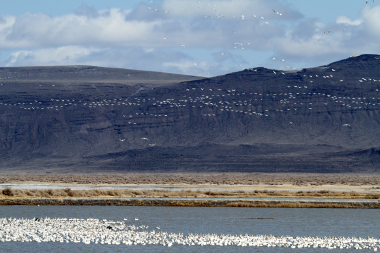
Mallard, gadwall, shoveler, and cinnamon teal are commonly observed, as are a few diving duck species. Migrant waterfowl are increasing in numbers, including white-fronted geese.
Canada geese remain widely distributed across the wildlife area.
A few resident and non-breeding trumpeter swans remain widely scattered across the wildlife area. These birds are part of restoration efforts and will be neck-collared with green collars and white alphanumeric symbols. Several swan broods have hatched on the area.
Shorebirds, wading birds, and other waterbirds Most phalaropes, snowy plover, American avocet, black-necked stilt, and long-billed curlew have started migrating out of the area. Many species can still be observed, including killdeer, dowitchers, multiple sandpiper species, and yellow legs.
White-faced ibis, American bittern, black-crowned night-herons, great egrets, and great blue herons can be found throughout the wildlife area. American coot are widely scattered across the wildlife area. Virginia rail and sora are throughout the wildlife area but can be difficult to locate due to the thick wetland vegetation they inhabit.
Multiple gull species can still be observed, but tern species have mostly left. Four species of grebes can be found in the wildlife area (Clark's, eared, pied-billed and western). Look for them in large open bodies of water such as Ana Reservoir, North Bullgate Refuge and North Levee Impoundment. Young grebes of various ages are easily observed.
Raptors and others
Northern harriers and red-tailed hawks are common this time of the year. Swainson's, coopers, and sharp-shinned hawks, as well as American kestrel, peregrine and prairie falcons can occasionally be found. Bald and golden eagles are also found on a regular basis, since both species frequently hunt the waterbirds in the wildlife area.
Great horned owls remain widely scattered across the entire wildlife area, especially in the trees at campgrounds. Short-eared owls can sometimes be found in early morning or evening hours. Barn owls can sometimes be observed, as well.
Upland game birds
California quail and ring-necked pheasants can sometimes be observed near Headquarters and north end upland areas. Broods of both species are mostly grown and difficult to differentiate from adults.
Songbirds and other passerines
Eurasian collared doves remain in small numbers and can be observed at Headquarters Complex and other areas.
American robins, Townsends solitaires, loggerhead shrikes, Steller's and scrub jays, and western bluebirds are in varied numbers across the wildlife area, especially around Headquarters and old homestead sites. Black-billed magpie and common ravens are also common throughout the area, as are Northern flickers.
There are very good numbers of marsh wrens and multiple sparrow species in the dense stands of hardstem bulrush and broad-leaved cattail along dikes and levees throughout the wetlands.
Blackbird species can be observed and include red winged, yellow headed and Brewer's. Western meadowlarks can be found scattered in good numbers throughout the area.
Most swallow species have migrated but small numbers can still be seen throughout the wildlife area.
A few migrating warblers can be observed in tree canopies and willow stands.
Habitat
Seasonal marsh areas are mostly flooded. Wetland habitat is in good condition. Irrigation season is coming over, and drier areas have filled with water.
Upland habitat remains in good condition, however, with the dry spring and summer, habitat may be dryer than normal.
For assistance and additional information, contact wildlife area staff at 541-943-3152.