Search myodfw.com
Showing 261 - 280 of 1673 results
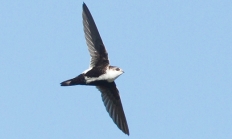
High overhead at the top of the rimrock in Oregon's desert country, the White-throated swift swoops, soars, and darts about erratically, hunting and catching insects. At great speed, it disappears into a crevice on a cliff without appearing to slow down. Its long, strong claws enable it to crawl deep inside these crevices to roosting and nesting areas, which often cannot be seen from the entrance. This bird is a locally common to abundant breeder, primarily on eastern Oregon cliffs. It is an occasional spring and sporadic fall migrant in western Oregon along the coast, in the Willamette Valley, and…
Hummingbirds are a popular backyard bird watching species, especially at hummingbird feeders. Avoid commercial mixes that contain red dye. Hummingbirds swoop and dive with most performing a low back-and-forth movement called a shuttle display. Feeding on flower nectar, hummingbirds often are stained with pollen and are an important pollinator.

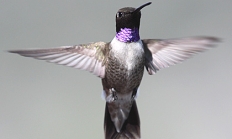
Noteworthy as a generalist, the Black-chinned hummingbird appears in a wide variety of habitats, including lush river bottoms, urban settings and desert canyons. Below the male's velvety black gorget is an iridescent purple band that can also look black in poor light. At rest, the wingtips are relatively broad and curved, unlike any other North American hummingbird. A rare to locally common resident east of the Cascades, it is least common in Klamath and Lake counties. Summer habitat in eastern Oregon includes canyons, juniper woodlands, and desert riparian zones. In the foothills of the Blue and Wallowa Mountains, it's found…
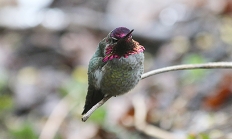
Anna's hummingbird is the largest hummingbird common to our region. It is the only hummingbird regularly found in Oregon in winter, during which time it is exposed to short day lengths, limited sources of food and periods of intense cold. It is more vocal than most hummingbirds with males uttering a dry, scratchy buzz of a song that can be heard throughout the year. It is a rare to locally uncommon summer resident west of the Cascades in interior valleys and along the coast; also along the Columbia River east to The Dalles. It occurs and probably breeds into the…
The Costa's hummingbird is a very rare spring and summer visitant to central and southwestern Oregon. Males are sometimes present for the entire year in the Rogue Valley. Males have been observed in canopy-free riparian habitat along Bear Creek and semi-open tall white oaks at the edge of Agate Lake. Many of these birds go undetected in Oregon because of their similarity with other hummingbird species. Hear the call of the Costa's hummingbird Photo by Mick Thompson, Flickr

This tiny jewel is the smallest breeding bird in North America and the smallest long-distance avian migrant in the world. The average weight of males is approximately 0.09 oz, about half of that of an Anna's hummingbird, and a little more than the weight of a penny. It breeds predominantly in mountain habitats, and despite its diminutive size, successfully withstands the chilly summer nights at high elevations. It is a common summer resident of the Blue and Wallowa Mountains and other high ranges east of the Cascade summit. Spring and fall migrants are rare at lower elevations east of the…

Perhaps the most enigmatic hummingbird found regularly in Oregon, the Broad-tailed hummingbird has so far eluded documentation of its breeding in the state, likely due to identification uncertainties and the remoteness of its preferred habitat. Primarily a Rocky Mountain species, its hard-to-define breeding range seems to reach its limit at Oregon's eastern edges where reports of this beautiful and rare species arise each summer. The relatively large adult male has a rose-red gorget and green plumage with no dorsal Rufous coloration. Females and immatures are nearly indistinguishable in the field from those of the more common Rufous hummingbird. Hear the…
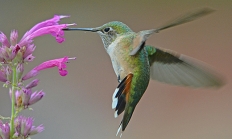
The Rufous hummingbird is the most common and widespread of Oregon hummingbirds. This rusty-red and fearless nectar feeder is a popular yard bird, inspiring even the most modest of nature lovers to set up a feeder. It is a common transient and breeder throughout most of western Oregon, especially in forested regions. Hear the call of the Rufous hummingbird Photo by Charlotte Ganskopp

Allen's hummingbird is a common breeder in the coastal fog belt from California into southern Oregon. It is closely related to the more wide-ranging Rufous hummingbird with only subtle differences in plumage, behavior, and vocalization. This is a fairly common spring and summer resident along the southern Oregon coast as far north as Bandon. It occurs as a very rare vagrant in other parts of western Oregon. Hear the call of the Allen's hummingbird Photo by Trish Gussler, Flickr

Oregon has one species of kingfisher, the raucous Belted kingfisher and 12 woodpecker species. Six woodpeckers are Oregon Conservation Strategy Species of management concern and in need of conservation. Famous for their hammering and hole drilling, woodpeckers might decide your home looks like a good place to set up shop. Learn how to discourage this on our Living with Wildlife, Birds page.

This majestically crested bird is often heard before being seen due to its conspicuous harsh rattling call. Kingfishers are most frequently associated with lake and pond shorelines and islands, as well as coastal dunes with ponds and widely scattered shrubs and trees. They hunt from a vantage point above water such as an overhead branch, telephone wires along shore lines or pilings of piers. This is a common permanent resident throughout most of the state except in the north Lake and east Deschutes counties where open water is generally absent Hear the call of the belted kingfisher Photo from ODFW

The Lewis's woodpecker was named for Meriwether Lewis, who first described the species in 1805. This medium-sizesd vaguely crow-like woodpecker relies on flycatching during the spring and summer and store mast in the fall and winter. Formerly widespread in Oregon, it is currently common year-round only in the white oak-ponderosa pine belt east of Mt. Hood. It also breeds in low numbers in open habitat along east Oregon river and stream valleys. The Lewis's woodpecker is an Oregon Conservation Strategy Species in these ecoregions: Blue Mountains, Columbia Plateau, East Cascades, Klamath Mountains, West Cascades. Hear the call of the Lewis's…

Spirited vocalizations make this handsome clown-faced woodpecker one of the more conspicuous residents of much of Oregon's oak woodland. It is unique among Oregon woodpeckers with its habits of communal living and acorn storage. It is fairly common in the Rogue Valley and adjacent hills and locally common in the Klamath River Canyon in southwest Klamath county and the southern part of the Willamette Valley. Acorn woodpeckers are Oregon Conservation Strategy Species in both the Klamath Mountains and Willamette Valley ecoregions. Loss of oak woodlands poses a major threat to this bird. Hear the call of the Acorn woodpecker Photo…

Male and female Williamson's sapsuckers look so different that until 1873, ornithologists thought they represented two distinct species. The mostly black male has a bright yellow belly and red chin. The female is pale brown with barred back and wings and dull yellow belly. It is a summer resident of forests in the Blue Mountains, on the east slope of the Cascades and east to Warner Mountains in the south. It breeds in mid - to high-elevation mature or old-growth conifer forests with fairly open canopy cover, and large dead trees suitable for nest cavities. Hear the call of the…
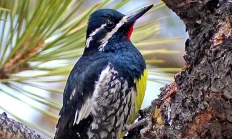
Lines of neatly drilled holes in even the smallest strand of aspen east of the Cascade summit are likely the work of the Red-naped sapsucker. The Red-naped sapsucker is a common summer resident throughout forested mountains east of the crest of the Cascades and a spring and fall migrant through the same mountains and lower elevations, preferring areas with trees. Hear the call of the Red-naped sapsucker Photo by Tom Koerner, USFWS
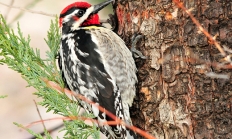
The only sapsucker regularly found in western Oregon, the Red-breasted sapsucker, with its raspberry-red head and breast, is unmistakable. It is found in moist coniferous coastal forest and mixed deciduous-coniferous coastal forest west of the Cascade crest, and in aspen-ponderosa pine forests east of the Cascades. Nest cavities are typically in large snags or live trees with decayed interiors. It is a fairly common breeder in the northern part of the state from the coast to the Cascades and south to the southern Cascades. Hear the call of the Red-breasted sapsucker Photo by Darla Marie Prater

This active and often unwary woodpecker, the smallest in North America, is generally the most often seen black and white woodpecker in human-settled areas. A preference is shown for decayed wood for nesting, though sound wood is also utilized. Nest sites are usually 10 to 12 feet off of the ground. It is found mostly at low to moderate elevations in deciduous and mixed deciduous-coniferous forests throughout much of the state, and less often in coniferous forests. Hear the call of the Downy woodpecker Photo by ©Keith Kohl, ODFW

This medium-sized woodpecker may be found in virtually any forested area in Oregon. It is found primarily in mixed-conifer and ponderosa pine forests, as well as adjacent deciduous stands, especially during the breeding season. Hairy woodpeckers feed on beetles, ants and other insects, spiders, miscellaneous plant matter, elderberry corn and mast (mostly acorns), and a few seeds. They are regular visitors to suet feeders and have been observed drinking from hummingbird feeders in central Oregon. It is a resident in forests throughout Oregon with the exception of juniper. Common throughout most of this range, but uncommon to fairly common along…
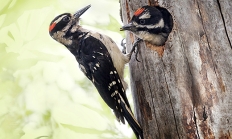
The White-headed woodpecker is the only woodpecker that relies heavily on the seeds of ponderosa pine for food. It occurs mainly in open ponderosa pine or mixed conifer forests dominated by ponderosa pine. They usually excavate nest cavities in snags but may use stumps, leaning logs and dead tops of live trees. It is an uncommon permanent resident in forests of the Ochoco, Blue, and Wallowa mountains and the east side of the Cascades, but suitable habitat is restricted. The White-headed woodpecker is an Oregon Conservation Strategy Species in the Blue Mountains, East Cascades, and Klamath Mountains ecoregions. Hear the…

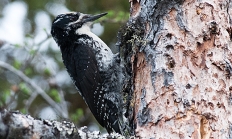
In Oregon, the American three-toed woodpecker tends to use higher-elevation forests; however, forest type may not be as important to this species as the presence of bark beetles. Nests are often fairly low; nest trees are often smaller in diameter than those used by other cavity nesters. Habitat requirements may include trees with heartrot for nesting and high densities of bark or wood-boring beetles. It is rare and local, particularly near and west of the Cascade summit, often near high-elevation lakes or beetle outbreaks. American three-toed woodpeckers are Oregon Conservation Strategy Species in the Blue Mountains and East Cascades ecoregions…