
Search myodfw.com
Showing 301 - 320 of 1673 results
Vireos and shrikes are predatory song birds. Their bills are strong and hooked to kill and dismember prey including insects and small birds, mammals and reptiles. These birds hunt from fences, wires and treetops and sometimes hang captured prey on thorns to eat them later.

This striking songbird is best known for its habit of impaling prey on thorns and barbed wire, or wedging items in a v-shaped branch for easier handling and storage. The Loggerhead shrike breeds in open habitats east of the Cascades where they are rare but regular in the winter, especially at low-elevation sites. They are uncommon and declining in northeast Oregon. West of the Cascades, there are usually a few records each year during fall, winter, and spring in open habitats of the coast and the Willamette, Umpqua, and Rogue valleys. The Loggerhead shrike is an Oregon Conservation Strategy Species…

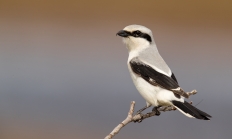
This is the larger of Oregon's two shrikes, and the more likely to be seen in winter. Most of those seen in Oregon are hatch-year birds wearing brownish plumage in the fall and graying as winter passes. Adults stand out from young of the year with more crisp gray, black, and white plumage. Shrikes inhabit open landscapes. They resemble and act like small raptors, however, they capture and kill prey with a hooked bill rather than with talons. The Northern shrike is an uncommon to locally common visitor in open habitats statewide. It is absent some years along the southern…
The more distinctive features on this gray and greenish vireo are the bright eye rings and lores, together called "spectacles." This bird is often difficult to see as it forages among the foliage; identification is usually based on hearing its distinctive song. Widespread in migration, when its habitat includes city parks and heavily wooded neighborhoods. The Cassin's vireo is an uncommon to rarely common summer resident in forests and woodlands, except along the immediate coast. it is an uncommon transient throughout the state. Hear the song of the Cassin's vireo Photo by Trish Gussler, Flickr

A quiet, modest, unobtrusive little bird that must be sought to be seen in its shady retreats, this little-studied species can easily be overlooked. It is typically associated with oaks and mixed woodlands, where it hops along the foliage hunting for insects. In winter it forages with flocks of chickadees, kinglets, and nuthatches. This is Oregon's only resident vireo. Although it is sometimes referred to as non-migratory, some seasonal movement has been observed. Similar in appearance and behavior to the more common and widespread Ruby-crowned kinglet. Hear the song of the Hutton's vireo Photo by Greg Gilson

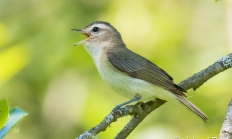
Despite being one of the most common songbirds in deciduous and riparian forests throughout Oregon, the Warbling vireo is frequently overlooked. Its plumage is indistinct. It tends to forage high in the treetops, moving slowly and deliberately among twigs and leaves gleaning insects. Despite its subtle plumage and habits, familiarity with its song makes this vireo easy to find, and a delight to listen to. The Warbling vireo breeds in moderate densities in deciduous habitat throughout Oregon from sea level to montane areas. It is most abundant in the central Coast Range. It is moderately abundant west of the Cascades…
When walking through riparian areas in certain parts of Oregon in summer, one can often hear a song which suggests the Robin's but with less volume and energy, and with a greater variety of phrase. Yet, when one looks up, the bird is often hidden within the canopy foliage. The Red-eyed vireo is a fairly common summer breeder in Wallowa County and an uncommon to rare breeder in Union County, Baker County, and eastern Grant and Umatilla counties, and northern Malheur County. Hear the song of the Red-eyed vireo Photo by John Sutton, Flickr

These birds are intelligent, curious, social and have good memories. Members of this group are commonly called the crow family, and are the among the most intelligent birds studied so far.
Gray jays are common visitors at mountainous campsites and parks and are commonly known as "camp robbers" for their habit of taking food from humans. Gray jays in the Blue Mountains have the top of their heads white, while birds in the Cascades and Coast ranges have white restricted to the forehead. Coast Range birds are decidedly browner vs grayish overall. In Oregon, the Gray jay resides in conifer forests of the Coast and Cascade ranges, the eastern slope of the Cascades at Ft. Klamath and in the southwestern part of the state. Hear the call of the Gray jay…

The Steller's jay is unmistakable with its charcoal and blue plumage, distinctive crest, and raucous call announcing its presence. Steller's jays forage on the ground and in trees and bushes. Omnivorous, they eat a variety of animal and plant food. This jay nests in trees or shrubs and often places the nest near the trunk and within 10-16 feet from the ground. In Oregon, it is a common resident in mesic and dry conifer and mixed conifer-hardwood forests from valley floors to near timberline. It is found in forests of the Coast and Cascade ranges during breeding season. Hear the…

One of the characteristic birds of woodlands and city streets is this loud, colorful jay. Its bright blue-and-white-plumage and shrill calls are quite distinctive. It is closely related to the Steller's jay and hybrid individuals have been noted where their ranges overlap. It is an opportunistic forager of small animals and invertebrates, but is predominantly a vegetarian. It is a rare to regular visitor to eastern and western Oregon from late September to late April. The Blue jay prefers open mixed forests or deciduous groves and is often found in orchards and parks and along wooded city streets. Hear the…

The name of the Western scrub-jay derives from its preference for "scrub" habitat, consisting chiefly of shrubs or brush intermixed with sparse trees. It calls attention to itself with its raspy metallic shriek. Its harsh voice and fussy, boisterous behavior might lead some to consider the scrub-jay a nuisance, but this bird also possesses abundant character and is considered to be uncommonly smart and adaptable. The Western scrub-jay is a common permanent resident in western interior valleys and foothills between the Coast Range and the Cascades, especially in the Willamette, Umpqua, and Rogue valleys. Hear the call of the Western…

The haunting cries of these wanderers evoke a variety of reactions from curiosity to wonder. Highly social, the Pinyon jay epitomizes the dynamics of flock behavior such as colonial nesting, communal feeding of young and non-territoriality. Although Pinyon jays are nomadic and unpredictable, each flock is a tight-knit, integrated unit occupying a home range that does not overlap with other flocks. Flocks may wander widely outside their home range if sufficient food is not available. The Pinyon jay is a permanent resident in juniper and ponderosa pine woodlands of central Oregon. Oregon's known breeding population is confined to the Metolius…

On his historic expedition with Meriwether Lewis, Captain William Clark, the bird's namesake, first mistook this species for a woodpecker undoubtedly because of its long, sharp beak. However, this most specialized member of the North American Crow family uses this apparatus to pry loose its favored seeds from unrelenting cones of several pines with which the nutcracker has a symbiotic relationship. The whitebark pine, in particular, is totally reliant on Clark's nutcrackers for seed dispersal and germination. In Oregon the Clark's nutcracker is a resident along the crest of the Cascades, usually above 4,000 feet, lower on the east slope…

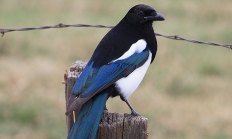
This is one of the most audacious of Oregon's resident avifauna both in appearance and behavior. Its black coat and streaming tail dappled in blue-green iridescence contrasts starkly with its flashing white wing feathers during flight. Common and conspicuous east of the Cascades, the magpie prefers open areas stippled with dense thickets or trees. They are highly social, often gathering in large flocks. Historically despised and persecuted by hunters, farmers, and ranchers, this trickster has flourished in the tradition of the coyote. Hear the call of the Black-billed magpie Photo by Kathy Munsel, ODFW

So familiar is the American crow that it has been said if a person knows only three species of birds, one of them will be the crow. Recognized by its coal-black plumage, fan-shaped tail, and nasal caw call, it is found throughout most of North America, and its seemingly mischievous character has been immortalized in folk tales and fables. These shrewd birds possess a superior intelligence and an ability to learn and make decisions. They are also sociable, joining together in large roosts, especially in fall and winter. Able to thrive in a wide variety of environments, crows are expanding…

Ravens are clever, innovative, and entertaining. They quickly exploit human-created opportunities for food and shelter. Their spectacular aerial acrobatics conducted under windy or thermal conditions appear to be an act of fun. The Common raven's plumage is entirely shiny black like the American crow, but the ravens appear 25 percent larger, have a wedge-shaped tail and have deeper croaks and other calls than the American crow. In Oregon, the Common raven is a fairly common, widespread resident in many habitats throughout the state; population densities are highest east of the Cascades. Hear the call of the Common raven Photo by…

Swallows and martins have smooth flights patterns, pointed wings, forked tails and feed almost entirely on the wing.

All have cause to marvel at the sight of a gorgeous male Purple martin. Adult males are entirely glossy bluish-purple, although they may look black in poor light. Females and yearling males are grayish below and darker above with a paler forehead and nape. The world's largest swallow, martins are uncommon in Oregon. They nest both solitarily and colonially in nest boxes specially put up for them, in crevices in human-made structures, and in cavities in snags and pilings. They are an uncommon local summer resident, principally inhabiting the Coast Range and Willamette Valley. They are also locally common at…
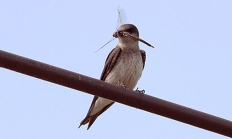
A colorful harbinger of spring, the hardy Tree swallow arrives from the south during February each year. It is a highly social species that is usually observed in large flocks often with Violet-green and other swallow species. It is not colonial but several pairs may nest together if available cavities are clustered. The Tree swallow is a bird of open places near water and is seldom seen in residential neighborhoods or built-up urban areas. It is the only swallow that eats berries and small seeds as well as insects. In Oregon, it is a locally abundant summer resident and breeding…
