Search myodfw.com
Showing 441 - 460 of 1673 results
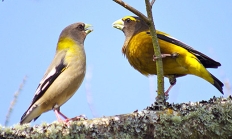
This sturdy-looking bird has a large head, short tail, and massive conical bill adapted for seed eating. The male plumage features bold patches of lemon yellow shading into olive, then brown and black, with white secondaries creating a flashy wing-patch easily seen in flight. The male's bill is chalky white in winter, but changes in early spring to a pale green that matches the new growth at the tips of spruce boughs, where they often nest. Many encounters with this species are of individuals heard flying high overhead, leaving the observer with little else to note. The Evening grosbeak is…
The House sparrow is an invasive species introduced from Europe. No other North American wild bird is so associated with human settlement as this introduced House sparrow. Its foods are nearly all imports, and its nesting and cover requirements are also human-derived. The House sparrow and European starling are the only introduced passerine birds that are thriving in Oregon. These birds can dominate bird feeders and utilize nest boxes that were intended for native species. The House sparrow can be found statewide around buildings at human developments of adequate size ranging from scattered farmsteads in remote and rural areas to…

Some of Oregon's larger mammals, such as deer and elk can easily be seen at places like Jewell Meadows Wildlife Area, Dean Creek Elk Viewing Area, and the North Bank Habitat Management Area. Black-tailed deer are frequently seen in western Oregon along roadsides. Commonly seen animals include raccoons, rabbits, squirrels, and skunks. A quiet walk in the forest or desert, a keen eye and a good pair of binoculars will reward you with glimpses of some of our more secretive animals. Some viewing tips include: keep your distance, move as silently as possible or pick a spot and remain still…
Invasive species are animals and plants that are not native to an ecosystem and that cause economic or environmental harm. Not all non-native species are invasive, however many become a serious problem. They can aggressively compete with Oregon's native wildlife for food and habitat.
In Oregon, the nutria is considered an invasive species. The nutria is a large rat-like semiaquatic rodent. The species has a hunched body; a round, nearly hairless tail; a valvular mouth and nose; and pentadactyl feet with naked soles. The toes of the hind feet, except for the hallux, are included in a web. As an adaption to the aquatic environment, the eyes, nostrils, and small ears are set high on the sides. The pelage consists of long, course guard hairs and soft, dense underfur. Overall, the color usually ranges from dark brown to yellow-brown. The muzzle is frosted with…

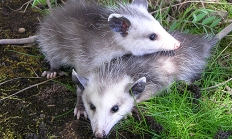
In Oregon, the opossum is considered an invasive species. The Virginia opossum is a cat-sized mammal with a pointed nose, unfurred, black, leathery ears with white edges; beady eyes; a hind foot with an opposable hallux (big toe); and a naked scaly tail. It was introduced in Oregon between 1910 and 1921. Populations were established in northwestern Oregon apparently from releases of animals brought to the state as pets or novelties. Small streams, forest communities, and agricultural lands planted to a variety of crops are typical of many habitats occupied by Virginia opossums in Oregon. They are active nocturnally and…

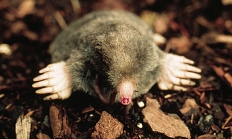
Enlarged front feet allow moles to dig underground while shrews do not have enlarged feet and use varied habitat. Moles are specially equipped to live underground and have ears and eyes so small they are not visible. Shrews have tiny eyes that are visible. They reuse mole and vole tunnels and are occasionally found invading buildings.

Baird's shrew is a medium-sized shrew in which the third unicuspid is smaller than the fourth. This shrew is endemic to Oregon. It occurs in the Coast Range from the Pacific Ocean east to Portland and south of the Columbia River down to Corvallis. It also occurs along the west slope of the Cascade Range from the Columbia River south to central Lane County.
This shrew is the largest member of the genus in North America. Truly a water shrew, it swims easily both on the surface and while submerged, mostly by alternate strokes of the hind feet. When leaving the water, it literally springs from the surface. In Oregon, it occurs in the northern Cascade Range in Clackamas, Hood River, and Multnomah counties, then west in Clatsop, Columbia, and Washington counties along the Columbia River, and southeasterly from Newport through Benton, Lane, Linn, Jackson and Klamath counties. Habitats include alder in riparian zones, skunk cabbage marshes, deep, dark, red cedar swamps, floating mats…
The Merriam's shrew is the smallest shrew in Oregon. This brownish shrew has a short, truncated skull and is medium dark-brown on the dorsum and pinkish white on the venter; the tail is sharply bicolored in the same tones as the body with dark and light portions about equal. In Oregon, it has been found in Grant, Harney, Lake, and Wasco counties. It occupies drier habitats and is reported to be associated with sagebrush-bunchgrass habitats.
The montane shrew is slightly larger and has a slightly longer tail than the vagrant shrew. It is distinctive in that the third unicuspid is smaller than the fourth. It occurs as a small population near the Columbia River and along the Pacific Coast in Clackamas, Clatsop, Columbia, Hood River, Multnomah, and Tillamook counties and as a series of populations at higher elevations in Baker, Crook, Grant, Harney, Union, Wheeler, and Wallowa counties.
The Pacific shrew is the only shrew in Oregon without a tine on the anteromedial surface of the first upper incisor but with a posteriomedial ridge visible in anterior view through the gap between the incisors. It is a large brown shrew with the third unicuspid smaller than the fourth. The species is often found in moist wooded areas with fallen decaying logs and brushy vegetation. It is endemic to Oregon and is distributed as two disjunct populations: one in the Coast Range from Cascade Head, Tillamook County, south to Coos Bay, Coos County and eastward to Philomath, Benton County…
The water shrew is a large shrew with a very dark gray to black dorsal pelage, a white venter and throat, and a sharply bicolored tail. It occurs, in Oregon, as disjunct populations in the Wallowa, Blue, Ochoco, Strawberry, Steens, and Hart mountains and in the High Cascade Range west and downslope to McKenzie Bridge, Lane county. It is almost always found near water. Undercut banks, exposed tree roots, and boulder-strewn streamsides vegetated by willow, willow-grass, or willow-alder associations seem to be prime habitat. Photo by Charlie Marshall, Flickr
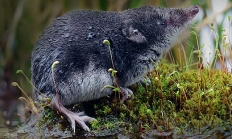
Preble's shrew is the smallest shrew in Oregon; adults commonly weigh less than a dime. The pelage is medium dark-brown to very dark-gray on the dorsum and silvery gray on the venter. The tail is bicolored, medium dark-brown on the dorsal surface, white on the ventral surface and darkening toward the tip. In Oregon, it has been found in Deschutes, Grant, Klamath, Lake, Harney, Malheur, and Wallowa counties. Its habitats include marshes, along streams, dry bunchgrass, and wet, alkaline habitat. Grasses and sagebrush are common to most habitats.
The fog shrew is the largest of the brown shrews in Oregon. Its range extends from Taft in Lincoln County east to near the eastern boundaries of Linn and Lane counties (except it is absent in the Willamette Valley) and southward along the west slope of the Cascade Range and in the Coast Range and Siskiyou Mountains. They are found in alder/salmonberry, riparian alder, and skunk cabbage marsh habitats and less often in conifer habitats.
Trowbridge's shrew is a medium-sized shrew, distinguished from other Oregon shrews by its dark-brown or grayish black pelage on both dorsum and venter, and its sharply bicolored tail, white below and dark brown or grayish black above. In Oregon, its range is west and south of a line connecting Parkdale, Hood River County; Pine Grove, Wasco County; Alder Spring, Lane County; Diamond Lake, Douglas County; Gearhart Mountain, Lake County; and Lakeview, Lake County. It occurs in all stages of the coniferous forest from old growth to recent clear-cuttings. Photo by Don Henise, Flickr
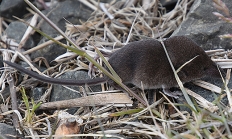
The vagrant shrew can be distinguished from all other congeners in Oregon by the combination of the upper unicuspids wider than long in ventral view. It is light medium brown on the dorsum, light pinkish-gray on the sides, and white on the venter, bases of hairs on all three areas are neutral very dark-gray. The tail is weakly bicolored (dark brown over white) in juveniles. The vagrant shrew occurs throughout the state except in the Columbia Basin. It tends to be more of a generalist than most Oregon shrews in terms of habitat affinities, nevertheless, it usually is found in…
The shrew-mole is the smallest talpid in Oregon. The pelage is black; the eyes are rudimentary. The tail is about 50 percent of the length of the head and body, fat, sparsely haired, blunt ended, covered with transverse annular rows of scales and tufted. In Oregon, the species occurs as far east as Brooks Meadows, Hood River County; Indian Ford Campground, Deschutes County; and Fort Klamath, Klamath County. It is most abundant in moist sod-free ravines with deep, black-silt soils with high humus content and covered with a layer of dead leaves and twigs. Dominant vegetation in these areas is…
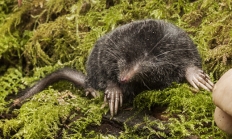
The broad-footed mole is intermediate in size among Oregon moles. It occurs south of a line connecting Hugo, Josephine County; Prospect, Jackson County; Crater Lake, Klamath County; and Fort Rock and Goose Lake, Lake County. Photo from Panegyrics of Granovetter, Flickr
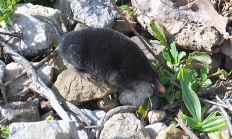
The coast mole is the smallest of the moles in Oregon. It occurs in Baker, Umatilla, Grant, Crook, Union, Sherman and Wasco counties east of the Cascade Range and throughout most areas west of the Cascade Range, except it is absent from much of the Willamette Valley. Photo by Peter Paquet, Flickr