
Search myodfw.com
Showing 741 - 760 of 1673 results
Features: Great whites are blue to gray on top and white underneath. They can grow as large as 20-feet long and weigh in excess of 4000 pounds! They have several rows of teeth in their large mouths. Habitat: Great whites stay in temperate ranges with water temperatures between 54- and 75-degrees Fahrenheit, including waters off the west coast. Technique: Great white sharks are protected under federal and state laws making them illegal to target or keep.

Features: Spiny dogfish are gray or brown with white spots on their back and a white belly. They can grow to be 5-feet long. They are called "spiny" as they have a spine behind each of the fins on their backs. Habitat: Spiny dogfish are widely dispersed, traveling from Alaska to Chile, and from intertidal waters down to 3,000 feet. They mostly eat small fish, squid, and octopus. Techniques: Being relatively small, spiny dogfish can be taken with light tackle. They tend to school around prey over soft bottoms. A good amount of weight will probably be necessary to keep…

Features: Eulachon smelt ( Thaleichthys pacificus) grow to be 6-9 inches long and live 3-5 years. They have elongated bodies with relatively large mouths. They are blueish on top and silvery on their sides and bellies. Habitat: The Pacific smelt spends most of its life in the ocean, migrating up rivers, including the Columbia and its tributaries, to spawn. The eggs attach to gravelly, woody, or sandy substrate of the river bottoms, but upon hatching the juvenile smelt get swept downstream back to the ocean. Technique: Dip netting for smelt when they run in the Sandy River is a great…


Features: Green sturgeon have olive to dark green backs and a yellowish, green-white belly. They also have a green strip down the middle of their stomachs. This fish will grow to 7-feet long and, as with white sturgeon, have bony body armor along their backs and are covered in sandpaper-like skin. Habitat: Green sturgeon are bottom dwellers, travelling all along the Pacific coast of North America. They spawn in deep pools in turbulent freshwater from March to July. Technique: Green Sturgeon may not be targeted for retention or catch-and-release angling. Any Green Sturgeon caught incidentally, for instance during White Sturgeon…
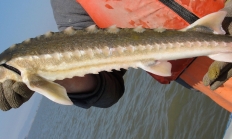
Features: There's no mistaking a sturgeon. This primitive looking fish has large bony plates running down its back, a long flat snout, and a deeply-forked tail. It's also covered in rough, scale-less skin, similar to a shark. Though they can reach lengths of 20 feet, most white sturgeon rarely get over 10-feet long, which seems plenty long to us. Some populations migrate between the ocean and freshwater, but not necessarily with the same consistency as salmon or steelhead. These prehistoric fish may live well over 100 years, and may not mature until they are 25-years-old. Habitat: White sturgeon are primarily…
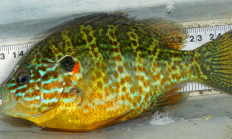
Features: Bluegills are distinguished from other panfish by the black ear flap and black spot at the rear base of the dorsal fin. Five to eight greenish, vertical bars are faintly visible on their sides. The body is olive-green in color, bluish above and silvery below. Breeding males develop a bright orange to red flush on the throat area. Adults in most waters measure 5- to 8-inches, but the state record bluegill exceeded 12-inches. Habitat: Bluegills prosper in clear, clean ponds, lakes and backwaters of slow streams with abundant vegetation. They feed on both plant and animal life, but primarily…

Features: Green sunfish have more of a bass-shaped body and a larger mouth than the other sunfishes, other than the warmouth. Also, unlike other sunfish except the warmouth, the pectoral fin is rounded, rather than pointed. Green sunfish are olive green on the back and sides with a yellowish-copper or brassy hue on the lower sides of the belly. Dusky, vertical bars are often present. Turquoise mottling, often in the form of bars, radiates backward from the snout and eye. They have a dark spot at the base of the rear lobe of the dorsal fin. Habitat: Green sunfish are…

Features: Redear sunfish are often confused with bluegill, but differ by having a red or orange border around the black ear flap and by lacking the spot on the dorsal fin and the vertical bars on the side. Habitat: In Oregon, redear sunfish are found only in a few ponds in the Willamette Valley and the central part of the state. In their native range, redear sunfish prefer warm, large lakes and reservoirs and bayous with vegetated shallow areas and clear water. They feed primarily on the bottom and seldom take surface insects. The diet consists mostly of zooplankton, insect…

Features: Sacramento perch are blackish above with about seven vertical dark bars that are irregular in form and position. They are not a true perch, but a sunfish. It is the only member of the sunfish family native to the west coast and, in Oregon, is found only in the Klamath Basin. Sacramento perch are distinguished from the other sunfish in Oregon by having 12 or 13 dorsal fin spines whereas all the others have 10 or fewer. Maximum size in Oregon is about 12-inches in length and a weight of about 3/4 pound, although in California they have been…

Features: Warmouth have more of a bass-shaped body and a larger mouth than the other sunfishes, other than the green sunfish. Warmouth are yellowish brown in color with three or four brownish bars radiating back from the eye over the gill cover. They can be distinguished from the green sunfish by the absence of turquoise mottling on the gill cover and the lack of a dark spot at the rear base of the dorsal fin. Habitat: In Oregon, warmouth are present in a few coastal lakes and widely distributed in the Columbia basin, but are not commonly caught by anglers…
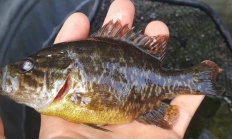
Features: They are aptly named for their color pattern and appetite. They have dark stripes running vertically down their sides, which vary in color from greenish-grey to a blush hue. They can grow in excess of 4-feet long and 30 pounds. Habitat: These fish were released in Phillips Reservoir near Baker City to help control the runaway yellow perch population that was harming the rainbow trout fishery. Technique: This is a catch-and-release fishery. Tiger muskie have a reputation for being elusive and difficult to catch. Anglers who target these fish will want a strong rod and line, a reel with…

Features: Color varies, but walleye are generally dark olive-brown on top grading to almost white below. Walleye have two well-separated dorsal fins; the first fin has a large black spot at its rear base. The opaque eyes, giving the fish its common name, and canine teeth are other prominent features. Habitat: Walleye are found in the Columbia, Willamette and Snake rivers. In the Willamette River, the walleye fishery is generally limited to the section downstream from Willamette Falls at Oregon City, although a few have been documented as far upstream as Dexter Dam. Walleye prefer large, clean and cold or…
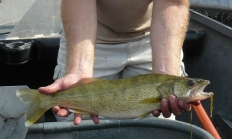
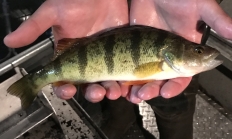
Features: Yellow perch are golden, with six to nine dark vertical bars. They have two well-separated dorsal fins; the second fin has two or three spines. Lower fins are yellowish-orange and, unlike walleye, yellow perch do not have canine teeth. Maximum size in Oregon exceeds 3 pounds and 18-inches long. They are prolific spawners, often resulting in an overpopulation of stunted fish. Habitat: Yellow perch prefer lakes, reservoirs and slower moving streams that have cool, clean water and ample vegetation. Perch bite readily and are therefore popular with young and novice anglers. Technique: In the spring and fall, find yellow…

Features: Both males and females have a bluish bill with a black tip. Drakes are white on the top of the head, green eye stripes, purplish breast and flanks, white belly and wing covert patch, and have an iridescent black/green speculum. The grayish hen shows white on the wing covert patch. Habitat: An abundant overwintering duck, especially in the Willamette Valley and coastal areas. Prefer shallow habitats like wet meadows or marshes where, like geese, they feed on green grass and sedges. Techniques: These ducks are early migrants (September) but can be common in mixed duck bags throughout the season…

Features: Drakes have a reddish head and neck; black breast, lower back and tail coverts; nearly white back, flank, and belly, and dark gray tail. The hen is grayish brown with a darker brown head, neck, breast and tail coverts. Canvasbacks are large; adults in good condition are as heavy as mallards and second in size only to the white-winged scoter among common Oregon ducks. Habitat: Brackish estuarine bays and marshes with abundant submerged aquatic vegetation and invertebrates are ideal wintering habitat for canvasbacks. Techniques: Generally part of a mixed duck bag. These ducks have a reputation as good table…

Features: Drakes are easily distinguished from American wigeon drakes by a reddish brown head, gray flank, and lack of green eye stripe. Hens are similar to American wigeon hens and difficult to distinguish. The call of the male is a shrill whistling, whe'e you; the female's voice a low purr or croak. It is a rare to uncommon visitant east of the Cascades.

Features: Adult drakes have a black bill, buff head, gray body, and black upper and lower tail coverts. Hens are nondescript brown ducks with a spotted, yellowish-orange bill with black edges. Unique among dabbling ducks, the gadwall has a partly white speculum (rear part of the wing) that can be seen when the bird is in flight. Habitat: Submerged aquatic vegetation makes up the majority of the gadwall's diet. As a result, they are often found feeding far from the shoreline, in deeper water than most other dabbling ducks. Can be abundant is eastern Oregon early in the season, but…
