
Search myodfw.com
Showing 761 - 780 of 1673 results

Features: Drakes show graceful patterns of black and white plumage, glossy purple heads, white crescent-shaped patches between the eye and bill, steep forehead, and short bill. Females and juveniles have a chocolate-brown head, slate-gray back, wings and tail; adult females have a golden bill. Habitat: Not common, but usually scattered on lakes, reservoirs and coastal estuaries. They share Snake River habitat with the common goldeneye. Techniques: Not usually targeted, they are a rare part of a mixed duck bag.

Features: Drakes have a black head with a white spot below and in front of the eye -- rather than the crescent-shaped patch of the barrow's goldeneye -- white neck, breast and flanks and a black back and tail. Hens have a brown head, light neck, breast and belly, brown backs and flanks. Drakes and hens of both common and Barrow's goldeneye have a distinctive golden ring around the pupil. Habitat: It is a common migrant in northeastern Oregon and winter resident of the Snake, Columbia, Klamath, Rogue and Umpqua rivers. Techniques: These ducks travel in small groups of two…

Features: Males have glossy, slate-blue plumage accented with white stripes and dots. Females are mottled brown. Habitat: In the summer these ducks breed on fast water rivers in western Oregon. During winter they can be spotted in rocky intertidal areas along the coast. Larger concentrations of wintering birds are usually seen in Lane, Lincoln and Coos counties. Techniques: These ducks are extremely rare in the bag. Their winter habitat of rocky intertidal areas are mostly inaccessible to hunters.

Features: The winter males' body is mostly white except for a black breast and central back; the wings are dark, scapulars long and gray, and the dark central tail feathers are long and slender. Winter females are darker above with a light head; scapulars and tail feathers are short and dark. Dark areas mark females' heads and males' necks. Habitat: Long-tailed ducks can show up almost anywhere from the coast (they usually winter off shore) to inland on the Columbia River and on lakes throughout the state. Techniques: Some long-tailed ducks are taken in Oregon, but not enough to show…

Features: During the fall, winter and spring months, males can be quickly identified by their distinctive iridescent green heads. Females are mottled-brown, with a dark brown stripe through each eye, an orange bill with black splotching and have orange legs. Immature ducks resemble adult females until the males develop more colorful plumage in early fall. After breeding season, males develop duller eclipse plumage beginning in June and resemble hens until mid-September. Wings of both sexes have a violet-blue speculum bordered in front and behind by a pronounced white stripe. Habitat: Mallards are the most common breeding and wintering duck in…
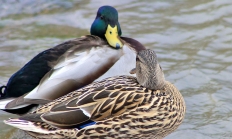

Features: Males have white sides and breasts, deep green heads and dark backs. The pearl gray bodies and white breasts of females, subadults, and eclipse males are sharply delineated from their full-crested chestnut heads. Habitat: During the winter, these ducks are wide-spread in rivers, lakes and marshes across the state. Techniques: Not usually sought for table fare.

Features: The male has a striking black head with a white crest, white breast, black back, and chestnut sides. Females and immatures are dull grayish brown except for a reddish-brown crest. Habitat: During migration hooded mergansers are widespread, though uncommon, across Oregon. They are usually in sheltered areas of lakes and ponds and less commonly on estuaries. Often seem in pairs or small groups. Techniques: Not usually targeted, they can be part of a mixed duck bag.

Features: Males have a ragged-crested, dark green head, a reddish-brown breast, a dark back and gray sides. Females share the ragged crest; their rufous heads and gray bodies may make it hard to tell them from female common mergansers. Their bills, however, are noticeably slimmer. Habitat: Red-breasted mergansers are common from fall through spring, mostly in coastal bays and estuaries but occasionally on the open ocean. Techniques: Their preferred habitat within dangerous ocean waters makes them inaccessible to hunters.

Features: The pintail is an elegant long-necked duck. The long-tailed, full-plumaged drake is striking with a chestnut head, gray back and flanks, bright white breast and front of neck, and iridescent green-bronze speculum. The brown hen is nondescript, but shares the long neck and graceful shape of the drake. Both have a blue-gray bill. Habitat: Pintails prefer the open habitats of sheet water fields and large marshes or ponds. They are a puddle or dabbling duck and usually feed by dabbling or dipping rather than submerging. It is a rare breeder but an abundant fall migrant statewide and one of…

Features: The other "greenhead", the drake is handsome with a dark iridescent green head, white breast, reddish belly, blue wing patch of coverts, and an iridescent green speculum. Brown hens also have blue wing patches similar to that of the cinnamon and blue-wing teal. Habitat: This dabbling duck prefers lakes and ponds where it uses its unique bill to sift through water in shallow areas. Food choices include the seeds of sedges, bulrushes and other aquatic plants, duck weed, and algae; also aquatic insects, mollusks and crustaceans. Common winter species in the Willamette Valley and Columbia Basin, but widespread throughout…

Features: The drake has a red head, black breast and tail coverts, and steel gray back, flanks and tail. Hens are a medium brown. During courtship, the drake utters a very unduck-like meow. Habitat: This diving duck is a locally common breeding species throughout the marshes of eastern Oregon such as Ladd Marsh, Summer Lake, the Warner Wetlands, and Malheur NWR. Known for nest parasitism, laying eggs in the nests of other birds, usually other diving ducks, redhead eggs have also been found in the nests of a variety of species. Techniques: The redhead is a very uncommon winter resident…

Features: The black back, white crescent on the side just in front of the wing, and white-ringed bill separate the drake ring-neck from the scaups. The brownish neck ring of the male in alternate plumage is not prominent. The hen is a small dark brown duck with a buff face. Drakes in courtship give a head-throw accompanied by a wow note while hens utter a growling purr. The ring-necked duck can resemble a scaup, so hunters need to know what they are shooting at. Habitat: These ducks are pretty widespread during the winter months. They generally prefer fresh water, from…

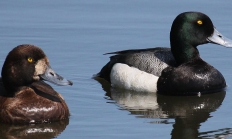
Features: Greater scaup are almost the size of redheads. In hand, they are easily distinguishable from lesser scaup by size and by the white wing stripe extending beyond the secondaries into the primaries. In the field, the two species can be difficult to separate. Drakes are black on both ends and white in the middle. Although not extremely reliable, in good light, generally the black head of drake grater scaup have a green sheen, while the head of a drake lesser scaup have a purple sheen. Hens are dark brown with a white mask around the base of the bill…
Features: Similar to the greater scaup in appearance and habits, but smaller and lacking the white on the primaries. In the field, however, the black-and-white drakes and brown hens are very similar to greater scaups. Habitat: In general, the lesser scaup is more likely to be found in interior or freshwater habitats while the greater scaup is more a coastal bird. Techniques: Scaup are rafting birds attracted to large spreads of scaup decoys. Popular hunting destinations include coastal estuaries and lakes, where most hunters hunt from a boat. However, in the marshes of eastern Oregon, there can be good hunting…


Features: Black scoters‘ plumage is pure black uninterrupted by any white. The swollen bright orange-yellow knob on the otherwise black bill is smaller than that of other scoters. Females' uniform soot upperparts and dark head cap are clearly delineated from paler cheeks. Habitat: This scoter can be uncommon to locally common along the coast fall through spring, usually on the ocean. Techniques: Like other scoters, black scoters are ducks of the open ocean, and inaccessible to most hunters.

Features: Adult males' plumage is black except for white patches on the forehead and nape. The most distinguishing feature is the bill, a swollen white, red-orange, yellow, and black wedge. This highly visible standard advertises male's presence for up to a mile. Dark-billed adult females and subadults are dark brown above and paler brown below, with two indistinct light patches on the cheeks and sometimes on the nape Habitat: The surf scoter does not breed in Oregon but is abundant on salt water along the coast from fall through spring. Look for surf scoters in the Columbia River estuary and…
