
Search myodfw.com
Showing 281 - 300 of 542 results
Find maps, boundary descriptions and hunts available in the new South Wallowa Hunt Area SW-02. Download printable PDF map
In Oregon, fork-tailed storm-petrels breed in numbers that are only a tiny fraction of those of Leach's storm petrels. This is the larger of the two storm-petrels breeding in Oregon and is gray in color. These birds leave and return to breeding colonies only at night, when they are best detected by their distinct raspy call. At sea, they are distinguished by quick, buoyant flight with short glides interspersed with wing fluttering to maintain their position at a food source. Fewer than 20 nests have been found in Oregon, all located in the same habitat as colonies of Leach's storm…

Features: Blue grouse are large in comparison to most other grouse species. The females are mottled brown, tan, and gray. The males are similar, but with solid blue-gray on the underside and bright orange-yellow combs over the eyes. Habitat: Blue grouse occupy the coniferous forests of western Oregon, the eastern slopes of the Cascades, the Blue Mountains of northeastern Oregon, and the Klamath Basin and south Warner Mountains. Preferred habitat includes timber edges, open timbered slopes, mountain meadows adjacent to springs or other sources of water, and near berry producing areas such as chokecherry thickets. Technique: Effective hunting techniques involve…

Find maps, boundary descriptions and hunts available in the new Devils Garden Hunt Area. Download printable PDF map
SALEM, Ore. – ODFW and the Oregon Hunters Association (OHA) will give away free wildlife forage seed to landowners at E.E. Wilson Wildlife Area near Corvallis on Saturday, May 9. The giveaway coincides with OHA's Youth Field Day (limited spots available). Seed giveaway More than 500 bags of free seed…
Searching for frogs and salamanders is a great way to introduce kids to the wonders of Oregon's wildlife and the great outdoors. Learn more about their various habitat needs and you'll increase your chances of seeing one of these unique species. Remember to leave no trace to preserve their habitat. Check out our fun facts on Oregon's frogs.
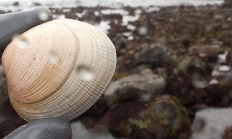
Features: Circular in shape and 1.5-2.5 inches across. Identified by concentric lines and radiating ridges. Longer lived and less abundant than cockles. Habitat: High salinity areas of sand, mud, gravel, or rock. Harvest them in Tillamook, Netarts, Yaquina, and Coos bays. Techniques: These clams can be found in rocky nearshore areas within 6 inches of the surface. Using a rake for these clams is the best harvest method. Learn more here before getting started clamming. See Oregon Sport Fishing Regulations for information on the daily catch limits for bay clams. How to dig for little neck clams (video)
SALEM, Ore.— The Commission set 2026 groundfish regulations during their meeting in Salem today. The daily catch limit for lingcod will increase from 2 to 3 fish next year, since lingcod populations are healthy and bycatch of yelloweye rockfish (a protected species) is still low. The daily limit for general…
Features: Plankton eaters, the American shad is the biggest of the herring species and averages 3 to 5 pounds. They are silver on the sides, and green to blue on top, with green shading on their fins. Habitat: Like other anadromous fish species, they spend most of their lives at sea and return to fresh water to spawn. Females release free-floating eggs that will be fertilized by later-arriving male, called buck shad, in a spawning frenzy. Eggs hatch in eight days and fry spend four to five years in salt water before returning to spawn. Shad often survive to spawn…

If this is a new activity for you, our friends at the Audubon Society have tips on how to start birding and how to connect with other birders. This is a great resource that also includes tips on choosing binoculars, reviews and recommendations on the best birding apps and field guides, and an easy seven-point guide on how to identify birds. The Cornell Lab of Ornithology has an extensive website that includes the world's largest archive of wildlife sounds and videos, bird cams, eBird citizen science opportunities, scientific publications, bird guides, bird nesting box plans and more. ODFW's Living with…
White River Wildlife Area was established in 1953. Located along the east slope of the Cascade Mountains in the north central part of Oregon, the wildlife area encompasses 29,480 acres. An additional 1,280 acres of land owned by the Bureau of Land Management (BLM) is managed by the ODFW bringing the total acres managed by the department to 30,760. The primary purpose of White River Wildlife Area is to provide winter range habitat for black-tailed deer and Rocky Mountain elk and to minimize big game damage to adjacent private agricultural lands.
With long, pointed wings, nighthawks can sometimes be seen during the day catching insects while in flight although most are active at night. Nighthawks roost by scraping the ground or roost on low branches. Nestlings can fly at 10 days old. Swifts nest on vertical walls, such as chimneys or old smoke stacks, hollow trees or rock crevices. It's fun to watch them at dusk in summer, circling their nesting site. These birds are never seen perched, but only in flight.

Find maps, boundary descriptions and hunts available in the new Poverty Basin Hunt Area. Download printable PDF map
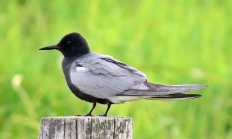
This is Oregon's smallest breeding tern, with black head and body and gray wings during the breeding season. Black terns are delicate, graceful fliers, reminiscent of a nighthawk or swallow. The Black tern breeds in marsh wetland complexes of southeast, south central and central Oregon. In western Oregon, a very small breeding population is found at a few sites in the Willamette Valley. Hear the call of the Black tern Photo by Bob, Flickr
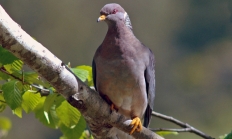
About the size of the domestic pigeon, this swift-flying species is popular among sport hunters. An arboreal bird, it is often observed perched alone on top of a tall tree or in flocks when flying about feeding areas and mineral sites. This is a common summer resident in forested areas west of the Cascade crest. It typically nests in forested mountain areas in the west Cascades. Hear the call of the Band-tailed pigeon Photo by Dave Budeau, ODFW
This group of animals is common throughout Oregon in various locations depending on species. Oregon just has one marmot, the yellow-bellied marmot and two of its squirrels are on the Oregon Conservation Strategy Species list: the Washington ground squirrel and the Western gray squirrel. View more information about Living with Wildlife, Tree Squirrels for tips on preventing conflicts, trapping, species status and recommended conservation actions.

The bright yellow, red, and black plumage of the male Western Tanager, so conspicuous in open situations is very obscure in forested areas where it tends to blend into the shaded foliage. The species perhaps is best known in migration when it visits city parks, orchards, and other open urban and suburban areas. It is attracted to birdbaths but seldom to bird feeders. It breeds in open coniferous forests and mixed coniferous and deciduous woodlands, primarily in mountains. They usually nest in conifers - rarely deciduous trees - at varying heights, usually well out on a branch, often at the…
