
Search myodfw.com
Showing 301 - 320 of 1128 results
CLACKAMAS, Ore.—Following an in-season assessment of the upriver spring Chinook return, fishery managers from Oregon and Washington added more recreational spring Chinook fishing days on the mainstem Columbia during a joint state hearing yesterday. Six additional fishing days downstream of Bonneville Dam and five additional fishing days upstream of Bonneville…
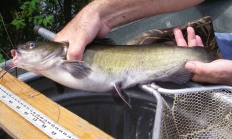
Features: Channel catfish are pale bluish-olive above and bluish-white below with a deeply forked tail, dorsal and pectoral spines, and an adipose fin. Like all other catfish, channel catfish have “whiskers” or barbels extending from the chin and upper jaw. Young fish have a varying number of small black spots over much of the body, while older fish may be partially or entirely without spots. Maximum size in Oregon approaches 40 pounds, but most are less than 10 pounds. Habitat: Channel catfish in western Oregon are limited to the Columbia River, lower Willamette River, and a few ponds in the…
Features: Both the male and female are gray or reddish-brown on the body with dark bars and spots throughout. They have variable tail colors but always have a black band near the tip. Habitat: Ruffed grouse are most commonly found in brushy riparian areas in eastern Oregon and in early-aged mixed woodlands in western Oregon, though birds may be found in pockets of good habitat nearly anywhere. Technique: The ruffed grouse is a bird of the edge, so look in edges of meadows, clearcuts, and where brushy growth meets timber. In September, when most ruffed grouse hunting takes place in…

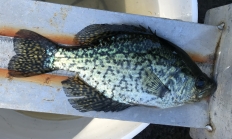
Features: Black crappie are silvery in color with numerous black or dark green blotches and no distinct vertical bars. This results in a darker overall color than seen in white crappie. The forehead is dished, but not as much as in the white crappie. The dorsal fin usually has seven or eight spines and its length is equal to or greater than the distance between the dorsal fin and eye. Habitat: Black crappie do best in clear waters of medium-sized lakes, reservoirs and large slow moving streams. They are less tolerant of flowing and muddy water than white crappie and…
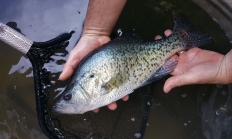
Features: White crappie are often confused with black crappie. White crappie have silvery bodies with blackish-green mottling forming narrow vertical bars on the sides. The forehead is more dished than in the black crappie. The dorsal fin has five or six spines and its length is less than the distance between the dorsal fin and eye. Habitat: White crappie do best in larger lakes and reservoirs and are more tolerant of turbidity and less dependent on aquatic vegetation than black crappie. They congregate around pilings, sunken logs, underwater brush, weed beds and rocks. White crappie begin life feeding primarily on…
Features: Steelhead are rainbow or redband trout ( O. mykiss) that migrate to the ocean during their first or second year, returning one to three years later to spawn. While in the ocean, steelhead are silvery in color and typically grow significantly larger than their siblings who never leave fresh water. Once back in fresh water, they usually turn dark-olive in color, with silvery-white undersides, heavily speckled bodies and a pink to red stripe running along their sides. Habitat: Summer-run steelhead return to freshwater between May and October and require several months to mature and spawn. Winter-run steelhead return to…

Features: These blue-green, silvery or light brown fish are a schooling fish and an important food source for larger fishes, sea birds and marine mammals. Habitat: Anchovy are frequently offshore, but can be caught inshore in harbors and large estuaries during spawning. Technique: Anchovy are usually targeted in bays with multiple-hook herring jigs.

Features: Coastal rainbow trout are often residualized steelhead that spend their entire life cycle in fresh water, never migrating to sea. They are a silvery color with black spots on their backs and fins, and a pink band running down their sides. Often their gill covers are pink as well. The pelvic anal, and dorsal fins have a white edge to them. Habitat: They can be found in cold rivers, creeks, and inland lakes. However, they require streams with clean gravel, complex habitat, and cool temperatures for spawning and rearing. Techniques: Trout in stillwaters tend to be on the move…

Features: Brant are a small to medium-size goose. They have smoky black backs and bellies, and dissected white collars and white around the tails provide striking contrast. The brant can live up to 20 years and are resilient enough to ride out storms on the open ocean. Habitats: Brant are primarily found in bays and estuaries, but on occasion can be found inland. They forage on eel grass and other aquatic vegetation. Most of their feeding is in shallow water or in tidal flats. They tend to feed in flocks. Techniques: As with any waterfowl hunting, location is key. Seek…

Features: Usually greenish to brown with darker mottling, but most fish have bright red blotches on their sides. They tend to have dark bars or blotches on their fins, and the inside of their mouths are bluish. Habitat: Their habitat is subtidal algal beds and rocky reefs from the Bering Sea to southern California. Technique: Try fishing for rock greenlings from the shore as they are often captured in shallow, rocky areas. These fish have small mouths, so try a #4 or #6 hook to catch these daytime feeders.

NEWPORT, Ore.–Chinook salmon fishing closes tonight, Aug. 17 at 11:59 p.m. from Leadbetter Pt., WA to Cape Falcon, OR. Hatchery coho fishing will continue in this area. Projected harvest of Chinook salmon in this area is near the quota allowance. The decision was made to reserve enough Chinook quota to…
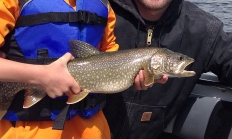
Features: The lake trout is not particularly colorful – usually gray with large pale spots – and can be distinguished from other trout by its deeply-forked tail. Lake trout, despite the common name, is not actually a trout but a member of the closely related char group. They can reach weights of 20 pounds. Habitat: These aggressive, fish-eating char are popular sport fish found in deep, cold water with plenty of oxygen and proper spawning areas. There also must be abundant forage fishes for them to eat. Techniques: Many anglers target lake trout in the spring, when they hang out…
Features: They are aptly named for their color pattern and appetite. They have dark stripes running vertically down their sides, which vary in color from greenish-grey to a blush hue. They can grow in excess of 4-feet long and 30 pounds. Habitat: These fish were released in Phillips Reservoir near Baker City to help control the runaway yellow perch population that was harming the rainbow trout fishery. Technique: This is a catch-and-release fishery. Tiger muskie have a reputation for being elusive and difficult to catch. Anglers who target these fish will want a strong rod and line, a reel with…

Features: While their coloration can be variable, bull trout are generally gray infused with green. The body is covered with small white or pale yellow spots. Some spots along the side may be deep orange to red. The leading edges of the fins along their bellies are white. Bull trout, despite the common name, is not actually a trout but a member of the closely related char group. Habitat: Bull trout require cold, clean water to survive and are typically found in the headwaters of Oregon rivers. Spawning occurs in the fall when water temperatures drop below 50F. Techniques: Anglers…

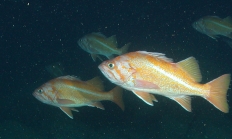
Features: Canary rockfish are named for their bright yellow to orange mottled bodies. They also have undertones of gray and three orange stripes across their heads. They grow to be 30-inches long, and have very firm and desirable meat. Habitat: Canary rockfish are a schooling fish, common along the Pacific Northwest coast over rocky reefs and pinnacles. Larger adults are usually further offshore, with younger fish sometimes common down to 100 feet. Yelloweye, canary and vermillion rockfish can look similar. See this rockfish identification article for distinguishing features for each species. Technique: They readily take both bait and lures. Locate…
Features: While in the sea, sea-run cutthroat feed on crustaceans and small fish and can grow up to one inch a month. By the time they return to fresh water to spawn, these fish can be up to 18-inches long and are bright silver, much like a small steelhead. Habitat: This is a sea-run strain of the coastal cutthroat that travels into the saltwater estuaries for a few months of the year. Unlike salmon and steelhead, sea-run trout don’t migrate far from their home river and return to freshwater in late summer – July and August. Technique: Sea-run cutthroat trout…
Features: Plankton eaters, the American shad is the biggest of the herring species and averages 3 to 5 pounds. They are silver on the sides, and green to blue on top, with green shading on their fins. Habitat: Like other anadromous fish species, they spend most of their lives at sea and return to fresh water to spawn. Females release free-floating eggs that will be fertilized by later-arriving male, called buck shad, in a spawning frenzy. Eggs hatch in eight days and fry spend four to five years in salt water before returning to spawn. Shad often survive to spawn…

Features: California halibut are usually solid brown to black or mottled with light and dark patches on the eyed side and white underneath. They have the ability to change skin color patterns to blend in with the ocean floor. The eyes on a California halibut are most commonly on the left side but may be on the right side as they are on a Pacific halibut. The upper jaw in a California halibut extends to the rear of the lower eye, while on a Pacific halibut the upper jaw only extends to the front of the lower eye. In both…

Features: There's no mistaking a sturgeon. This primitive looking fish has large bony plates running down its back, a long flat snout, and a deeply-forked tail. It's also covered in rough, scale-less skin, similar to a shark. Though they can reach lengths of 20 feet, most white sturgeon rarely get over 10-feet long, which seems plenty long to us. Some populations migrate between the ocean and freshwater, but not necessarily with the same consistency as salmon or steelhead. These prehistoric fish may live well over 100 years, and may not mature until they are 25-years-old. Habitat: White sturgeon are primarily…

Features: Olive brown to red on back, silvery-red to pink on sides. Lower jaw is long and extends at least to the eye socket. Short second anal fin spine. These fish can grow up to 3 feet long. Habitat: Most common between 160 and 820 feet deep. Adults show a preference to stay close to their home swatch of rocky bottoms or outcrops. Technique: Their diet consists of invertebrates and small fishes – try a lure that mimics these sea creatures.