
Search myodfw.com
Showing 421 - 440 of 897 results
With long, pointed wings, nighthawks can sometimes be seen during the day catching insects while in flight although most are active at night. Nighthawks roost by scraping the ground or roost on low branches. Nestlings can fly at 10 days old. Swifts nest on vertical walls, such as chimneys or old smoke stacks, hollow trees or rock crevices. It's fun to watch them at dusk in summer, circling their nesting site. These birds are never seen perched, but only in flight.


NE BIG GAME HUNTING June 25, 2026 Currently open Cougar ( check current harvest numbers), Coyote Announcements and resources Check the Leftover Tag List for an opportunity to hunt this year. View the Big Game raffle and auction hunt results along with the 2026 seed number drawing results. Big game harvest statistics - You'll find links to population, harvest and point summary reports that can help you decide what hunts to apply for this season. Please report elk with hoof disease - If you see elk showing signs of elk hoof disease, including lame or limping elk or elk with…
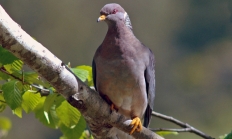
About the size of the domestic pigeon, this swift-flying species is popular among sport hunters. An arboreal bird, it is often observed perched alone on top of a tall tree or in flocks when flying about feeding areas and mineral sites. This is a common summer resident in forested areas west of the Cascade crest. It typically nests in forested mountain areas in the west Cascades. Hear the call of the Band-tailed pigeon Photo by Dave Budeau, ODFW
This group of animals is common throughout Oregon in various locations depending on species. Oregon just has one marmot, the yellow-bellied marmot and two of its squirrels are on the Oregon Conservation Strategy Species list: the Washington ground squirrel and the Western gray squirrel. View more information about Living with Wildlife, Tree Squirrels for tips on preventing conflicts, trapping, species status and recommended conservation actions.


A research study that began in 2012 confirmed Sierra Nevada red fox presence in the Oregon Cascades, specifically in the Mt. Jefferson, Mt. Washington, and Three Sisters Wilderness Areas. Confirmation was through genetic testing of hair and scat samples. Sierra Nevada red fox is a subspecies of Red fox that live in high elevations. They are slightly darker than Red fox and are highly specialized to montane (mountain) ecosystems. In the red color phase, the upper body is reddish-brown with white chin, cheeks, throat and belly. This fox ranges from silver to black in the black/silver color phase with silver…

Features: Adult drakes have a black bill, buff head, gray body, and black upper and lower tail coverts. Hens are nondescript brown ducks with a spotted, yellowish-orange bill with black edges. Unique among dabbling ducks, the gadwall has a partly white speculum (rear part of the wing) that can be seen when the bird is in flight. Habitat: Submerged aquatic vegetation makes up the majority of the gadwall's diet. As a result, they are often found feeding far from the shoreline, in deeper water than most other dabbling ducks. Can be abundant is eastern Oregon early in the season, but…

Features: Largemouth bass are greenish on the back and sides with a white belly and usually a dark horizontal stripe along the side. They are distinguished from their close cousin, the smallmouth, by a large mouth with the upper jaw extending behind the eye. Largemouth bass in Oregon can exceed 25 inches in length and a weight of 12 pounds. Habitats: Their preferred habitats are shallow ponds and lakes, or the backwater sloughs of rivers where aquatic plants or submerged logs and brush provide abundant cover. Largemouth bass begin life feeding on zooplankton (tiny crustaceans), but soon switch to insects…

One of the most numerous breeding birds in Douglas-fir and true fir forests of western Oregon is the Hermit warbler, yet it is often overlooked. This may be surprising, given the male's bold colors; however, it seldom descends from the higher reaches of the forest canopy. If you are familiar with its song, you can often hear three to five males singing on a spring morning from many places in appropriate habitat. The male Hermit warbler has a bright yellow head, set off by a black throat and nape. The gray back is marked with black stripes that vary in…

The drake gadwall is a large mostly gray dabbling duck. Adult drakes have a black bill, buff head, gray body, and black upper and lower tail coverts. Hens are nondescript brown ducks with a spotted, yellowish-orange bill with black edges. Gadwalls are unique among dabbling ducks in having a partly white speculum which can be observed in flight. Common vocalizations include the deep, reed-like sounds of the male and the female's quacking, similar to but more nasal and higher pitched than the mallard hen. It is an abundant breeder locally in eastern Oregon and an uncommon breeder in western Oregon…

Oregon's owls are mostly nocturnal, hunting for insects, fish, frogs, birds, mice and other small mammals in the night. Their hoots, screeches and calls can be heard after dark or early in the morning. Owls don't build nests, but instead use tree cavities, nests created by other species, naturally occurring structures or human-made nest platforms. The Western burrowing owl nests underground in abandoned dens dug by squirrels, prairie dogs and badgers. Learn more about Oregon's owls.

This largest of the commonly encountered loons is perfectly built for underwater prey pursuit. Ungainly on land, this may be the price it pays for being a great diver. Large and blocky-headed, with a straight, robust bill, the common loon is separated from the yellow-billed by its straight bill and winter face pattern, and from smaller loons by its more angular head and often-retracted robust neck. Black head, white "necklace," incomplete black-and-white neckband, and white-checkered black back define breeding adults. Dark gray upperparts of winter adults shade to white underparts. Take-off is impossible by land and labored on water, but…

The Striped skunk is about the size of a house cat with a pointed head; slightly upturned, nearly spherical nose pad; and beady black eyes. The pelage is entirely black except for a narrow white stripe on the forehead and nose, a white pate leading to two diverging white stripes on the back that extend partly or completely to the rump. Entirely white skunks, or skunks with the black replaced by seal brown or the white replaced by yellow are also know to occur. Without doubt, the most widely recognized characteristic of the Striped skunk is the pungent odor of…

Columbia Fishing June 25, 2026 Current and upcoming fishing opportunities: Steelhead fishing is fair downstream of Rainier. Shad fishing is still good for bank anglers at Bonneville Dam. For the latest regulations for the summer management season, see the fishing regulation update page. Announcements For the latest regulations, including in-season changes see the fishing regulation update page. Forecasts for 2026 Columbia River Spring Chinook, Summer Chinook and Sockeye are available here. Fish consumption advisories The Oregon Health Authority has issued consumption guidelines for parts of the Columbia River due to high levels of mercury and/or PCBs. Fish with these chemicals…

SALEM, Ore. – A Chinese mitten crab, a prohibited species in Oregon, was found in the Willamette River near the Sellwood Bridge and reported to ODFW on Nov. 17. The crab was spotted in shallow water and captured by hand. It was alive and not released back into the river…
The common goldeneye drake is a strikingly handsome black-and-white diver about the size of a greater scaup. Goldeneyes are strong, fast flyers nicknamed "Whistlers" for the sound of their primaries as they zoom past on a still day. Drakes have a black head with a white spot below and in front of the eye, white neck, breast and flanks and a black back and tail. Hens have a brown head, light neck, breast and belly, brown backs and flanks. They are fairly silent and usually alone or in small groups. They tend to remain apart from other ducks. It is…

The California kangaroo rat is the largest kangaroo rat in Oregon, but is only of moderate size within the genus. It has a moderately broad face, relatively large ears, and awl-shaped lower incisors. The tail is 150 percent of the length of the head and body. It is the darkest-colored kangaroo rat in Oregon. The pelage of the dorsum is composed of hairs with dark-gray bases, a narrow dark-buff band and black terminus. The venter, feet, upper lip,; and base, sides, and tip of tail are white and there is a white spot above each eye and behind each ear…

Cassin's auklet uses a few offshore lands for breeding in Oregon. It forages in the marine environment and nests in a chamber under rocks or digs its own burrow, two to six feet long, in the soil. This species spends its day at sea and only comes to the burrow at night, perhaps to reduce discovery by predacious Western gulls. Although few Cassin's auklets nest in Oregon, nesting sites are found along the entire coast where offshore rocks provide appropriate habitat. During the non-breeding season this is the most abundant alcid seen at sea in Oregon. They are present offshore…
