
Search myodfw.com
Showing 521 - 540 of 1416 results
Marion Forks Hatchery began operation in 1951. The U.S. Army Corps of Engineers (COE) funds the majority of operational costs as mitigation for the development of Detroit and Big Cliff dams. The hatchery is used for egg incubation and rearing of spring Chinook.
WILLAMETTE WILDLIFE VIEWING June 25, 2026 Corvallis area EE Wilson Wildlife Area There are lots of deer, shorebirds and waterfowl to see on the wildlife area – look for goose, mallard, hooded merganser and wood duck broods. Wildlife viewing remains good for waterfowl and shorebirds. Note: Dogs are required to be on a leash inside the wildlife area boundary. Rifles and pistols are prohibited year-round. Find directions to EE Wilson Wildlife Area. A parking permit is required to park at EE Wilson Wildlife Area. Find out how to buy a parking permit. Eugene area Fern Ridge Wildlife Area Observant visitors…
The Columbia Basin Wildlife Areas are a composition of four Oregon Dept. of Fish & Wildlife managed wildlife areas located along the Columbia River in the Columbia Basin. The four wildlife areas (Power City, Irrigon, Coyote Springs, and Willow Creek) are within the Columbia Plateau ecoregion. Management agreements for these areas were initially established between 1971 and 1977 between the department and Federal agencies which own the lands. The Columbia Basin Wildlife Areas, which total approximately 1,885 acres, provides an important landbase for the conservation and recreation of fish and wildlife within a highly privatized and altered landscape and play…
Following droughts in the 1930s that affected most of North America, major conservation efforts, both private and governmental, were enacted to reverse trends of degrading and disappearing wetlands. During this time period there was a major creation and expansion of Federal refuges and State wildlife areas. As the concept of waterfowl flyway management was endorsed and developed, wildlife areas were acquired and managed as part of a larger plan focused on migratory waterfowl needs. Klamath Wildlife Area was one of several wetland-focused wildlife areas established in Oregon. KWA was established in 1958, with primary objectives of protecting and improving waterfowl…
SALEM, Ore.—ODFW is seeking to fill three vacant positions on the Salmon and Trout Advisory Committee (STAC). One position will represent the Mid-Coast District, the second will represent the Upper Rogue District, and the third will represent the Umpqua District. Interested individuals are encouraged to apply by 5:00 p.m. on…
Gnat Creek Hatchery was constructed in 1960 as part of the Columbia River Fisheries Development Program (Mitchell Act)—a program to enhance declining fish runs in the Columbia River Basin. The facility is used for egg incubation and rearing of spring Chinook and winter steelhead. Most of the production is released off-station. The hatchery is an easy drive toward Oregon’s coast on Highway 30 and a visitor-friendly place for the entire family. With lots to do, located on beautiful Gnat Creek and tucked away amid the rainforest, this is a worthwhile stop on the way to the coast.
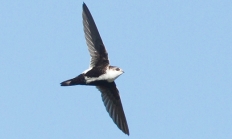
High overhead at the top of the rimrock in Oregon's desert country, the White-throated swift swoops, soars, and darts about erratically, hunting and catching insects. At great speed, it disappears into a crevice on a cliff without appearing to slow down. Its long, strong claws enable it to crawl deep inside these crevices to roosting and nesting areas, which often cannot be seen from the entrance. This bird is a locally common to abundant breeder, primarily on eastern Oregon cliffs. It is an occasional spring and sporadic fall migrant in western Oregon along the coast, in the Willamette Valley, and…
Chukars are ground-loving birds that quickly run uphill or burst from cover with rapid wing-beats and a characteristic whitoo call if alarmed. Introduced by managers wishing to increase hunting opportunities in arid western North America, the chukar is a very successful exotic species that occupies habitats where few other gamebirds exist. It is the most harvested upland bird in Oregon. It is a common permanent resident of eastern Oregon. Populations are distributed in steppe habitats along the breaks of the Columbia, John Day, Snake, Owyhee, Deschutes, Malheur, Burnt and Grand Ronde rivers and lesser watercourses or reservoirs. Hear the call…

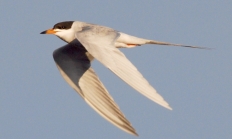
Terns are generally associated with marine environments and salt marshes, but the Forster's tern inhabits freshwater areas. During the breeding season this graceful bird is eastern Oregon's resident small white tern. Typical of terns, the Forster's employs a dramatic hunting method of plunge-diving into shallow waters to capture small fish, the bird sometimes submerging completely. This is an uncommon but highly visible colonial breeder east of the Cascades. Hear the call of the Forster's tern Photo by Dave Budeau, ODFW
This tiny owl has a reputation as an aggressive predator on everything from mice and voles to birds and mammals over twice its size. Coloration is highly variable with brown and gray morphs. In Oregon, color varies from dark brown in coastal mountains to gray in eastern Oregon, with an intermediate pale grayish-brown form in the Cascade mountains. About the length of a White-crowned sparrow, it has striking yellow eyes, dark vertical streaks on the breast and abdomen, and dark "eyespots" on the back of the head. It is primarily diurnal and can often be approached quite closely when it…

Summer Lake Wildlife Area was established in 1944, with primary objectives of protecting and improving waterfowl habitat and providing a public hunting area. It is now a popular destination for hunting, wildlife viewing and environmental education due to its geographic setting, the abundance of wildlife present and species diversity.
SALEM, Ore.—Oregon's Fish and Wildlife Commission meets April 23-24 in Lincoln City. View the agenda online. Commissioners will visit coastal coho habitat restoration and monitoring projects in the Siletz River Basin during a field tour on Thursday. To join the tour, meet at the Shearwater Inn, 120 Inlet Court at…
Teach, restore, study, host, build, communicate When you sign up to be an ODFW volunteer, you are helping to protect Oregon's fish and wildlife, manage ODFW properties and spark a passion in others to hunt, fish and appreciate the outdoors building and enhancing fish, wildlife and their habitats for current and future generations. Donating even one day a year is all it takes to be helpful. We can be as flexible as possible to find the right opportunity to fit your schedule. Join thousands of volunteers by sharing your time and talents with ODFW.