
Search myodfw.com
Showing 101 - 120 of 272 results
This diminutive owl is one of the smallest in North America, with a body mass of about 1.9 ounces. It has dark eyes, brown plumage with darker and reddish variegations, and small ear tufts. The Flammulated owl is unique among owls in the Pacific Northwest in that it preys almost exclusively on insects and is a neotropical migrant. Additionally, the pitch of its rather ventriloquial hoot is among the lowest of all North American owls. The Flammulated owl breeds on the eastern slope of the Cascades, in the Blue and Wallowa mountains, and in small numbers in the mountains of…
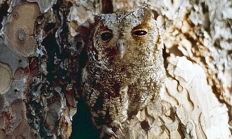
Because of its association with old forests, this inconspicuous, dark brown owl has become one of the most controversial birds in the Pacific Northwest. The dark eyes and creamy white mottling on the breast and abdomen are distinctive, as is the lack of fear of humans. Both adults and young will typically allow humans to approach within a few feet, and it is not unusual for curious juveniles to follow hikers through the woods. The Northern spotted owl is a permanent resident in forested regions of western Oregon, from the coastal mountains to the eastern foothills of the Cascade Range…

The Common nighthawk is a migrant to Oregon with one of the longest migration distances of any North American bird. It is also one of the last to arrive in Oregon. Long, slender wings are marked by a white patch on the "hand" visible in flight from great distances. When perched on the ground, the cryptic brown, gray, and black mottling makes the bird almost invisible. This bird breeds and migrates at all elevations through the state. Its nesting habitat is characterized by open landscapes with little ground cover and is most abundant in sagebrush and rocky scablands and rimrock…

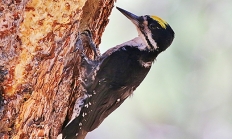
In Oregon, the American three-toed woodpecker tends to use higher-elevation forests; however, forest type may not be as important to this species as the presence of bark beetles. Nests are often fairly low; nest trees are often smaller in diameter than those used by other cavity nesters. Habitat requirements may include trees with heartrot for nesting and high densities of bark or wood-boring beetles. It is rare and local, particularly near and west of the Cascade summit, often near high-elevation lakes or beetle outbreaks. American three-toed woodpeckers are Oregon Conservation Strategy Species in the Blue Mountains and East Cascades ecoregions…
These small salamanders have solid green- brown- or gray-colored sides and backs with bright yellow or orange undersides. Adults can grow to four inches in total length. Columbia torrent salamanders spend their lives in and near cold and clear water bodies including mountain streams, springheads, waterfalls and seeps in older forests. They need loose gravel stream beds for hiding and foraging. They are highly connected to their water sources, but in times of heavy rainfall, they may venture into a nearby forest. The Columbia torrent salamander is an Oregon Conservation Strategy Species in the Coast Range and Willamette Valley ecoregions…

This bat, found in older forests, has a wingspan of about 10 inches. Its fur is glossy black, tipped with white. It forages over ponds, streams, meadows and roads, often flying very low and roosting behind loose tree bark. Maternity roosts of the silver-haired bat are found in trees. This bat usually bears twins. The silver-haired bat occurs statewide in Oregon except for most of the Columbia Basin and is an Oregon Conservation Strategy Species in all ecoregions except the Nearshore ecoregion. It is primarily associated with coniferous forests, including the juniper woodlands in the southeastern portion of the state…

Initial Columbia River spring Chinook seasons set - Sturgeon retention days added in The Dalles Pool
UPDATE FEB. 26, 2026: Fishery managers added another day of sturgeon retention in The Dalles Pool (Tuesday March 3, 2026). The same bag limit and legal size restrictions apply on the days noted below. CLACKAMAS, Ore.—Fishery managers from Oregon and Washington adopted initial recreational spring Chinook seasons on the Columbia…
Of Oregon's breeding seabirds, Leach's storm-petrel is the smallest, most pelagic, and flies the farthest offshore of any of Oregon's breeding seabirds to feed. It spends the non-breeding season in the subtropical and equatorial Pacific. It is the second most abundant breeding seabird in Oregon, and is rarely seen from land or close to shore. It comes to its breeding islands, where it nests in burrows, only under the cover of darkness. Its plumage is black and Oregon populations have a distinct white rump. Leach's storm-petrels are long lived birds characterized by long-term pair bonds and may breed yearly for…

This small shorebird moves along the sand by foot rather than flight. It has a distinct black cap behind a white forehead, a dark line though the eye, and an incomplete black breast band. Males have darker and more distinct breeding plumage than females; both sexes loose coloration during late summer. It is the only shorebird that regularly breeds on Oregon's beaches. East of the Cascades, the Western Snowy plover is a summer resident breeding on alkaline flats and salt pans. On the Oregon coast, this species is found year-round between Heceta Head and Cape Blanco. Western snowy plovers are…

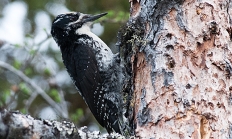
The Black-backed woodpecker can often be found in the open expanses of a recent forest fire or the twiggy closets of a bark beetle outbreak. It may be heard before seen, with its accelerating drum ringing from a prominent snag or its snarling call. Its nest is often low in a tree; both living and dead trees are used, but may require heartrot for excavation of nest cavities. Nest trees are often smaller in diameter than those used by other cavity nesters. It is a rare to locally common resident near the summit and on nearby plateaus and ridges on…
The Juniper titmouse presents the demeanor of a miniature jay with its crest jutted proudly upright. It is a pale gray bird above and underneath, with little or no brown coloration. Songs and calls are useful in locating hidden titmice. The Juniper titmouse occurs in pinyon pine-juniper woodlands in the bulk of its range. This bird is a cavity nester. The nest is often placed in a crevice of a twisted trunk of large, older junipers. It primarily forages in junipers and juniper seed are important in the winter diet. An Oregon Conservation Strategy Species in the Northern Basin and…

The red tree vole is a medium-sized vole. It is uniquely colored among North American voles: bright orangish-red to cinnamon on the dorsum, silvery gray (often with some light orangish hairs) on the venter, and a tail pale orangish on the venter grading to black on the dorsum. This vole is endemic to western Oregon. It occurs at moderate elevations on the west slope of the Cascade Range southward as far as the Douglas-Jackson county line and in the Coast Range to the Oregon-California border. It is largely arboreal and builds nests on suitable foundations (commonly nests of birds or…

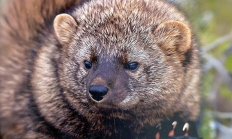
The Fisher is considerably larger than the marten and males are considerably larger than females. It is more stockily built than the weasels, but is similar in that the head is somewhat pointed, the body elongate, and the legs short. The pelage is long except on the face. The fur is dark brown grading to black on the rump and legs; the tail is black. Fishers once occurred throughout the coniferous and mixed forests of Oregon's Coast Range and Cascade Mountains. Currently, there is a native population in the Siskiyou Mountains and an introduced populations in the southern Cascades that…
Siskiyou Mountains salamanders are similar to Del Norte salamanders, except they are a little shorter, growing to about five-and-a-half inches in total length. An adult salamander is brown with a light brown stripe along the back and a grayish-purple belly. It has light scattered flecks along the body. The Siskiyou Mountains salamander is a lungless salamander and breathes through its skin. Siskiyou Mountains salamanders require talus (rock fragment piles) or rock outcrops in older forests. This salamander retreats deep within rocky crevices that remain cool and moist during the dry summer. Even during the rainy season, Siskiyou Mountains salamanders typically…

These large toads are well camouflaged in earth tones with dry bumpy skin that aids in protection from predators. Their color can be highly variable among individuals ranging from gray or reddish-brown to yellow or green. They have a light colored stripe that runs along the center of the back. Adult female toads are larger than males, growing to five inches in length. They live mainly on land in a range of habitats from forests to mountain meadows to desert flats. During the non-breeding season, they are nocturnal. They dig their own burrows in loose soil, use existing burrows or…

Adult Oregon spotted frogs have moist bumpy skin that is reddish-brown on their topsides. On their heads, backs, sides and legs, they have black spots with light centers that darken with age. They also have red bellies and orange-red underlegs. Adult females grow to four inches in length and males to three inches. Oregon spotted frogs live in wet areas that provide abundant aquatic vegetation such as marshes, permanent ponds, lake edges and slow streams. When frightened, they hide in dense vegetation or under debris at the bottom of shallow wetlands. Adult frogs hibernate during the winter in freeze-free seeps…

This medium-sized, shy grebe has bright white cheeks that contrast sharply against a dark crown and rust red neck during the breeding season. An aquatic bird, it breeds in lakes and ponds, usually in forested areas. In Oregon, it is found in waters with hardstem bulrush intermixed with open water over five feet deep. Five to 20 birds at Rocky Point in the Upper Klamath Lake National Wildlife Reserve form the only consistent breeding population in Oregon. The red-necked grebe reaches its greatest numbers during winter along the coast. The red-necked grebe is an Oregon Conservation Strategy Species in the…

SALEM, Ore. – The Private Forest Accord (PFA) Advisory Committee will hold its regular virtual meeting on Tuesday, Sept. 30, 2025. ODFW staff will present two new funding pathways for the PFA Grants Program, Land Transactions and Water Transactions, followed by Advisory Committee discussion of these pathways and the accompanying…
SALEM, Ore.— The Commission set 2026 groundfish regulations during their meeting in Salem today. The daily catch limit for lingcod will increase from 2 to 3 fish next year, since lingcod populations are healthy and bycatch of yelloweye rockfish (a protected species) is still low. The daily limit for general…
In Oregon, fork-tailed storm-petrels breed in numbers that are only a tiny fraction of those of Leach's storm petrels. This is the larger of the two storm-petrels breeding in Oregon and is gray in color. These birds leave and return to breeding colonies only at night, when they are best detected by their distinct raspy call. At sea, they are distinguished by quick, buoyant flight with short glides interspersed with wing fluttering to maintain their position at a food source. Fewer than 20 nests have been found in Oregon, all located in the same habitat as colonies of Leach's storm…
