

Search myodfw.com
Showing 101 - 120 of 672 results
Press Release
SALEM, Ore. – Oregon's Fish Screening Task Force will meet virtually on Thursday, April 2 at 8:30 a.m. The meeting is open to the public and will be held virtually through Teams. The meeting agenda includes updates on the Fish Screening Program, new task force members, and the development of…
March 24, 2026
Press Release
OTIS, Ore.—ODFW's recent legislatively adopted budget did not include funding to continue the operation of Salmon River Hatchery, one of more than 30 hatcheries that ODFW maintains in the State. The cost of operating and maintaining the hatchery exceeded available revenue, but funding is just one of the issues facing…
September 8, 2025
Landing page
Upper and Lower Bennett Dams are located southeast of the town of Stayton on the North Santiam River. Upper Bennett Dam is on the south side of Stayton Island and Lower Bennett Dam is on the north side.
October 13, 2017
Zones or Areas
A dozen great rivers pour out of the Coast Range Mountains into tidal bays that welcome runs of salmon and steelhead. Bays are the year-round home to marine perch, rock fish, crabs and clams, while other species come and go with the seasons and tides. A handful of ponds dot the forested slopes, and there are dozens of dune lakes— many stocked with rainbow trout, and some harboring largemouth bass, perch, crappie and brown bullhead.
Zones or Areas
There is year-round salmon, steelhead, trout and smallmouth bass in the Southwest Zone. Rainbow trout are stocked in the upper Rogue River and in lakes nestled among fir forests and wind-swept dunes. Big reservoirs provide fishing for trout and for thriving populations of largemouth bass, catfish, perch and crappie. Coastal bays serve as gateways to rich offshore reef fisheries, and miles of public beach allow anglers to fish for surfperch against a backdrop of rugged capes.
Zones or Areas
Abundant rainfall feeds the massive Willamette River watershed, tamed by a system of reservoirs that are stocked annually with hundreds of thousands of rainbow trout. Some of these reservoirs also grow trophy-size largemouth and smallmouth bass, as well as bluegill, brown bullhead and crappies. Smaller lakes and ponds nearer the valley floor provide springtime trout fishing close to home. Salmon and steelhead navigate the Willamette River and its tributaries, many of which are also home to rainbow and cutthroat trout.
Zones or Areas
The granite peaks of Oregon’s Blue and Wallowa Mountains form the backdrop for many of this zone’s glacier-carved lakes and crystalline streams. Bull trout thrive in this zone’s cold, clear rivers, which also sustain whitefish and rainbow trout, and welcome returning runs of hatchery-reared steelhead. Chinook salmon travel over 300 miles up the Columbia to spawn in rivers such as the Imnaha and Wallowa. Warmwater fisheries are few, but the John Day River offers world-class fishing for smallmouth bass.
Zones or Areas
Trout fishing opportunities abound in this zone, known for its high desert climate, sage-covered canyons, glacial peaks and mountain lakes. Anglers will find year-round trout fishing in the Deschutes, Metolius, Fall and Crooked rivers, while several central Oregon lakes and reservoirs are renowned for their trout and kokanee fishing – and their beauty. The Hood and lower Deschutes – both tributaries of the Columbia River – offer high desert fishing for Chinook salmon and summer steelhead.
Zones or Areas
The Columbia River is renowned for its salmon and steelhead runs. In a year of good returns, over 1 million Chinook, coho and sockeye salmon, and summer steelhead travel up the river to spawn in its tributaries. Less known are the river’s excellent smallmouth bass and walleye fisheries. While most anglers fish this large river from a boat, there is plenty of good bank access at various parks, boat launches and beaches.
Zones or Areas
Wide open spaces, wild windy places, and extreme temperatures characterize Oregon’s largest, most remote fishing zone. Redband trout are native to its rivers and streams, including the Williamson, Malheur and Chewaucan. Brown and hatchery rainbow trout can grow to trophy-size in many of its lakes and reservoirs, many of which also feature crappie, yellow perch and bass.
Zones or Areas
Oregon’s beaches, bays and ocean waters have more kinds of fishing than anywhere in the state. From chasing surfperch in the… well, surf, to hooking cabezon from a rocky jetty, to going deep after rockfish and halibut, to the line-screaming runs of an albacore tuna, this zone offers a species and fishing technique for every angler. Subscribe for updates Starting Jan. 1, 2026, an Ocean Endorsement is needed for most recreational anglers fishing in the ocean. Check the Ocean Endorsement page for more information. Ocean Endorsement
Zones or Areas
The Snake River and its impoundments offer first class fishing for warmwater species such as channel catfish, crappie and smallmouth bass. That part of the river running through the spectacular Hells Canyon Wilderness may have some of the best summer steelhead fishing in the state.
Press Release
WALDPORT, Ore. — The Oregon Department of Fish and Wildlife and First Baptist Church of Waldport will host the 27th annual family fishing event at Eckman Lake on Saturday, May 16. The event will take place from 9 a.m. to 2 p.m. for youth ages 17 and younger. Each participant…
May 11, 2026
Press Release
SALEM, Ore.--Oregon's Fish Passage Task Force will meet Wednesday, March 11, from 8:00 a.m. to noon online. The meeting agenda includes numerous ODFW Fish Passage Program updates, Task Force business items, and a round table discussion by Fish Passage Task Force Members and ODFW staff on fish passage guidance documents…
March 4, 2026
Species and Subspecies
Features: These fish are light silvery-white, dark on top, and have up to 8 dark, broken stripes running along the sides of their bodies. They are typically less than 10 lbs but can grow to 22 lbs. They have two dorsal fins, the front one with eight or nine spines and the rear one with one spine and 13 or 14 soft rays. Habitat: Hybrid bass were originally stocked in Tenmile Lakes on the south coast and in Ana Reservoir in Lake County. They have since been introduced into Thompson Reservoir, also in Lake County. The only established population is…

Species and Subspecies
Features: Tiger trout are a hybrid between a female brown trout and a male brook trout. They are greenish yellow to brown with dark patches along their sides creating a maze-like pattern. Their belly is yellowish orange and the tail fin is square. Habitat: These sterile fish have been introduced to Diamond and Fish lakes to help combat several invasive bait fish species. Since they do not reproduce, tiger trout are catch-and-release only. Techniques: Tiger trout will go for flies, spoons, spinners and bait. Because tiger trout are piscivorous (they eat other fish), fishing a minnow imitation can be effective.

Species and Subspecies
Features: When in the ocean chum salmon are bluish green on their backs. Their tails lack spots but tend to have silver streaks like the coho. Their lower jaw will be dark at the gum line and white or pink both inside and outside of the gum line. Once in freshwater, chums become dark green to brown with red to purple marks going vertically down their sides. Habitat: Like other salmon species, chum spend most of their lives at sea and return to their natal streams to spawn. Most spawning runs are over a short distance. Adults are strong swimmers…

Species and Subspecies
Features: Common carp are deep-bodied, heavy-looking fish with short heads and forked tails. They have large (really large) scales ranging from grey to bronze. Two barbels hang from each side of the upper lip of their subterminal (near the bottom of the head) mouth. This distinguishes them from goldfish that have no barbels. The dorsal fin is elongated. Habitat: Though tolerant of most conditions, common carp prefer large bodies of slow moving or standing water with soft sediments like mud or sand, and good growths of aquatic vegetation. They’re omnivorous bottom feeders that prefer aquatic insects, worms, mollusks and zooplankton…

Species and Subspecies
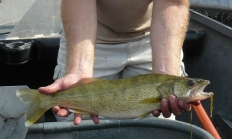
Features: Color varies, but walleye are generally dark olive-brown on top grading to almost white below. Walleye have two well-separated dorsal fins; the first fin has a large black spot at its rear base. The opaque eyes, giving the fish its common name, and canine teeth are other prominent features. Habitat: Walleye are found in the Columbia, Willamette and Snake rivers. In the Willamette River, the walleye fishery is generally limited to the section downstream from Willamette Falls at Oregon City, although a few have been documented as far upstream as Dexter Dam. Walleye prefer large, clean and cold or…
Species and Subspecies
Features: Largemouth bass are greenish on the back and sides with a white belly and usually a dark horizontal stripe along the side. They are distinguished from their close cousin, the smallmouth, by a large mouth with the upper jaw extending behind the eye. Largemouth bass in Oregon can exceed 25 inches in length and a weight of 12 pounds. Habitats: Their preferred habitats are shallow ponds and lakes, or the backwater sloughs of rivers where aquatic plants or submerged logs and brush provide abundant cover. Largemouth bass begin life feeding on zooplankton (tiny crustaceans), but soon switch to insects…
