
Search myodfw.com
Showing 101 - 120 of 509 results

Crabbing and clamming are year-round activities on the Oregon coast. Clam diggers will want to watch for low tides, when more beach is exposed for digging. Crabbers will have the best luck during slack tide when crabs are walking about foraging. Visit e-regulations
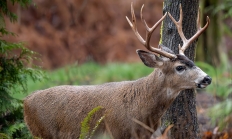
Duck season has begun, plan your Sauvie Island hunt using the reservation summaries and daily harvest reports to increase your odds of success.
Each year ODFW assesses the freshwater escapement of Rogue River coho, fall Chinook, late run summer steelhead, and "half-pounder" steelhead by beach seining the waters near Huntley Park three times a week from Mid July thru October.

Features: Hungarian partridge have a gray-brown body with reddish brown barring on their wings, back and tail. Their beak and legs are gray. Habitat: In eastern Oregon, the best partridge populations exist in Columbia and Snake River basin counties. Although some birds may be found many miles from farming areas, the bunchgrass and sagebrush foothills adjacent to wheat and other farmlands provide the best habitat and the most stable populations. Technique: "Huns" are swift and challenging birds to hunt, usually bursting from the cover with a startling squeal and clatter of wings. They are typically hunted incidentally to pheasants or…

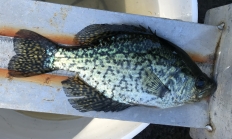
Features: Black crappie are silvery in color with numerous black or dark green blotches and no distinct vertical bars. This results in a darker overall color than seen in white crappie. The forehead is dished, but not as much as in the white crappie. The dorsal fin usually has seven or eight spines and its length is equal to or greater than the distance between the dorsal fin and eye. Habitat: Black crappie do best in clear waters of medium-sized lakes, reservoirs and large slow moving streams. They are less tolerant of flowing and muddy water than white crappie and…
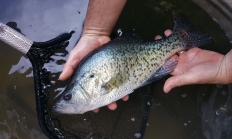
Features: White crappie are often confused with black crappie. White crappie have silvery bodies with blackish-green mottling forming narrow vertical bars on the sides. The forehead is more dished than in the black crappie. The dorsal fin has five or six spines and its length is less than the distance between the dorsal fin and eye. Habitat: White crappie do best in larger lakes and reservoirs and are more tolerant of turbidity and less dependent on aquatic vegetation than black crappie. They congregate around pilings, sunken logs, underwater brush, weed beds and rocks. White crappie begin life feeding primarily on…
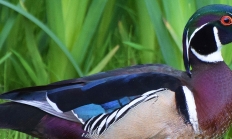
Features: Wood ducks can not be mistaken. The drake's iridescent chestnut, greens and white patterning are distinctive. The hen has a unique profile and white pattern around the eye. Habitat: Wood ducks are found in wooded swamps, on rivers and ponds. They feed on mostly seeds, but wood ducks will supplement their diet with aquatic plants, insects and crustaceans too. Acorns, hazelnuts, waste grains, and fallen seeds from trees and shrubs make up a good deal of their diet. As the name implies, they nest in tree cavities near water. Techniques: Search out a wood duck's food source and wait…

Three Mile Falls Dam is located at river mile three on the Umatilla River. The dam was constructed in the early 1900s and serves as an irrigation dam that is a complete barrier to fish migrating upstream. In order to successfully migrate past the dam, all adult salmon and steelhead must use the fish passage facility located on the east side of the dam. The fish facility consists of a fish ladder, viewing window, fish trap and holding pond. Every adult salmon and steelhead heading upstream is counted at this facility using a combination of trapping and video tape enumeration…

Central Fishing May 7, 2026 Best bets for weekend fishing Anglers that have been able to get on the water at Lava and Little Lava Lakes report excelling early season trout fishing for large holdover trout. See Announcements about access. Shevlin Park youth and disabled fishing pond, Prineville youth pond, and Pine Nursery Pond were recently stocked to provide excellent spring angling opportunities. The Metolius youth and disabled fishing pond reopened on May 1 with good numbers of large holdover trout. North and South Twin Lakes were recently stocked in late April with both legal and trophy rainbow trout. Wickiup…
Features: Bullheads present in Oregon are distinguished from channel catfish by their square or rounded tails and lack of spotting. They seldom exceed 18 inches in length and a weight of 2 pounds. Yellow bullheads are a more uniform yellow color with white or cream chin barbels and a rounded tail. Habitat: Bullheads are found on the bottom in the shallows of mud-bottomed ponds, lakes, reservoirs and backwaters of rivers. The yellow bullhead is found mainly in the Willamette basin. Technique: Bullheads can be caught any month of the year, but fishing is best from the first warm days of…
