
Search myodfw.com
Showing 1201 - 1220 of 1410 results
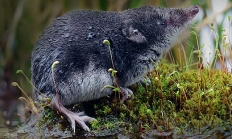
The water shrew is a large shrew with a very dark gray to black dorsal pelage, a white venter and throat, and a sharply bicolored tail. It occurs, in Oregon, as disjunct populations in the Wallowa, Blue, Ochoco, Strawberry, Steens, and Hart mountains and in the High Cascade Range west and downslope to McKenzie Bridge, Lane county. It is almost always found near water. Undercut banks, exposed tree roots, and boulder-strewn streamsides vegetated by willow, willow-grass, or willow-alder associations seem to be prime habitat. Photo by Charlie Marshall, Flickr
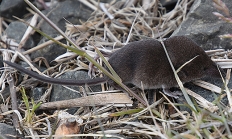
Preble's shrew is the smallest shrew in Oregon; adults commonly weigh less than a dime. The pelage is medium dark-brown to very dark-gray on the dorsum and silvery gray on the venter. The tail is bicolored, medium dark-brown on the dorsal surface, white on the ventral surface and darkening toward the tip. In Oregon, it has been found in Deschutes, Grant, Klamath, Lake, Harney, Malheur, and Wallowa counties. Its habitats include marshes, along streams, dry bunchgrass, and wet, alkaline habitat. Grasses and sagebrush are common to most habitats.
The fog shrew is the largest of the brown shrews in Oregon. Its range extends from Taft in Lincoln County east to near the eastern boundaries of Linn and Lane counties (except it is absent in the Willamette Valley) and southward along the west slope of the Cascade Range and in the Coast Range and Siskiyou Mountains. They are found in alder/salmonberry, riparian alder, and skunk cabbage marsh habitats and less often in conifer habitats.
Trowbridge's shrew is a medium-sized shrew, distinguished from other Oregon shrews by its dark-brown or grayish black pelage on both dorsum and venter, and its sharply bicolored tail, white below and dark brown or grayish black above. In Oregon, its range is west and south of a line connecting Parkdale, Hood River County; Pine Grove, Wasco County; Alder Spring, Lane County; Diamond Lake, Douglas County; Gearhart Mountain, Lake County; and Lakeview, Lake County. It occurs in all stages of the coniferous forest from old growth to recent clear-cuttings. Photo by Don Henise, Flickr
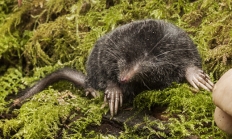
The shrew-mole is the smallest talpid in Oregon. The pelage is black; the eyes are rudimentary. The tail is about 50 percent of the length of the head and body, fat, sparsely haired, blunt ended, covered with transverse annular rows of scales and tufted. In Oregon, the species occurs as far east as Brooks Meadows, Hood River County; Indian Ford Campground, Deschutes County; and Fort Klamath, Klamath County. It is most abundant in moist sod-free ravines with deep, black-silt soils with high humus content and covered with a layer of dead leaves and twigs. Dominant vegetation in these areas is…
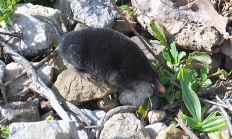
The broad-footed mole is intermediate in size among Oregon moles. It occurs south of a line connecting Hugo, Josephine County; Prospect, Jackson County; Crater Lake, Klamath County; and Fort Rock and Goose Lake, Lake County. Photo from Panegyrics of Granovetter, Flickr
The coast mole is the smallest of the moles in Oregon. It occurs in Baker, Umatilla, Grant, Crook, Union, Sherman and Wasco counties east of the Cascade Range and throughout most areas west of the Cascade Range, except it is absent from much of the Willamette Valley. Photo by Peter Paquet, Flickr
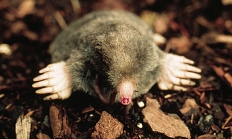
Townsend's mole is the largest talpid in Oregon. In Oregon, it is restricted to the interior valleys and coastal regions west of the foothills of the Cascade Range. It occupies pastures, prairies, and shrub habitats in lowlands and river flood plains. The highest densities were recorded in pasture areas in Tillamook County. Photo by J. Maughn, Flickr
The Western small-footed myotis is among the smaller bats in Oregon and is brown to pale yellow with black ears and a black mask across its eyes and nose. It lives in dry climates, especially cliffs and rocks, and forages back and forth along the face of cliffs. It hibernates in caves and mines from November through February. In Oregon, the species only occurs east of the Cascade Range. Photo by ©Michael Durham

This bat is commonly found in attics and buildings during summer months in maternity colonies. It weighs about half an ounce and has a wingspan of nine to 11 inches. It prefers to live in forests near water. One baby is born in spring or summer. In winter, this bat hibernates in caves. The little brown myotis occurs throughout Oregon in a wide variety of habitats, but seems especially prone to establish residence near a lake, pond, or stream. Photo by ©Michael Durham

The long-legged myotis lives in forests and comes out early in the evening to hunt. It is a fast flier and will chase insects for a long distance. One baby is born in the summer, and the species hibernates in winter. In general, the long-legged myotis is a species associated with montane coniferous forests, but it also occurs in some desert and riparian habitats. The long-legged myotis is an Oregon Conservation Strategy Species in these ecoregions: Blue Mountains, Coast Range, East and West Cascades, Klamath Mountains, and Northern Basin and Range. Photo by ©Michael Durham
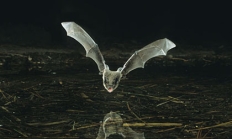
The hoary bat has a wingspan of nearly 16 inches. It has dark fur tipped with white, a dark mask on its face, a yellow-orange throat and round ears edged in black. This bat roosts in branches of trees and likes to feed around outdoor lights. Hoary bats migrate south in winter, returning to Oregon in the spring. This bat usually bears twins. Hoary bats are found at scattered localities over most of the region west of the Cascade Range and in montane regions east of the Cascade Range. They are an Oregon Conservation Strategy Species in all ecoregions except…

The canyon bat weighs less than one quarter of an ounce! Its fur is pale yellow to brownish gray with a dark face mask. It lives in eastern Oregon, likes rocky canyons and outcrops and flies early in the evening when it feeds on swarms of flying insects. Photo by ©Michael Durham

Spotted bats are rare in North America, living in dry climates and often roosting on high cliffs. They are white underneath with dark fur on their back and with large white spots. The spotted bat is found in eastern Oregon and is an Oregon Conservation Strategy Species in the Blue Mountains, Columbia Plateau, East Cascades, Klamath Mountains and Northern Basin and Range ecoregions. Photo by ©Michael Durham

This is a large, pale bat with huge ears, large eyes and a dog-like face. Its wing beat is slower than most bats. It emerges late at night to feed primarily on the ground, eating large beetles, crickets, and even scorpions. Pallid bats can walk on the ground and are immune to a scorpion’s sting. The pallid bat is uncommon and is found mostly in arid regions in canyons in southwestern and eastern Oregon. It's an Oregon Conservation Strategy Species in the Blue Mountains, Columbia Plateau, East Cascades, Klamath Mountains, and Northern Basin and Range ecoregions. Photo by ©Michael Durham

The Brazilian free-tailed bat is a fast-flying, medium-small bat with long narrow wings and a tail. It survives the cold winters in Oregon by staying in heated buildings instead of hibernating or migrating, often sharing these quarters with other bat species. Roseburg may be the most northern part of this bat’s range. Photo by ©Michael Durham

The rat-sized American pika is characterized by rounded ears, no external tail, bare planter pads, and hind feed scarcely longer than the front feet. The pika requires talus, creviced rock, and other high elevation microhabitats that provide cool microclimates. Adequate forage close to rocky crevices is needed. In Oregon, the species is limited to suitable habitats in the Cascade Range and the Wallowa, Blue, Strawberry, Steens, Hart, and Warner mountains, and at Newberry Crater in Deschutes County and Grizzly and Cougar peaks in western Lake County. The American pika is an Oregon Conservation Strategy Species and is limited by its…

The ears of the pygmy rabbit are short, rounded, and covered with long silky hairs inside and out; the tail is small and covered with hairs possessing wide buffy bands with narrow blackish tips above and below; and the feet are short, densely furred below, and colored a light orangy-buff. In Oregon, pygmy rabbits have been found east and south of a line connecting Klamath Falls, Fremont, Redmond, and Baker City. This rabbit is closely tied to habitats dominated by big sagebrush. The Pygmy rabbit is an Oregon Conservation Strategy Species in the Northern Basin and Range ecoregion. Photo from…

The brush rabbit rarely ventures more than a few meters from the extremely dense brush that constitutes the requisite component of their habitat. Runways are interlaced through brushy clumps into surrounding grassy areas and are kept clear of vegetation for easy and quick access to and from foraging areas. In Oregon, the brush rabbit occurs in the Willamette Valley and other interior valleys, in coastal areas, and in valleys along coastal streams from the Columbia River south, and from the foothills of the Cascade Range west. Photo by ©Keith Kohl, ODFW

The eastern cottontail is the largest member of the genus in Oregon. Overall, the dorsal pelage is brownish, becoming darker (almost black) on the rump and lighter buffy brown on the flanks; the nape patch is orangy brown without black hairs, and the head is the same color as the dorsum. The hairs on the dorsum have steel gray bases followed by bands of brownish black, buff, and black. The venter hairs are white with gray bases, giving a splotched appearance when the hairs are spread, and the tail hairs are white to the base. This rabbit was introduced into…
