
Search myodfw.com
Showing 1301 - 1320 of 1410 results
Oregon's three cat species all belong to the same family as the domestic house cat. Cats are muscular but graceful and have retractable claws to hold prey.
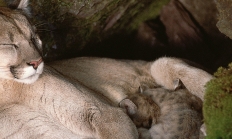
The Canada lynx is only slightly larger than the bobcat. Nevertheless, long legs and long fur produce the illusion that the lynx is considerably larger than it actually is. Documented accounts of wild lynx are rare and lynx are not expected to currently reside in Oregon. However, if lynx were to be observed, it is likely to occur at higher elevations such as in the Cascade Range, Blue Mountains or Wallowa Mountains. Habitats used by lynx often are defined in terms of habitats used by their primary prey species, thus good snowshoe hare habitat usually is considered to be good…

The bobcat is the smallest wild felid in Oregon, with females being considerably smaller than males. The bobcat is about twice the size of a domestic cat, but its legs are longer, its tail is shorter, and its body is more muscular and compact. The feet are relatively small and the bobcat is not well adapted to negotiate deep snow. In general, the variously spotted pelage is yellowish with grayish overtones in winter and with reddish overtones in summer, reflecting the two annual molts. The ears are black with a large white spot and are equipped with short black tufts…

Oregon's hoofed mammals include three sub-species of deer, along with moose, elk, goat, and sheep. Otherwise known as ungulates, these animals are herbivores.
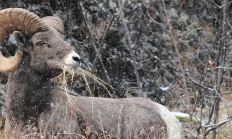
The moose is the largest member of the family Cervidae. The pelage is blackish or dark brownish grading to dark gray or grayish brown on the venter and leg. The muzzle is broad and overhanging, the palmate antlers of adult males are massive, and a "bell" (waddlelike flap of skin on the throat) is present. The first moose to come to Oregon wandered south from Washington or west from Idaho across the Palouse Prairie. They stayed to establish a herd in the Blue Mountains north of Elgin, and today there are an estimated 50 adults and calves in the area…

The pronghorn, often called "antelope," is deer-sized with relatively long and thin legs and feet with just two digits on each foot, a relatively small tail, and unique horns consisting of deciduous keratin sheaths set on bony cores arising from the fontal bones. Among males, the laterally flattened sheaths are long, branched and recurved, but in those females that possess horns they are short and simple. The horns and hooves are black. The front feet are larger and carry most of the weight when the pronghorn runs. The pelage is course. The dorsum is a light buff and is separated…
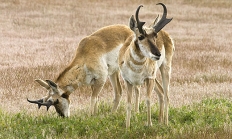
The mountain goat is a stockily built bovid with black scimitar-shaped horns, large black hooves and prominent dew claws, and an entirely white, wooly pelage. Sometimes the pelage contains scattered brown hairs on the dorsum and rump. A long beard, pointed ears, and a squarish muzzle are also characteristic. Males are larger, and have longer, larger-diameter, and more evenly curved horns that females. Mountain goats are denizens of high altitudes, remote, and barren montane regions where they are capable of moving through exceedingly rugged and precipitous terrain with speed and agility. Nevertheless, mountain goats are known to fall occasionally, whereupon…
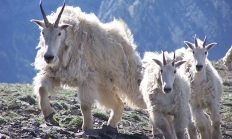
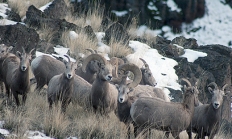
The bighorn sheep is a medium-sized, largely brownish bovid with a white rump patch, muzzle, venter, and rear portion of the legs. The tail is blackish brown on the exposed surface. The hooves are equipped with a rubberlike pad that facilitates negotiating rocky terrain. The ears are relatively small and somewhat pointed. Both sexes are equipped with horns; those of males are massive and spiral outward, whereas those of females are relatively thin, recurved, and mostly directed upward and posteriorly. Horn growth reflects nutritional status. Bighorn sheep are capable of moving with speed and agility through the precipitous terrain in…
There are about 80 species of whales, dolphins and porpoises with 10 of those in the waters off Oregon's coast. These include the mighty gray whale, the awe-inspiring killer whale, and the charming and intelligent bottlenose dolphin.
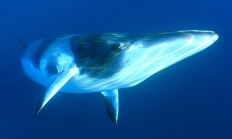
The minke whale is one of the smallest baleen whales, growing to about 35 feet. They feed along the coast in the same area as gray whales. It is close enough in size to a gray whale that you could mistake one for the other at a distance. At close range, however, the difference is apparent. Minkes have a dark black or gray, sleek body with a white underside. They are often recognized by surfacing snout first and a small, weak, but visible, bushy blow that is about six to 10 feet high. When diving, they do not display their…
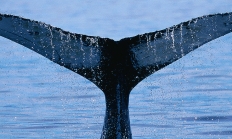
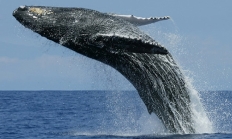
Humpback whales are seen during their north and south migrations from northern waters to breeding grounds near Hawaii and also feeding offshore during the summer. Humpbacks have been documented travelling 3,000 miles between Alaska and Hawaii in as few as 36 days. They are usually five to 15 miles offshore, so they are most often seen by fishers. Humpback whales live in all major oceans from the equator to sub-polar latitudes. Humpbacks eat primarily krill and small fish and can consume 3,000 pounds of food a day. Humpbacks grow to 60 feet in length with a stocky body, an obvious…
Sperm whales inhabit all oceans of the world, and have been observed in Oregon waters from March through November. Sperm whales are usually found in deep off-shore waters so they are only occasionally seen off Oregon by fishers and birders on offshore trips. It is the largest of the toothed whales and possesses the largest brain of any animal with an enormous head to house it. Sperm whales have 20 to 26 large conical teeth found only in their lower jaw. A mature male can grow to 52 feet long with its head representing up to one-third of its length…

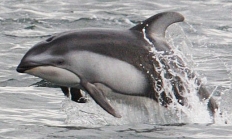
The Pacific white-sided dolphin is most abundant in the Southern California Bight in winter, but move further north, off Oregon and Washington in summer. These animals can be found from the tip of Baja to the Aleutians and the western Pacific from the Kuril Islands to Japan. They prefer deep, off-shore waters, so sightings are usually limited to recreational and commercial fishers. The Pacific white-sided dolphin is about seven or eight feet long. It has three colors: the chin, throat and belly are creamy white; the beak, flippers, back, and dorsal fin are a dark gray, and there are light…
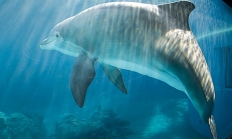
The bottlenose dolphin is the most common of the oceanic dolphins and can be found in all tropical and temperate oceans. Flipper was a bottlenose dolphin. Their considerable intelligence and permanently-affixed smile make them a favorite of aquarium and television shows. The U.S. Navy also uses bottlenose dolphins to find mines and booby traps underwater. Oregon is the northern extent of its range on the West Coast. They are most often seen offshore during the summer by tuna and other fishers. They are gray with light gray to white on the undersides. In size they range from six to 13…
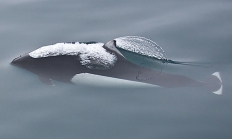
A thick body, small head and coloration similar to a killer whale make this dolphin easy to recognize. Dall’s porpoise is mostly black with a large white patch on the belly and flanks. The small dorsal fin is partly white and the trailing edges of the tail are frosted white. About seven feet long and weighing around 400 pounds, Dall’s live only in the north Pacific. Dall’s are the fastest of all small cetaceans and can swim at up to 35 miles per hour, almost as fast as a killer whale. When swimming at the surface they create a characteristic…
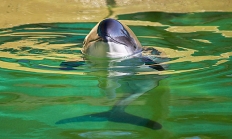
Like the name suggests, harbor porpoises remain close to shore and in river estuaries and bays usually less than 650 feet deep. This makes them the most likely porpoise seen from shore. They seem more shy than their larger, more gregarious cousins, like the Dall’s porpoise or bottlenose dolphin. You won’t see them riding the bow waves of boats. They are also not as social, usually seen alone or in small groups of two or three, rarely more than five individuals. Found throughout the temperate coastal waters of the Northern Hemisphere, harbor porpoises are the smallest of the Northern Pacific…
Seeing killer whales off the Oregon coast is a rare treat, but whale watchers can usually count on a pod of orca’s patrolling the coast in mid-April – just in time to intercept baby gray whales. Orcas are most often seen in the ocean off Depoe Bay and Newport, but can be spotted coastwide. The first thing you are likely to see when sighting killer whales is their dorsal fin. Male orcas have a dorsal fin that can be six feet in height, juveniles and females have shorter fins. These large fins can be seen from quite a distance. There…

Western painted turtles need marshy ponds, small lakes, slow-moving streams and quiet, off-channel portions of rivers. They prefer waters with muddy bottoms with aquatic vegetation. Open ground for nesting and logs for basking help keep this species healthy. These painted turtles occur in the Blue Mountains and Willamette Valley ecoregions. In the Columbia Plateau, East Cascades and West Cascades ecoregions, they live only along the Columbia River. Western painted turtles are an Oregon Conservation Strategy Species in these: Blue Mountains, Coast Range, Columbia Plateau, East Cascades, West Cascades, Willamette Valley. Photo by Robert Bryce Ott
