Search myodfw.com
Showing 141 - 160 of 903 results
Features: Males have glossy, slate-blue plumage accented with white stripes and dots. Females are mottled brown. Habitat: In the summer these ducks breed on fast water rivers in western Oregon. During winter they can be spotted in rocky intertidal areas along the coast. Larger concentrations of wintering birds are usually seen in Lane, Lincoln and Coos counties. Techniques: These ducks are extremely rare in the bag. Their winter habitat of rocky intertidal areas are mostly inaccessible to hunters.

Features: Slender birds, mourning doves have long tails and small heads. Their soft cooing and whistling wings make them unmistakable. Habitats: Mourning doves perch on telephone wires or in trees. They forage on the ground for seeds. Techniques: Scouting is always helpful. Look for a tree or telephone line that is near a food crop. Once a location is found, find a spot where a backdrop will breakup your silhouette and take a seat. Wait for a passing shot. Extra shells may be necessary.

Features: Adult drakes have a black bill, buff head, gray body, and black upper and lower tail coverts. Hens are nondescript brown ducks with a spotted, yellowish-orange bill with black edges. Unique among dabbling ducks, the gadwall has a partly white speculum (rear part of the wing) that can be seen when the bird is in flight. Habitat: Submerged aquatic vegetation makes up the majority of the gadwall's diet. As a result, they are often found feeding far from the shoreline, in deeper water than most other dabbling ducks. Can be abundant is eastern Oregon early in the season, but…

Features: The drake has a red head, black breast and tail coverts, and steel gray back, flanks and tail. Hens are a medium brown. During courtship, the drake utters a very unduck-like meow. Habitat: This diving duck is a locally common breeding species throughout the marshes of eastern Oregon such as Ladd Marsh, Summer Lake, the Warner Wetlands, and Malheur NWR. Known for nest parasitism, laying eggs in the nests of other birds, usually other diving ducks, redhead eggs have also been found in the nests of a variety of species. Techniques: The redhead is a very uncommon winter resident…



Features: Brant are a small to medium-size goose. They have smoky black backs and bellies, and dissected white collars and white around the tails provide striking contrast. The brant can live up to 20 years and are resilient enough to ride out storms on the open ocean. Habitats: Brant are primarily found in bays and estuaries, but on occasion can be found inland. They forage on eel grass and other aquatic vegetation. Most of their feeding is in shallow water or in tidal flats. They tend to feed in flocks. Techniques: As with any waterfowl hunting, location is key. Seek…

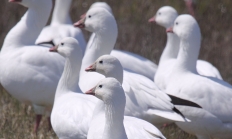
Features: The small Ross's goose looks very similar to a snow goose, but with some slight distinguishing features. Like the snow goose, this goose has black primary feathers. But it does not have the black grin of a snow goose on its pink bill. Also, their wing beat is faster and call higher pitched than a snow goose's. Habitats: The Ross's goose can be found in shallow lakes and wetlands while in migration. It feeds on grasses, sedges and small grains. Techniques: Often taken while snow goose hunting, the techniques are similar. Create a white decoy spread with silhouettes, white…
Features: Drakes have a black head with a white spot below and in front of the eye -- rather than the crescent-shaped patch of the barrow's goldeneye -- white neck, breast and flanks and a black back and tail. Hens have a brown head, light neck, breast and belly, brown backs and flanks. Drakes and hens of both common and Barrow's goldeneye have a distinctive golden ring around the pupil. Habitat: It is a common migrant in northeastern Oregon and winter resident of the Snake, Columbia, Klamath, Rogue and Umpqua rivers. Techniques: These ducks travel in small groups of two…

Features: Blue grouse are large in comparison to most other grouse species. The females are mottled brown, tan, and gray. The males are similar, but with solid blue-gray on the underside and bright orange-yellow combs over the eyes. Habitat: Blue grouse occupy the coniferous forests of western Oregon, the eastern slopes of the Cascades, the Blue Mountains of northeastern Oregon, and the Klamath Basin and south Warner Mountains. Preferred habitat includes timber edges, open timbered slopes, mountain meadows adjacent to springs or other sources of water, and near berry producing areas such as chokecherry thickets. Technique: Effective hunting techniques involve…

Features: Spruce grouse are gray with white spots on the belly. The back feathers often have dark bars. Females tend to be paler in color than the males. The eyes are outlined by red combs over and white arcs underneath. Habitat: The spruce grouse is native to Oregon and found in coniferous forests across northern North America. However, Oregon is on the periphery of this species' range and they likely were never abundant in the state. Currently, spruce grouse can only be found in the Wallowa Mountains and Snake River divide of northeastern Oregon. Technique: Spruce grouse have been protected…


SALEM, Ore.—Oregon's Fish and Wildlife Commission today made changes to the formula used to allocate mule deer Landowner Preference (LOP) tags, which was needed due to the new harvest and population management system for mule deer approved in 2024. In a 6-0 vote (one abstention), the Commission approved shifting to…
Hunter's Guide Hunter's Resources Hunter's Technique Hunter's Bounty
Spring and Fall
Online Learning