Search myodfw.com
Showing 161 - 180 of 672 results
Species and Subspecies
Features: Similar to the greater scaup in appearance and habits, but smaller and lacking the white on the primaries. In the field, however, the black-and-white drakes and brown hens are very similar to greater scaups. Habitat: In general, the lesser scaup is more likely to be found in interior or freshwater habitats while the greater scaup is more a coastal bird. Techniques: Scaup are rafting birds attracted to large spreads of scaup decoys. Popular hunting destinations include coastal estuaries and lakes, where most hunters hunt from a boat. However, in the marshes of eastern Oregon, there can be good hunting…

Zones or Areas
Hunting opportunities abound in the densely forested southwest corner of Oregon. From the beautiful, ragged coastline through the Siskiyou Mountains to Crater Lake National Park, there is something for every game bird hunter.
Species and Subspecies
Features: Female pheasants are brown on top and paler underneath. They have black spots on their sides and black bars throughout their tails. The males are much more conspicuous with bright red on their head, a white band around their necks, and an iridescent copper color on their sides and backs. Their tails are long and pointed with barring. Habitat: The ringneck is a farmland species, heavily dependent on cereal grains and other seeds. They also like taller vegetation for cover. Technique: Because pheasants are tied so closely to agriculture, the majority of hunting opportunity occurs on private lands. State…

Species and Subspecies
Features: In breeding plumage, green-winged drakes have a cinnamon-colored head with a green eye-stripe, gray back, flanks, and a bright patch of iridescent green on the rear of the wing (speculum). Hens are brown with a green speculum. Habitat: Green-winged teal are primarily winter migrants in Oregon. They are puddle (dabbling) ducks that prefer shallow areas like ponds and marshes, where they feed on or near the surface of the water by tipping up. Techniques: Teal are early migrants that begin arriving in Oregon in August but will continue to arrive into November. There are good early season hunts in…

Species and Subspecies
Features: Canada geese come in many sizes and colorations. All have the same general long, black neck and white chinstrap. Their breast color can range from light gray to a dark brown. Habitats: Canada geese have become abundant in many city parks and agricultural fields where forage grasses are available. They can be found floating in bays, estuaries, rivers, reservoirs and lakes as well. Techniques: Canada geese can be hunted like other waterfowl. From jump shooting to calling birds into a decoy spread, Canada goose hunting can be productive. Note: If you want to hunt geese in Northwest Oregon, a…

Species and Subspecies
Features: Columbian black-tailed deer are smaller and darker than mule deer. As the name suggests, black-tailed deer have a wide, triangular tail with a dark brown or black top and a white underside. Habitat: Blacktails are a subspecies of mule deer found in western Oregon from the Coast Range east to the Cascade Mountains. They are edge-adapted species using the region’s dense forest cover to hide during the day and are then more open in early successional forest to feed at dawn and dusk. Places with a mix of forest age classes offer the best habitat for black-tailed deer. Techniques…

Species and Subspecies
Features: Mule deer are larger and lighter in color than black-tails. Mule deer have a thinner “ropelike” tail that is white with a black tip. Their antlers are forked, as opposed to having a main beam. And as their name implies, they have large ears, like a mule, that stand at an angle. Habitat: Mule deer occupy a wide range of habitat types; some live in desert shrub-steppe, some in woodlands, and some in conifer forests. In general, however, mule deer occupy the more open, rugged areas. Although mule deer commonly are considered “browsers," they consume a wide variety of…

Species and Subspecies
Features: Valley quail are often detected by their distinctive call which seems to say "Chicago". They are a covey-loving bird and wintering groups may number over 100. They are gray to brown with intricate scaling in the feathers on the belly. Their top knot droops forward toward the beak. Habitat: Valley quail are among Oregon's most widely distributed game birds. They may be found associated with agricultural and urban areas, as well as in riparian habitats located miles from human habitation. Within these areas, however, valley quail habitat needs are rather specific. Valley quail feed on a wide variety of…

Zones or Areas
From the eastern flanks of Crater Lake National Park through ponderosa pine forests to the nationally-renowned Klamath National Wildlife Refuge, there is something for every bird hunter in south central Oregon.
Zones or Areas
From the eastern flanks of Crater Lake National Park through the national forests of Douglas fir and ponderosa pine forests to the California border, there's plenty of public land to find your hunt.
Zones or Areas
From the rugged Coast Range to the Cascade Mountains, this vast area offers good general season hunting opportunities.

Zones or Areas
Densely forested hillsides from the coast through the Siskiyou Mountains to the Cascade Range offer excellent habitat for a myriad of big game species.

Species and Subspecies
Features: Hungarian partridge have a gray-brown body with reddish brown barring on their wings, back and tail. Their beak and legs are gray. Habitat: In eastern Oregon, the best partridge populations exist in Columbia and Snake River basin counties. Although some birds may be found many miles from farming areas, the bunchgrass and sagebrush foothills adjacent to wheat and other farmlands provide the best habitat and the most stable populations. Technique: "Huns" are swift and challenging birds to hunt, usually bursting from the cover with a startling squeal and clatter of wings. They are typically hunted incidentally to pheasants or…

Species and Subspecies
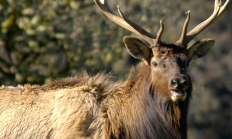
Features: Rocky Mountain elk are one of two subspecies of elk found in Oregon, with a population estimate of more than 74,000 in the state. They are lighter in color and slightly smaller in size than Roosevelt elk, but their antlers are the largest of all elk and can weigh up to 40 pounds. Habitat: Rocky Mountain elk inhabit most of eastern Oregon with concentrations in the Blue Mountains and south-central Oregon. Techniques: Rocky Mountain elk live in much more open country that Roosevelts so try glassing, still hunting, spot and stalk and calling. Rifle, archery and muzzleloader seasons are…

Species and Subspecies
Features: Roosevelt elk are one of two subspecies of elk found in Oregon, with an estimated population of 59,000 in the state. “Rosies” are darker in color than other elk subspecies and the largest in terms of body size, with bulls generally weighing 700-1,100 pounds. Habitat: Roosevelt elk occupy most of western Oregon, with concentrations in the Cascade and Coast ranges. All elk west of Hwy 97 are considered to be Roosevelt elk, though there is some overlap of Oregon’s two subspecies in the Cascades. Techniques: Roosevelt elk make their home in the thick and lush forests of western Oregon…
Species and Subspecies
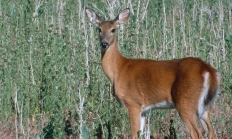
Features: Oregon’s rarest deer has a brown tail that is longer than a blacktail’s wide tail. Its antlers will branch off from a single main beam, unlike mule deer and blacktail antlers that branch twice. Habitat: The Columbian whitetail is a subspecies unique to Oregon and southwest Washington and found in just a few locations—along the lower Columbia River in Oregon and Washington, and in the Umpqua Basin near Roseburg (where it is expanding its range). Techniques: Just a few controlled hunts for this subspecies exist in the Umpqua Basin region and tags are limited; see the regulations for details.
Species and Subspecies
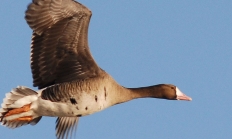
Features: The distinctive white band across the base of their bill gives this goose its name. It is medium in size with a gray and brown body. Adults have d ark brown and black spots on their chests and breasts give this goose the "specklebelly" nickname, while the young of the year birds are a nondescript gray with yellow legs and bills. Habitats: The white-fronted goose grazes on a mixture of grasses and grains. It can often be found in agricultural lands. Techniques: Hunting white-fronted geese is not for the faint-hearted. Scouting is necessary. And since they're mostly found in…
Species and Subspecies
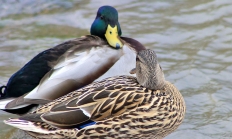
Features: During the fall, winter and spring months, males can be quickly identified by their distinctive iridescent green heads. Females are mottled-brown, with a dark brown stripe through each eye, an orange bill with black splotching and have orange legs. Immature ducks resemble adult females until the males develop more colorful plumage in early fall. After breeding season, males develop duller eclipse plumage beginning in June and resemble hens until mid-September. Wings of both sexes have a violet-blue speculum bordered in front and behind by a pronounced white stripe. Habitat: Mallards are the most common breeding and wintering duck in…
Species and Subspecies
Features: A medium-size goose, adult snow geese are white with black-tipped wings that are visible in flight. Their pronounced pink bill has a dark "grinning" patch across it, and they have pinkish feet. Young of the year snow geese are grayish white with grey legs and bills. These birds are very vocal and can be heard over a mile away. Habitat: Snow geese are well-adapted to agricultural land. They can also be found in wetlands, roosting in open water. Sauvie Island, Summer Lake and Klamath wildlife areas have abundant snow goose populations during various times of year. Technique: Snow geese…

Article
Take a look at what's available this year! ODFW connects people to Oregon's great outdoors by offering a multitude of workshops and events throughout the year. Education programs cover Hunter Safety certification courses and field days, ability level and age specific workshops, and events for the entire family. Upcoming classes and workshops
February 4, 2026