
2024 Sport Halibut Newsletter
This newsletter provides a summary of Oregon’s 2024 sport Pacific halibut fishery.
2024 Season Summary
High landings but small, young fish
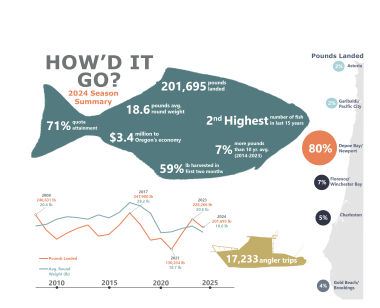
The 2024 recreational (sport) Pacific halibut season had a high quota of 283,784 pounds net weight (dressed, head-on), of which approximately 71 percent was landed. Net weight is the "currency" of Pacific halibut and how the quota is allocated and tracked.
May was a productive start to the season with roughly 53,300 pounds landed (26 percent of the total landed). The highest landings were in June with 65,516 pounds landed (32 percent of the total). There were 14,557 Pacific halibut landed in 2024, the second highest in the last 15 years.
Newport had the highest halibut landings of any port in Oregon for 2024, with nearly 74 percent of the total weight (135,193 pounds). Winchester Bay landed just over seven percent of the total weight (13,077 pounds), and Depoe Bay landed just under six percent of the total weight (10,726 pounds). All other ports had landings under 10,000 pounds each.
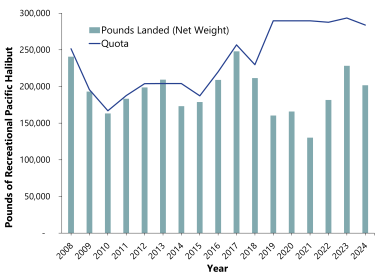
Compared to 2023, total landings decreased in 2024, with 201,695 pounds landed (Figure 1), but this was still seven percent more than the ten-year average (2014-2023). There were 17,233 halibut angler trips this year, roughly 1,600 fewer trips than in 2023.
The average weight of all sport halibut landings in 2024 was 18.6 pounds round weight (whole fish). This was under the average round weight of each of the last three years: 20.6 pounds in 2023, 19.8 pounds in 2022, and 18.7 pounds in 2021. This indicates that the average size of halibut is no longer increasing, and anglers are catching smaller, younger fish compared to the previous three years. See the Length Frequency section for more information.
The 2024 recreational Pacific halibut season generated approximately $3.4 million to Oregon's economy. See the Economic Impact section for more information.
Oregon Subareas and Allocations
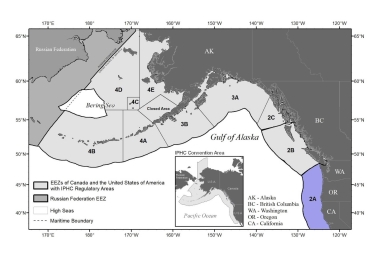
Pacific halibut range from northern California through British Columbia and Alaska to Russia. Fisheries for Pacific halibut in Oregon, Washington, and California are managed collaboratively between the three states, the International Pacific Halibut Commission (IPHC), and the National Oceanic and Atmospheric Administration (NOAA) Fisheries as Regulatory Area 2A (Figure 2). This area accounts for about four percent of the biomass of Pacific halibut in the Eastern North Pacific.
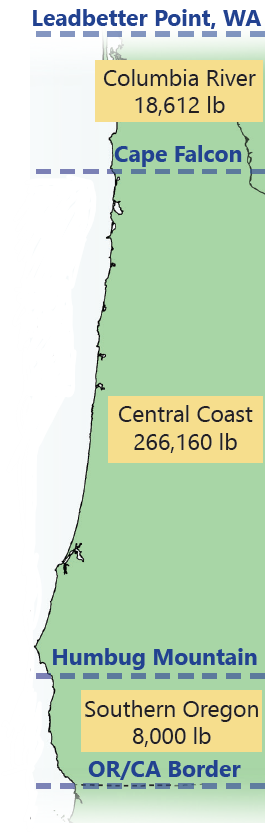
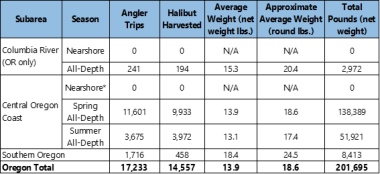
Oregon's recreational fisheries receive 29.7 percent of Regulatory Area 2A's non-tribal allocation. In 2024, this was 283,784 pounds of halibut. This fishery is managed in three subareas: Columbia River, Central Oregon Coast, and Southern Oregon. Each subarea gets a certain amount of quota, as shown on the map in Figure 2. In two of the subareas, the quota is divided based on depth and season (see Table 1 below).
Columbia River Subarea
The Columbia River subarea is jointly managed with the Washington Department of Fish and Wildlife. This subarea's quota is split between the nearshore and all-depth fisheries.
Nearshore
The nearshore fishery was allocated 500 pounds of the quota. This lets anglers fishing for other species keep incidentally caught halibut when the all-depth halibut fishery is not open. There were no landings into Oregon or Washington ports in 2024. The highest landings in this fishery have reached about 250 pounds, but in most years, they are under 100 pounds. If effort and landings increase, the quota can be adjusted through the annual Catch Sharing Plan process, discussed in the Regulating Pacific Halibut section.
All-Depth
This fishery received 18,112 pounds of quota. The fishery was open every Tuesday, Thursday, and Sunday from May 2 through June 30 except it was closed on Tuesday, May 28. The daily bag limit was one halibut per angler. Fishing started off fairly steady, and by the end of June, 13,605 pounds had been landed (75 percent of the quota).
Enough of the quota remained in the Columbia River to re-open this fishery from August 22 through September 3, seven days per week, and every Tuesday, Thursday, and Sunday from Sept. 5-29. During August and September, 3,900 pounds were landed. In total, the all-depth fishery landed 17,504 pounds, falling about 600 pounds shy of the quota.
Central Oregon Coast Subarea
This subarea's quota is split between the spring all-depth, summer all-depth, and nearshore fisheries.
Spring All-Depth
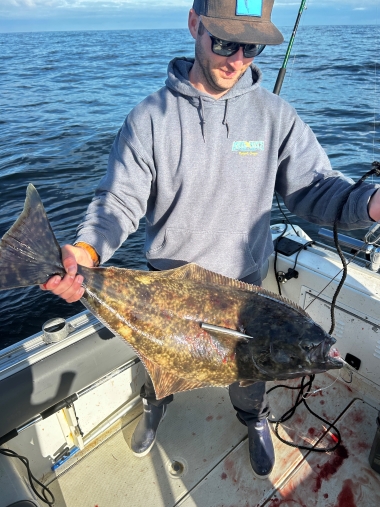
This fishery was initially open May 1 through June 30, seven days per week, with a two-fish bag limit and an initial quota of 167,681 pounds. With over 50,000 pounds of quota remaining by the end of June, the fishery was also open July 1-31, seven days per week.
Total landings were 138,390 pounds, 20 percent less than what was landed in 2023. Average weekly landings were about 10,600 pounds, but in the last week of June nearly 25,500 pounds of halibut were landed – the highest weekly landings of the season. The majority of the catch came from Newport where 81 percent of the pounds were landed. Depoe Bay saw eight percent of the pounds landed, and the other ports each saw five percent or less.
Summer All-Depth
This fishery was open seven days per week beginning August 1 with an initial quota of 66,540 pounds. Effort and catches were steady throughout August but then dropped off. Weather and ocean conditions remained good through mid-October, though access to coho salmon and albacore tuna most likely drew anglers away from all-depth halibut.
Halibut fishing closed by regulation on October 31 with 51,921 pounds landed, 27 percent more pounds landed than in 2023. Again, Newport had the majority (73 percent) of the pounds landed. Winchester Bay had 16 percent of the pounds landed and the other ports combined had a little over 10 percent.
Nearshore
This fishery was not utilized in 2024 since halibut fishing was open at all-depths seven days per week for the duration of the spring and summer seasons. The nearshore fishery exists as part of the all-depth halibut fishery when halibut fishing is open at all-depths, and all landings count against the all-depth quota rather than the nearshore quota.
Southern Oregon Subarea
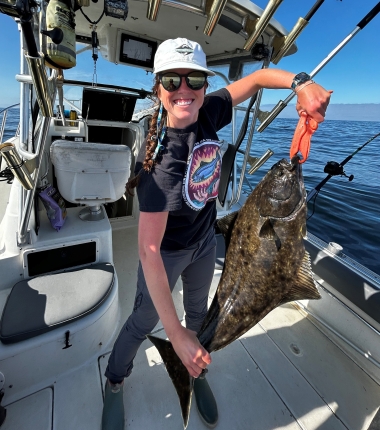
This fishery opened May 1, seven days per week, with a two-fish bag limit and a quota of 8,000 pounds. Landings averaged around 60 pounds per week through June. In early July, halibut effort and landings increased, averaging about 680 pounds per week through Labor Day weekend.
The quota was reached in early October. However, due to remaining quota in other Oregon subareas, the Southern Oregon subarea remained open through the regulatory closure date of October 31. Total landings were 8,413 pounds, a slight decrease from last year's landings.
Enforcement
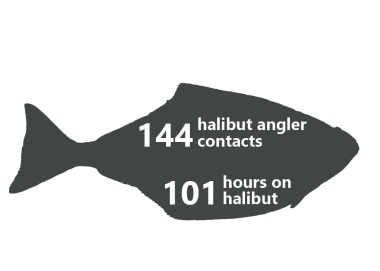
Three agencies patrol on land and at sea to enforce marine fishing regulations: the Marine Fisheries Team from the Oregon State Police (OSP) Fish and Wildlife Division, the U.S. Coast Guard, and the NOAA Fisheries Office of Law Enforcement. Regulations keep fisheries sustainable, and enforcement is a key piece of fisheries management.
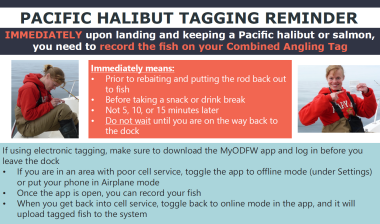
Common issues seen are fishing without a license, not immediately tagging landed halibut, exceeding the bag limit, keeping prohibited species (such as yelloweye or quillback rockfishes), and fishing in closed areas such as Marine Reserves or the Stonewall Bank Yelloweye Rockfish Conservation Area (YRCA).
2024 OSP Halibut Contacts and Stories
Fishing for Halibut in Stonewall Bank YRCA
During an OSP patrol out of Newport, troopers contacted a sport boat fishing for halibut inside the Stonewall Bank YRCA. They had two halibut and a chilipepper rockfish on board the vessel. Troopers were able to determine that all the fish were caught inside the closed area. The fish were seized, and the captain of the vessel was cited for Angling in a Closed Area and Failure to Validate a Harvest Tag. The fish were donated to a local charity.
Three Halibut and Four Fishing Rods Seized
Coos Bay Fish and Wildlife Troopers contacted a boat with three subjects as it returned to port in Charleston. The subjects denied catching any fish, but one of them had tagged a Pacific halibut. The subject who tagged the halibut said he didn't realize the fish was thrown back by the boat captain, and the group again denied having any fish on board. A consent search of the fish hold under a rubber mat revealed nine Pacific halibut, only one of which was tagged. The group was interviewed, and they all stated they hadn't paid attention to how many halibut they caught and thought they were legal. Each member of the party was cited for Exceeding the Daily Limit of Halibut and Failure to Immediately Validate Harvest Tag and were warned for Failure to Allow Inspection of Catch. Three Pacific halibut were seized and donated. The four rods and reels used during the trip were seized as evidence.
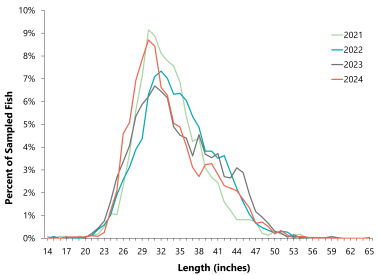
Length Frequency
In 2024, anglers caught higher numbers of "smaller" fish, ranging from 28-33 inches, as shown in Figure 4.
Previously, the trend from 2020 through 2023 showed anglers were catching larger fish each year, tracking with the growth of a large year class growing into the fishery. The previous IPHC annual survey showed this was the 2012 year-class, the largest since 2005.
However, the 2024 survey saw more of the 2016 year-class. This means that younger - and smaller - halibut are being caught, reminiscent of what was observed in 2021 with the influx of the 2012 year-class.
2024 Lengths
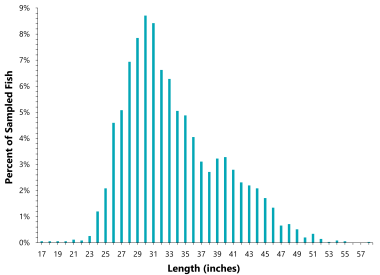
Oregon Recreational Boat Survey (ORBS) samplers collected length information on 2,766 Pacific halibut in 2024. The figures on the left show the average length of sampled recreational Pacific halibut from 2001 through 2024 (Figure 5) and the length frequency distribution of sampled Pacific halibut during the 2024 recreational season (Figure 6).
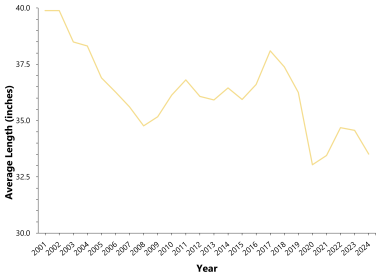
These figures show that the average length of Pacific halibut caught in 2024 decreased, and higher numbers of smaller fish were caught. The most common length of Pacific halibut that were sampled was 30 inches.
Economic Impact
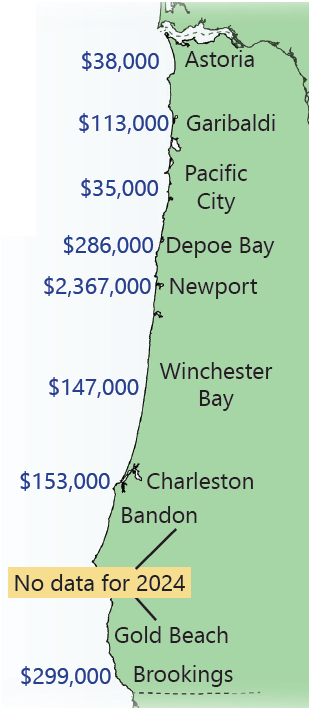
The recreational Pacific halibut fishery contributed approximately $3.4 million to Oregon's economy in 2024 through fishing-related costs such as gas, bait, gear, moorage, food, and hotels. This translates to about 35 full-time jobs per calendar year.
Anglers fishing out of Newport contributed about $2.4 million (Figure 7). Anglers fishing out of Depoe Bay and Brookings added roughly $286,000 and $299,000 respectively. Even in ports with less halibut effort, halibut fishing can have an important role in local economies, especially in the spring and early summer before other fisheries, like salmon, begin.
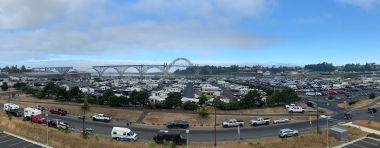
Picture: Port of Newport on a busy halibut weekend. Photo courtesy of Justine Kenyon-Benson.
Sport Halibut Monitoring Update
How Does MRP Monitor the Sport Pacific Halibut Fishery?
ODFW's Marine Resources Program (MRP) has a fishery monitoring program to collect necessary recreational Pacific halibut fishery information to inform management recommendations. MRP thanks all our ORBS port samplers and the industry for remaining flexible and maintaining safety when collecting samples this past year.
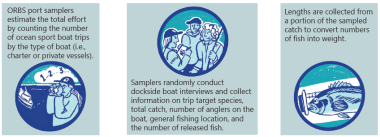
See additional information on ORBS and the Oregon recreational Pacific halibut fishery
Regulating Pacific Halibut
The International Pacific Halibut Commission (IPHC) oversees all things Pacific halibut in the Eastern North Pacific Ocean. This includes Alaska, British Columbia, Washington, Oregon, and California.
IPHC conducts research and stock assessments and sets harvest levels (allocations/quotas) for these areas including Regulatory Area 2A, which is Washington, Oregon, and California.
Through negotiations with the three west coast states and the Washington Treaty Tribes, IPHC has allocated 1.65 million pounds of Pacific halibut to Regulatory Area 2A from 2019 through 2024. The allocation for the first four years (through 2022) was set to provide some stability to fishing communities and has since been extended each year. Prior to 2019, quotas had been volatile year to year causing market issues and irregular fishing seasons.
The Pacific Fishery Management Council (PFMC) divides Regulatory Area 2A's quota (set by the IPHC) between Tribal, commercial, and recreational halibut fisheries. This information is outlined in the 2024 Pacific Halibut Catch Sharing Plan.
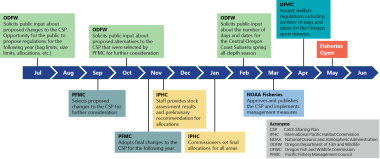
PFMC considers changes to the Catch Sharing Plan annually at its September and November meetings. Anglers can propose changes through that process.
ODFW holds public meetings each year in late July or early August to get angler input on how the fishery has gone so far that year and to discuss any proposed changes for the following year. These meetings tend to have lively discussions with participation from charter captains, individual anglers, fishing-related businesses, and sometimes even port officials. This public input helps form the recommendations for the following year's halibut fishery.
How and When to Get Involved?
With several agencies involved in managing Pacific halibut, knowing how, when, and where to provide input or suggest changes can be confusing. PFMC, IPHC, and Oregon Fish and Wildlife Commission (ODFW) meetings are open to the public and provide time and opportunity for public comments (see Figure 8 below).
Other Updates and Reminders
Non-Trawl Rockfish Conservation Area
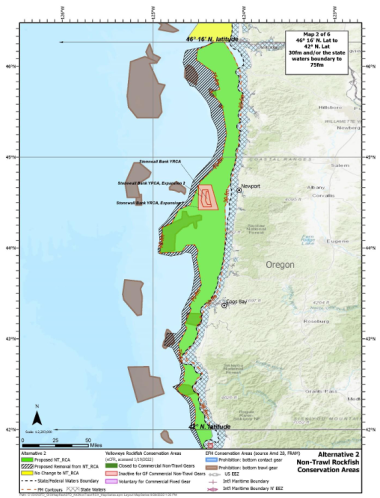
Starting in 2024, the seaward boundary of the Non-Trawl Rockfish Conservation Area (RCA) was moved from 100 fathoms to 75 fathoms (Figure 9) for all non-trawl commercial groundfish sectors and the directed commercial (DC) Pacific halibut fishery.
This is of interest to recreational Pacific halibut anglers because participants in the DC Pacific halibut fishery can now fish between 75 and 100 fathoms. This federal regulation change is to allow commercial fishery access in areas with healthy bottomfish stocks as shelf rockfish (i.e., yelloweye rockfish and cowcod) are recovering from being overfished in the 1990s. It did not increase the quota for the DC Pacific halibut fishery.
For current information about Pacific halibut & in-season changes please visit: Pacific halibut sport regulations
We are always interested in hearing from you about your fishery and the issues that are important to you.
Oregon Department of Fish and Wildlife, Marine Resources Program
2040 SE Marine Science Dr., Newport, OR 97365
541-867-4741
Christian Heath - Halibut & Recreational Groundfish Project Leader Christian.T.Heath@odfw.oregon.gov
Melanie Bukovec - Groundfish & Halibut Assistant Project Leader Melanie.A.Bukovec@odfw.oregon.gov

Check out the Latest Recreation Report
Current conditions and opportunities to fish, hunt and see wildlife. Updated weekly by fish and wildlife biologists throughout the state.