
2024 Sport Bottomfish Newsletter
This newsletter provides a summary of Oregon’s 2024 sport bottomfish fishery.
2024 Season Summary
Bottomfish by the Numbers
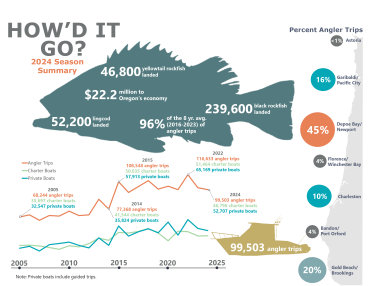
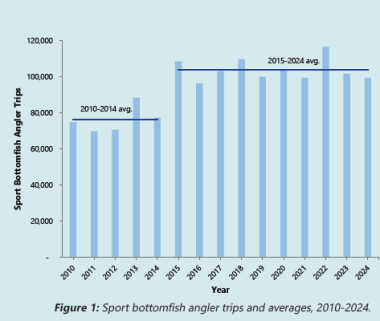
2024 was another popular year for the recreational (sport) bottomfish fishery, with 99,503 angler trips. This aligns with the current trend of higher effort that started in 2015, with an average of about 103,900 trips annually, making up 96 percent of the ten-year average (2015-2024). Prior to 2015, the average number of angler trips was around 76,300 trips annually (Figure 1).
Newport had the highest bottomfish effort of any Oregon port in 2024, with roughly 24 percent of the total effort. Depoe Bay closely followed with a little over 21 percent of the total effort. Garibaldi, Charleston, and Brookings each had between 10 and 16 percent of the effort. All other ports each had five percent or less of the total effort.
The recreational bottomfish fishery is made up of many different species, including all rockfish species, cabezon, lingcod, greenlings, skates, and sablefish.
Black rockfish are the most popular species to catch off the Oregon coast, and in 2024 there were about 239,600 fish or 249 metric tons (mt) landed from bottomfish trips. There were 45,400 (31 mt) blue and deacon rockfishes landed. The catch of nearshore rockfish species (China and copper rockfishes) was 9,600 (11 mt). Anglers landed 52,200 (150 mt) lingcod and 4,100 (11 mt) cabezon.
The offshore long-leader fishery allowed anglers to have good success catching mid-water rockfish species with 46,800 (47 mt) yellowtail rockfish and 31,100 (36 mt) canary rockfish landed in the offshore long-leader and traditional bottomfish fisheries combined.
The 2024 recreational bottomfish season generated approximately $22.2 million to Oregon's economy. See economic impact section for more information.
Monitoring Sport Bottomfish
How Does MRP Monitor the Sport Bottomfish Fishery?
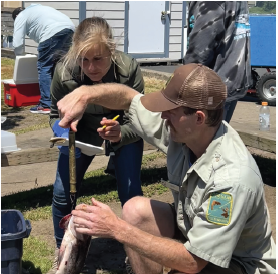
ODFW's Marine Resources Program (MRP) has a fishery monitoring program to collect necessary information on the recreational bottomfish fishery to inform management decisions and provide valuable data for stock assessors. Sampling is conducted by ODFW's Ocean Recreational Boat Survey (ORBS). MRP thanks all our samplers and the industry for remaining flexible and maintaining safety when collecting samples this past year.
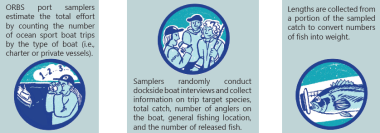
See additional information on ORBS and the Oregon recreational bottomfish fishery
Managing Sport Bottomfish
For most recreationally encountered species, there is a federal or state annual quota (Table 1), which is the amount of fish ODFW has to work with in setting season structures and bag limits. Exceeding quotas could lead to overfishing or have an impact on other fisheries. Note that lingcod does not currently have a quota in Oregon's recreational fishery because all fisheries combined (commercial and recreational) are taking far less than the total allowable amount for the West Coast north of Cape Mendocino, CA.
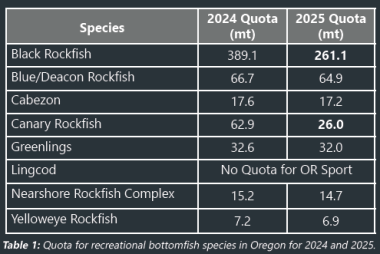
The yelloweye rockfish bycatch quota is similar for 2024 and 2025. The yelloweye rockfish stock size has improved, though not enough to allow anglers to retain them.
The 2024 black rockfish quota was the same as the previous year. However, changes are coming in 2025 to this quota as well as the canary rockfish quota following the results of the 2023 black rockfish stock assessment and the 2023 canary rockfish stock assessment. See allocation changes for 2025 section for more details.
Economic Impact
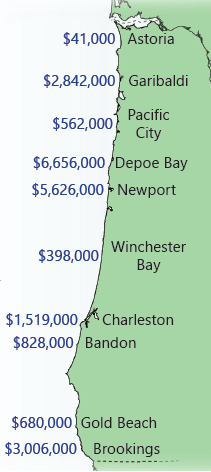
The recreational bottomfish fishery contributed approximately $22.2 million to Oregon's economy in 2024 through fishing-related costs such as gas, bait, gear, moorage, food, and hotels. This translates to about 360 full-time jobs.
Anglers fishing out of Newport and Depoe Bay had the most effort and the highest economic contribution with about $5.6 and $6.7 million, respectively (Figure 2).
Anglers fishing out of Garibaldi, Charleston, and Brookings added another $1.5 to $3 million per port.
Even in ports with fewer bottomfish angler trips, this fishery can have an important role in local economies, especially in the winter, spring, and early summer before other fisheries, like salmon, begin.
Bottomfish Identification
Bottomfish, or groundfish, refers to several groups of fish that are generally associated with the ocean bottom. Off Oregon, this includes rockfish, flatfish, lingcod, cabezon, greenlings, sablefish, skates and rays, along with three species of sharks. With all of those species of fish, it can be difficult to know what you have caught.
The ODFW website has a variety of tools to help anglers with fish identification, including: rockfish identification tips, rockfish and flatfish species information, and "What can I keep and how many?". The following quizzes will test your identification skills: Common Bottomfish Species, Yelloweye Rockfish or Not?, and Black Rockfish or Not?
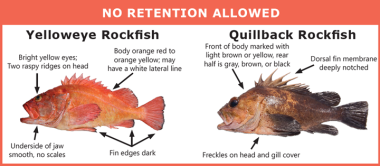
Correctly identifying fish is important for following species harvest and size regulations and to accurately report species caught and released to the ODFW dockside sampler. It is also important to know your fish ID to avoid keeping an illegal fish. Retention of quillback rockfish and yelloweye rockfish remains prohibited. See Other Updates and Reminders section for identification tips for these species.
Enforcement
Three agencies patrol on land and at sea to enforce marine fishing regulations: the Oregon State Police (OSP) Fish and Wildlife Division and specifically the Marine Fisheries Team, the U.S. Coast Guard, and the National Oceanic and Atmospheric Administration (NOAA) Fisheries Office of Law Enforcement. Regulations keep fisheries sustainable, and enforcement is a necessary piece of fisheries management.
Common issues seen are fishing without a license, not immediately tagging landed Pacific halibut or salmon, exceeding the bag limit, keeping prohibited species (such as yelloweye or quillback rockfishes), and fishing in closed areas such as Marine Reserves or the Stonewall Bank Yelloweye Rockfish Conservation Area (YRCA).
2024 OSP Bottomfish Contacts and Stories
Caught with Fillets
Astoria Fish and Wildlife Troopers boarded multiple commercial salmon trollers south of Cape Falcon. One boat that was contacted had two salmon on board, and the captain said he did not have any other fish on board. A subsequent search of a tote on the back deck found three gallon-size Ziplock bags buried under ice with multiple lingcod and rockfish fillets in them from a total of 14 fish. The captain said he was going to take them home to eat and he knew he was not allowed to fillet and take the fish. The captain was cited for Unlawful Possession of Mutilated Marine Fish. One of the troopers had criminally cited this same captain in 2023 when he boarded the same boat while it was trolling for salmon and found numerous fillets from undersized salmon on board.
Compliance Crackdown out of Newport
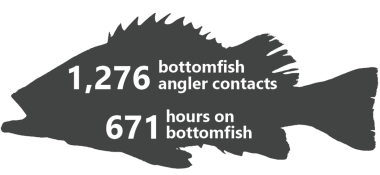
A Sergeant and Troopers patrolled the Newport area checking sport anglers. The compliance rate was less than 25%. Troopers issued 10 citations for Failure to Validate a Tag, four citations for Angling in a Prohibited Area: Stonewall Bank YRCA; and one citation each for No Angling Tag, No Electronic Tag in Possession, and Aiding in a Wildlife Offense: Unlawful Take of Lingcod in a Prohibited Area. One warning was issued for Unlawful Use of Barbed Hooks. One lingcod was seized and donated to charity.
Allocation Changes for 2025/2026
The Pacific Fishery Management Council (PFMC) finalized the annual catch limits (ACL) for all bottomfish species for 2025 and 2026 as well as season structures and regulations at its June 2024 meeting.
In 2025, the Oregon black rockfish ACL will be decreasing by about 33 percent. The stock is considered "healthy," but the estimate of the scale of the total biomass has decreased, prompting the decrease in allowable catch.
The coastwide (Washington, Oregon, and California) canary rockfish ACL will be decreasing by about 52 percent in 2025. These rockfish are in the "precautionary zone," meaning the current estimate biomass is below 40 percent of the estimated unfished biomass. Therefore, reductions are necessary to get the stock back above that 40 percent target threshold and out of the precautionary zone.
Both of these reductions are due to new assessments that say the scale of the overall biomass is lower than what was estimated during the previous assessments. See below for a summary of the most recent black rockfish stock assessment. For more information on the two assessments
The Oregon Fish and Wildlife Commission set the 2025 season in December 2024.
Black Rockfish Stock Assessment
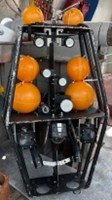
An Oregon black rockfish stock assessment (a model that uses fishery and survey information to create a population estimate) was completed in 2023, updating population status and overfishing limits from the previous 2015 assessment. The 2023 model includes new and updated data and is structured around using the first fishery independent black rockfish survey completed in 2021 along Oregon's entire coast.
This survey provides an estimate of the absolute biomass, anchoring the scale of the population in the model, which was a critical request following the previous assessment. The 2021 survey used a scientific fish finder with an underwater camera to effectively count black rockfish.
The 2023 assessment used a wide range of fisheries data, including length, age, and reproductive information. These were from the commercial non-trawl fleet, the recreational fleet, the marine reserves hook and line survey, a tagging study of black rockfish off the central Oregon coast, and the 2021 coastwide black rockfish survey as shown in Figure 3.
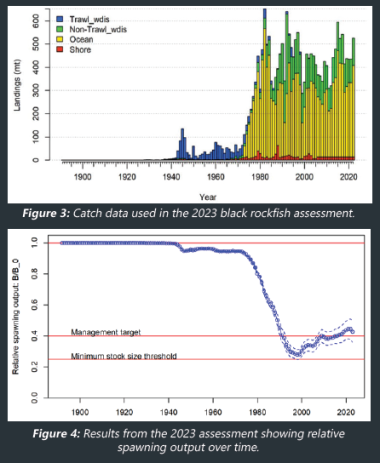
Results from the assessment model indicate that the stock size of black rockfish are at 45 percent which is just above the management target stock size of 40 percent (Figure 4). The stock status could drop below the management target without a reduction in catch prior to the next assessment.
Offshore Long-leader Fishery
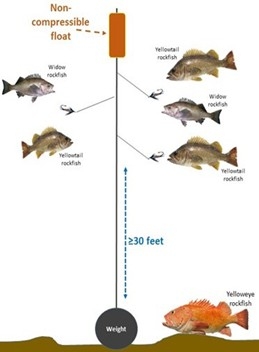
The offshore long-leader fishery is a year-round opportunity to target midwater rockfish species (while avoiding benthic species such as yelloweye rockfish) outside (seaward) of the 40-fathom regulatory line, using long-leader gear only. For waypoints and maps of fathom lines.
The gear required consists of a fishing line and tackle configuration with a minimum of 30 feet of line between the terminal weight (sinker) and the lowest hook and a non-compressible float affixed above the top hook. See Figure 5. Lures must be less than five inches in length, and natural bait is prohibited.
The only species allowed are the following: yellowtail, widow, canary, greenstriped, redstripe, bocaccio, chilipepper, blue, deacon, and silvergray rockfishes. Check out the offshore Long-leader Fishery Species ID sheet
Lingcod, cabezon, kelp greenling, and other rockfish species not listed above are not allowed on the same trip. Bottomfish listed under the general marine species daily bag limit may be kept on a separate trip on the same day. A separate trip is when an angler returns to shore and offloads all fish prior to going out on another trip. Anglers may also return to shore, offload all long-leader rockfish, and then go back out on a separate trip for lingcod.
Anglers may combine an offshore long-leader trip with an all-depth Pacific halibut trip. However, long-leader fishing and regular bottomfish fishing cannot be combined on the same trip.
History of the Long-leader Fishery
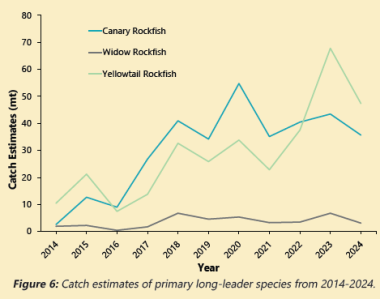
The offshore long-leader fishery has been available year-round off the Oregon coast starting in October 2017. Since then, there has been a significant increase in the catch of three midwater rockfish species commonly encountered with long-leader gear: yellowtail, canary, and widow rockfishes.
The catch of all three of these species decreased a bit in 2024 compared to 2023 (Figure 6). Canary rockfish is also commonly caught with traditional gear inside of the 40-fathom regulatory line and higher catch of this species is closely tied to the general marine species bag limit.
The long-leader fishery provides anglers an opportunity to take home more fish. In 2024, the limit was 12-fish year-round.
Other Updates and Reminders
Rockfish Recompression
When a rockfish is brought to the surface, gas in the swim bladder expands. A fish suffering from barotrauma, an injury caused by a change in air pressure, will have a swollen body or stomach, esophagus protruding into its mouth, and/or bulging eyes. The expanded gas can make the fish too buoyant to swim back down to depth on their own.
Research shows that rockfish released near the depth of capture have a higher survival rate than those released at the surface. PFMC incorporates this into management for rockfish species. For yelloweye rockfish, releasing at depth has helped prevent additional fishery restrictions and reduced the chance of a recreational fishery closure due to bycatch.
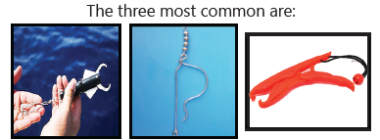
It is mandatory to have a descending device onboard the vessel when fishing for bottomfish or Pacific halibut and to use the descending device when releasing rockfish outside (seaward) of the 30-fathom regulatory line.
Types of Descending Devices
A variety of commercially available and homemade devices are used. Find what works for your vessel and set up. For additional information, see ODFW's Rockfish Recompression
We are always interested in hearing from you about your fishery and the issues that are important to you.
Oregon Department of Fish and Wildlife, Marine Resources Program
2040 SE Marine Science Dr., Newport, OR 97365 - 541-867-4741
Christian Heath - Halibut & Recreational Groundfish Project Leader Christian.T.Heath@odfw.oregon.gov
Melanie Bukovec - Groundfish & Halibut Assistant Project Leader Melanie.A.Bukovec@odfw.oregon.gov

Check out the Latest Recreation Report
Current conditions and opportunities to fish, hunt and see wildlife. Updated weekly by fish and wildlife biologists throughout the state.