

Turkey Hunter's Guide
Spring habitually leads turkey hunting season, however, Oregon opens up additional opportunities in the fall with an extended hunting season. While spring is primarily breeding season with many successful hunters often setting up in a well-camouflaged location to call a male turkey into shooting range. Fall harvest can be just as thrilling to bring home a bounty to share at your table.
Hunter's Resources Hunter's Technique Hunter's Bounty Hunter's Plan
When to hunt wild turkey
By the time hunting season opens on April 15, most of the hen turkeys have already bred. Though they may not be sitting on their nests quite yet. Toms may stay close to the hens during the first few weeks of the season, sometimes making it difficult for hunters to lure them away and into shooting range.
If tom numbers are low, they are less likely to leave their strutting ground and the hens in one area to check out a random hen (you) calling in the distance. If tom ratios are high and the competition to breed is intense, hunters can set up farther away and still call in a tom. If hens are sparse, it's not uncommon for an eager tom to travel a quarter-mile or more to check out your call.
As the season progresses and hens begin incubating their eggs, toms often go in search of hens that may have missed being bred, or may have lost a clutch and need to breed again. When these toms are on the move, they'll be more susceptible to your calling.
During the last couple weeks of the spring season, toms largely concentrate on eating, which means calling in food-rich habitats can be productive. Newly sprouting grass seeds and some berries, fruits and insects are key food sources. Often times the biggest toms are taken by hunters late in the season, once all the hens have begun raising their broods.
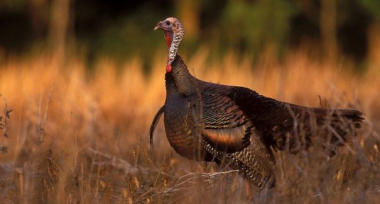
Fall offers an extended turkey hunting season, and the chance to harvest your own Thanksgiving bird!
In late summer and early fall, turkeys gather in family units. By October, you might see a flock of 200 turkeys consisting of multiple family units. By December, a single flock of 50 or more turkeys is not uncommon.
When Oregon's fall turkey season begins, turkeys are largely feeding on insects, fruits, berries, and some grasses and weeds. Flock patterns are easy to spot when tracking their daily movements.
As long as there's food in the area, turkeys will cover the same ground every day, at nearly the same time. If you study this pattern before your hunt, you can plan where to set up and wait for the birds to come by. Ground blinds are popular for this kind of hunting – it's nice to have a comfortable place to sit while waiting for turkeys to approach.
Turkeys can be called in the fall, but calling may not be as effective as during the spring breeding season. Both tom and hen turkeys can be harvested during Oregon's fall season as well as an additional late season beardless turkey permit in select areas, check Game Bird Regulations for more details.
Where to hunt wild turkey
West of the Oregon cascades, most turkeys are found on private land, where they have gravitated to easier food sources and safety away from hunters and predators. The exception is southwest Oregon, which has one of the most robust turkey populations in the state, with plenty of oak savannah areas located on public National Forest land.
In eastern Oregon, turkey populations are growing, providing excellent hunting in many locations including the White River area and the Blue Mountains in the northeast.
Turkey habitat
While scouting for turkeys, look for loose turkey feathers, tracks and droppings in areas around and beneath roost trees.
When food is regularly available, turkeys establish a regular travel route from their roost to a food source. They'll use this same route over and over for days, weeks and sometimes months. Look for this route to change as food sources change each season.
Study the birds in the area you want to hunt and try to figure out their routine. What time do they usually leave the roost? Where are they going to feed? The more you can predict the birds' behavior, the better your chances of finding a good place to set up and hunt.
Once you've patterned a flock, you can set up along their predicted path of travel and wait for feeding birds to work within shooting range.
Hunters in Oregon can access millions of acres of public land open to hunting:
National Forests
BLM land
State Forests
Wildlife Areas
Access and Habitat
See Oregon hunting map to find a place to hunt.
After your hunt
Immediately validate your tag by e-tagging or paper tagging.
- Write down the confirmation number provided by the app, plus your name, ODFW ID, date of birth and harvest date on anything that will stand up to the elements (like flagging or duct tape). Affix it to the bird to transport.
Report your hunt online or at an ODFW office or license vendor before the deadline.
- All hunters must submit a report even if they didn't harvest or actually hunt. If you bought a tag you must report, even in you weren't successful. Hunters have until Jan. 31 to report their previous year's hunts. Learn how to report.

Check out the Recreation Report
Current conditions and opportunities to hunt, fish and see wildlife. Updated weekly by fish and wildlife biologists throughout the state.