
Search myodfw.com
Showing 821 - 840 of 1647 results
Popularly called "Gooneybird" for its elaborate mating antics and clumsy takeoffs and landings and breeding islands, this is a large, spectacular seabird. Though small for an albatross, it glides on wind currents just above the ocean waves on long narrow wings which span approximately six-and-a-half feet. The dark gray wings, back and tail contrast with a white body and upper tail coverts. Singles or small groups are reported occasionally on offshore Oregon birding trips, primarily in winter. Hear the call of the Laysan albatross Photo by ©Greg Gilson

A big, well-mannered bird of friendly, even playful disposition, with an abundant curiosity as to human presence and activities within the realm of open ocean over which he presides. Long-winged, to seven feet, and dark sooty-brown; adults have a white rump and feathering, which juveniles lack, around the base of a large bill. Every sighting of these gentle giants gliding up to the boat evokes delight. The black-footed albatross is a regular visitant spring through fall offshore, but is irregular in winter. They glean squid, fish and fish eggs from the ocean surface and also eat galley scraps. Hear the…

One of Oregon's characteristic offshore seabirds, these stocky gull-like birds with steep foreheads come in a broad range of color morphs from white to slate gray, with buffy, bluish-gray, mottled and brown intermediates. The round head and pecking motion of birds feeding on the water is reminiscent of the shape and behavior of pigeons. The heavy hooked bills are divided into colorful plates of green, yellow, and orange, with large tubed nostrils atop. They are irregularly common to abundant in Oregon in winter, especially beyond five miles from shore. Hear the call of the Northern fulmar Photo by Martyne Reesman…

The mottled petrel breeds in New Zealand and nearby islands, and ranges throughout much of the Pacific Ocean, mostly far from land. It is a common May to October visitant in the northern and eastern North Pacific, with non-breeding birds occurring during the winter months. Photo by Dominique, Flickr

The world population of this species, which probably does not exceed 25,000 pairs, is quite low for a seabird. Nevertheless, these are the common light-bellied shearwaters off Oregon in summer. They are larger, bulkier, and fly more deliberately than the usually much more abundant sooty shearwaters with which they associate. They are uniform gray-brown above; the underparts are white; the vent and underwings variably smudged with dusky. The pinkish bill is dark-tipped and the feet are pink. It is a common summer visitor and very common fall transient offshore on shallow shelf waters. It is usually seen seaward, approximately five…

Flesh-footed shearwaters are always exciting birds to find, as they are one of the rarest of the seabirds to occur annually in Oregon. Single birds are sometimes found in flocks of other shearwaters. They are very similar to sooty shearwaters but they are larger with pink or pale whitish feet and dark-tipped pale bills. In addition, their plumage is a deep chocolate-brown, lacking the grayness of the upperpart coloration of sooty shearwaters; and the underwing does not show the sooty's white coverts. It is a rare late fall transient offshore at the western edge and slopes of the continental shelf…
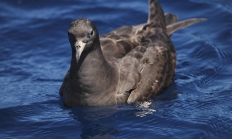
Few seabirds have been labeled "stunning;" but with their graceful flight, boldly patterned upperparts, and brilliant white underparts, these birds truly are one of the most beautiful in Oregon waters. They have a black cap, wings angled forward, long body and tail, and a unique dark 'M' pattern against light gray back and wings. Often seen in small groups mixed among other more abundant shearwaters, they sometimes form pure flocks all flying in gracefully synchronized flight. While regular in Oregon in late fall, they are still uncommon enough to excite observers when encountered at sea. Photo by Tony Morris, Flickr
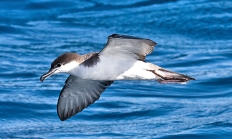
This seabird, the most abundant in Oregon, has recently suffered severe declines or significant population shift in the eastern North Pacific. Similar in shape to thin, long-winged gulls, sooty shearwaters are dark sooty gray with limited amounts of white on the underwing coverts. They glide on wind currents along wave troughs on stiff wings. Gregarious, they form huge loose flocks in migration, often passing for hours within site of land-based observers. In Oregon, it is an abundant summer visitor and transient offshore on the inner shelf and is most numerous three to six miles offshore. Hear the call of the…

These very abundant seabirds are uncommon off Oregon in winter. Their arrival coincides with some of the Pacific Northwest's stormiest weather. Complicating detection difficulties is their identification; they look very much like the abundant sooty shearwaters - all dark, but slightly smaller with shorter bills and tails. Studied on their Tasmanian breeding grounds continuously for over 45 years, once they leave for the open ocean little is known about them. Popularly know as "muttonbirds," they have been harvested as food for centuries on their southern seas breeding islands. Even today, up to 300,000 chicks are harvested in Tasmania each year…

In Oregon, fork-tailed storm-petrels breed in numbers that are only a tiny fraction of those of Leach's storm petrels. This is the larger of the two storm-petrels breeding in Oregon and is gray in color. These birds leave and return to breeding colonies only at night, when they are best detected by their distinct raspy call. At sea, they are distinguished by quick, buoyant flight with short glides interspersed with wing fluttering to maintain their position at a food source. Fewer than 20 nests have been found in Oregon, all located in the same habitat as colonies of Leach's storm…

Of Oregon's breeding seabirds, Leach's storm-petrel is the smallest, most pelagic, and flies the farthest offshore of any of Oregon's breeding seabirds to feed. It spends the non-breeding season in the subtropical and equatorial Pacific. It is the second most abundant breeding seabird in Oregon, and is rarely seen from land or close to shore. It comes to its breeding islands, where it nests in burrows, only under the cover of darkness. Its plumage is black and Oregon populations have a distinct white rump. Leach's storm-petrels are long lived birds characterized by long-term pair bonds and may breed yearly for…

Oregon has two species of pelicans, American white and the Brown pelican, and three species of cormorants. All are fish-eating water birds with four toes joined by webbing. Depending on the species, pelicans and cormorants inhabit the Oregon coast, rivers or interior waterbodies.

Large and primarily white, the American white pelican has the longest wingspan of any bird in Oregon. It also has an enormous orange bill, and flies with neck withdrawn. During the breeding season the top of the bird's head becomes dusted with black and a horn grows on the upper mandible; this projection serves as a target for aggressive encounters to avoid injury to the essential bill pouch, but is shed after the eggs are laid. This pelican makes unusually long flights for feeding and migration, and at great distances, soaring flocks have been reported as UFOs. In Oregon, it…

Commonly found along beaches and about estuaries, this large, ponderous bird is a conspicuous member of the summer coastal community, easily recognized by its large size, massive bill, and brownish plumage. Highly gregarious, it often forms large flocks; regularly observed foraging over the ocean just offshore. Brown pelicans often join mixed flocks of birds attracted to schools of small fish. They are common spring, summer, and fall visitors along the Oregon coast. Brown pelicans are an Oregon Conservation Strategy Species in the Nearshore ecoregion. Hear the call of the brown pelican Photo by Michael Lazott

Brandt's cormorants nest colonially on offshore islands and mainland cliffs and are the most common of the cormorants on the Oregon coast in summer. In the breeding season, males are easily distinguished by their intense blue gulag pouches, displayed with a skyward pointing of the bill. They also have wispy white plumes along the side of their head and on their back, which show well against the solid black of the rest of their plumage. In bright light they have a green iridescence. During all seasons they can be distinguished from the two other Oregon species by buff-colored feathers that…

Adaptable and opportunistic, the double-crested is the most abundant and widespread of the three cormorant species found in Oregon, occurring inland and on the coast. Adults have deep, coppery feathers, bordered in black, that glisten with a green iridescent and offset a rich orange throat atop a long curved neck. The bird earns its name from plumes, ranging from white to black, that crown either side of the head during the breeding season. The double-crested cormorant is a common breeder in spring and summer at bays and estuaries, and on islands and cliffs along the coast and lower Columbia River…
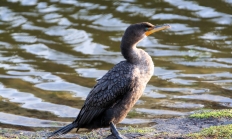
Seemingly misnamed, pelagic cormorants are rarely seen far from land. During the breeding season the distinct white flank patches contrast markedly with their black plumage. In bright light the slender neck has a purple iridescent sheen, and the back shines green accenting white filoplumes. They nest in loose colonies on ledges on vertical cliffs on rocky islands and headlands. It is common year-round along the entire coast and is not found away from salt water. Hear the call of the pelagic cormorant Photo by ©Greg Gilson

Bitterns, herons, and egrets are all long-legged wading birds with long necks and pointed bills for spearing fish or other prey.

Skulking through wetlands, the American bittern is rarely seen - it has an extremely slow and stealthy walk, and when a threat approaches it freezes and mimics marshland plants with upright posture and beak pointed skyward. These behaviors combined with its cryptic plumage effectively camouflage the bird. However, it is occasionally seen in flight, and its low, gurgling song can be heard over long distances. An uncommon to fairly common breeder east of the Cascades and a rare migrant in Malheur county it has also been noted at mountain lakes east of the Cascades in Lake County. In western Oregon…

Inconspicuous and master of stealth, the Least bittern inhabits densely vegetated deep-water marshes, making observations rare and difficult; its call is often the only way to detect this secretive species. The smallest of herons, its long neck and legs make it appear larger. The crown, back and tail of male birds is greenish black; purple-chestnut on female. Neck, flanks, and underparts are brown and white and the wings buff. It is a rare spring and summer resident in larger freshwater marshes of eastern Oregon and a very rare spring through fall visitor in the Rogue and Willamette valleys. At Upper…
