
Search myodfw.com
Showing 241 - 260 of 509 results
Enterprise, Ore. – Beginning Friday, Sept. 19 through Friday, Oct. 31, harvest of wild adult Chinook salmon (non-adipose clipped, ≥ 24 inches) will be closed in the Snake River from the Oregon/Washington border upstream to Hells Canyon Dam. During this period, anglers may continue to harvest adipose-clipped (hatchery) fall Chinook…
Invasive species are animals and plants that are not native to an ecosystem and that cause economic or environmental harm. Not all non-native species are invasive, however many become a serious problem. They can aggressively compete with Oregon's native wildlife for food and habitat.
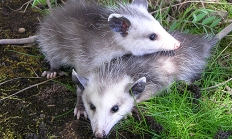
CENTRAL POINT, Ore. – The Oregon Department of Fish and Wildlife is conducting research on fisher, a forest-dwelling carnivore that once occupied forests across the Cascade and Klamath-Siskiyou regions. Today, Oregon's remaining fisher persist as a small, isolated population in the Klamath-Siskiyou Mountains. And ODFW researchers want to know how…
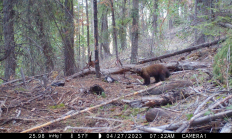
The American bullfrog is a non-native invasive frog that survives and reproduces very successfully in Oregon. Bullfrogs aggressively compete for food and living space with our native frogs. They eat many types of native wildlife including other frogs, young pond turtles, and ducklings. Bullfrogs can lay almost 10 times more eggs than native frogs and can quickly out number them. Photo by Kathy Munsel

SALEM, Ore. – A Chinese mitten crab, a prohibited species in Oregon, was found in the Willamette River near the Sellwood Bridge and reported to ODFW on Nov. 17. The crab was spotted in shallow water and captured by hand. It was alive and not released back into the river…
Cassin's auklet uses a few offshore lands for breeding in Oregon. It forages in the marine environment and nests in a chamber under rocks or digs its own burrow, two to six feet long, in the soil. This species spends its day at sea and only comes to the burrow at night, perhaps to reduce discovery by predacious Western gulls. Although few Cassin's auklets nest in Oregon, nesting sites are found along the entire coast where offshore rocks provide appropriate habitat. During the non-breeding season this is the most abundant alcid seen at sea in Oregon. They are present offshore…

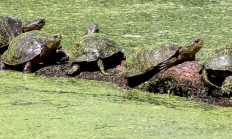
Western pond turtles prefer marshes, streams, rivers, ponds and lakes. They need sparse vegetation nearby for digging nests and like to bask on logs. Population declines are due to habitat loss, degradation of nesting areas by invasive plants, competition from non-native turtles and disease. Predators include raccoons and invasive bullfrogs and fish. Western pond turtles are Oregon Conservation Strategy Species in the Coast Range, East and West Cascades, Klamath Mountains and Willamette Valley ecoregions. Photo by Simon Wray, ODFW


A quiet, modest, unobtrusive little bird that must be sought to be seen in its shady retreats, this little-studied species can easily be overlooked. It is typically associated with oaks and mixed woodlands, where it hops along the foliage hunting for insects. In winter it forages with flocks of chickadees, kinglets, and nuthatches. This is Oregon's only resident vireo. Although it is sometimes referred to as non-migratory, some seasonal movement has been observed. Similar in appearance and behavior to the more common and widespread Ruby-crowned kinglet. Hear the song of the Hutton's vireo Photo by Greg Gilson

The plumage and perching habits of the Eastern kingbird make it one of the more conspicuous birds in open habitats of eastern Oregon. The plumage is well defined: black on the upperparts and white on the underparts, and a white band on the terminal tip of the tail feathers. It is a relatively large flycatcher, often perching on powerlines, fences, or exposed perches on trees or snags. They hawk aerial insects during the breeding season. The Eastern kingbird breeds throughout non-forest of most of northeast Oregon lowlands with spotty distribution in central and southeast Oregon. They are most abundant in…
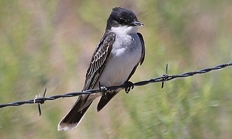
Features: Drakes have a reddish head and neck; black breast, lower back and tail coverts; nearly white back, flank, and belly, and dark gray tail. The hen is grayish brown with a darker brown head, neck, breast and tail coverts. Canvasbacks are large; adults in good condition are as heavy as mallards and second in size only to the white-winged scoter among common Oregon ducks. Habitat: Brackish estuarine bays and marshes with abundant submerged aquatic vegetation and invertebrates are ideal wintering habitat for canvasbacks. Techniques: Generally part of a mixed duck bag. These ducks have a reputation as good table…

Of several swans found in Oregon, the tundra swan is by far the most common during the non-breeding season. It is most readily distinguished from the similar-appearing trumpeter swan by voice, although subtle differences in physical appearance and behavior can separate the two with difficulty. It is a fairly common transient throughout the state but most abundant at large bodies of water and wetland complexes east of the Cascades including the Malheur National Wildlife Refuge and the surrounding Harney Basin, Summer Lake Wildlife Area and the Klamath Basin. Hear the call of the tundra swan Photo by Kathy Munsel, ODFW
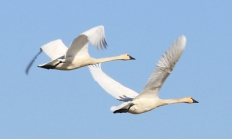
During the breeding season Pigeon guillemots are easily seen flying low over the water along rocky coastlines or in estuaries. They have striking red feet, legs, and mouth linings and their large white wing patches contrast markedly with the rest of their black plumage. When standing on land they have a distinctive upright posture and often emit a high-pitched squeal. In the non breeding season they move offshore and look entirely different when their black plumage becomes mottled with white. The Pigeon guillemot occurs during the breeding season all along the Oregon coast wherever offshore islands or rocky cliffs are…

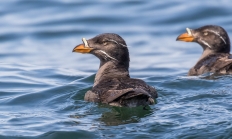
Rhinoceros auklet are one of the rarer breeding alcids in Oregon. Adults are easily recognized during the breeding season by the vertical "horn" at the base of the upper mandible. Birds in breeding plumage have brownish gray backs, a gray-brown chest, and a dirty white belly. Two distinct plumes are present on the head, one above and one below the eye. The bill is orange. In non-breeding plumage the horn is greatly reduced, the plumes absent or reduced, and the bill duller. It nests in small numbers in Oregon with Goat and Hunter Islands having the largest concentrations of breeding…


The haunting cries of these wanderers evoke a variety of reactions from curiosity to wonder. Highly social, the Pinyon jay epitomizes the dynamics of flock behavior such as colonial nesting, communal feeding of young and non-territoriality. Although Pinyon jays are nomadic and unpredictable, each flock is a tight-knit, integrated unit occupying a home range that does not overlap with other flocks. Flocks may wander widely outside their home range if sufficient food is not available. The Pinyon jay is a permanent resident in juniper and ponderosa pine woodlands of central Oregon. Oregon's known breeding population is confined to the Metolius…

Of Oregon's breeding seabirds, Leach's storm-petrel is the smallest, most pelagic, and flies the farthest offshore of any of Oregon's breeding seabirds to feed. It spends the non-breeding season in the subtropical and equatorial Pacific. It is the second most abundant breeding seabird in Oregon, and is rarely seen from land or close to shore. It comes to its breeding islands, where it nests in burrows, only under the cover of darkness. Its plumage is black and Oregon populations have a distinct white rump. Leach's storm-petrels are long lived birds characterized by long-term pair bonds and may breed yearly for…

Oregon's native turtles are in trouble. Invasive, non-native turtles such as the red-eared slider and snapping turtle compete with Oregon's turtles for food, habitat and nesting sites. Our native turtles are also preyed upon by bullfrogs and are affected by habitat loss and degradation. Check out this video to learn more about Oregon's native turtles and invasive turtles.
These large toads are well camouflaged in earth tones with dry bumpy skin that aids in protection from predators. Their color can be highly variable among individuals ranging from gray or reddish-brown to yellow or green. They have a light colored stripe that runs along the center of the back. Adult female toads are larger than males, growing to five inches in length. They live mainly on land in a range of habitats from forests to mountain meadows to desert flats. During the non-breeding season, they are nocturnal. They dig their own burrows in loose soil, use existing burrows or…
