
Search myodfw.com
Showing 241 - 260 of 1128 results
Study ahead: Oregon Furbearer Trapping and Hunting Regulations
2026-27 License and cards available now
Online Learning


Find maps, boundary descriptions and hunts available in the new Painted Hills Hunt Area. Download printable PDF map
Find maps, boundary descriptions and hunts available in the new Sage Hen Hunt Area. Download printable PDF map
Find maps, boundary descriptions and hunts available in the new Sage Hen Hunt Area. Download printable PDF map
Find maps, boundary descriptions and hunts available in the new Crooked River Hunt Area. Download printable PDF map
Features: Bullheads found in Oregon are distinguished from channel catfish by their square or rounded tails and lack of spotting. They seldom exceed two pounds and 18-inches long. Brown bullheads are a mottled yellowish-brown with a yellow belly and dark chin “whiskers” or barbels that are white near the base. They have a square tail. Habitat: Bullheads are found on the bottom in the shallows of mud-bottomed ponds, lakes, reservoirs and backwaters of rivers. The brown species is common throughout the state. Technique: Bullheads can be caught any month of the year, but fishing is best from the first warm…

Find maps, boundary descriptions and hunts available in the new Devils Garden Hunt Area. Download printable PDF map
Find maps, boundary descriptions and hunts available in the new Klamath Basin Hunt Area. Download printable PDF map
Find maps, boundary descriptions and hunts available in the new South Wallowa Hunt Area SW-02. Download printable PDF map
The Columbia River is renowned for its salmon and steelhead runs. In a year of good returns, over 1 million Chinook, coho and sockeye salmon, and summer steelhead travel up the river to spawn in its tributaries. Less known are the river’s excellent smallmouth bass and walleye fisheries. While most anglers fish this large river from a boat, there is plenty of good bank access at various parks, boat launches and beaches.
Find maps, boundary descriptions and hunts available in the new Devils Garden Hunt Area. Download printable PDF map
Features: Common carp are deep-bodied, heavy-looking fish with short heads and forked tails. They have large (really large) scales ranging from grey to bronze. Two barbels hang from each side of the upper lip of their subterminal (near the bottom of the head) mouth. This distinguishes them from goldfish that have no barbels. The dorsal fin is elongated. Habitat: Though tolerant of most conditions, common carp prefer large bodies of slow moving or standing water with soft sediments like mud or sand, and good growths of aquatic vegetation. They’re omnivorous bottom feeders that prefer aquatic insects, worms, mollusks and zooplankton…

Find maps, boundary descriptions and hunts available in the new Poverty Basin Hunt Area. Download printable PDF map
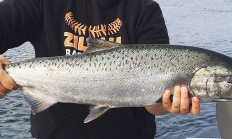
Features: While in the ocean, Chinook salmon often have a purple hue to their backs with silvery sides and bellies, large oblong black spots on the back, and round black spots on both lobes of the tail (note that tail spotting may be obscured in ocean fish by “silver” in the tail). Upon returning to freshwater to spawn, Chinook darken in color and develop red on their bellies and fins. A key identifier is the black gum line on the lower jaw with dark colors both inside and outside of the gum line. Spawning generally occurs from August to early…
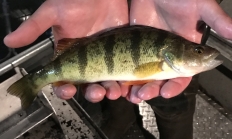
Features: Yellow perch are golden, with six to nine dark vertical bars. They have two well-separated dorsal fins; the second fin has two or three spines. Lower fins are yellowish-orange and, unlike walleye, yellow perch do not have canine teeth. Maximum size in Oregon exceeds 3 pounds and 18-inches long. They are prolific spawners, often resulting in an overpopulation of stunted fish. Habitat: Yellow perch prefer lakes, reservoirs and slower moving streams that have cool, clean water and ample vegetation. Perch bite readily and are therefore popular with young and novice anglers. Technique: In the spring and fall, find yellow…
NEWPORT, Ore. – Ocean sport salmon fishing closes at 12:01 a.m., Tuesday, Aug. 19 in the Columbia River Subarea (Leadbetter Pt., WA to Cape Falcon, OR) and possession of salmon on board a vessel is prohibited. Fishing is allowed on Monday and is closed Tuesday. Projected harvest of marked (fin-clipped)…
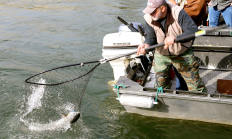
NEWPORT, Ore. – The commercial Dungeness crab fishery opens Dec. 31 from Cape Falcon to the Washington border. Fishermen can begin the presoak period – setting baited crab pots in the water – on Dec. 28 in this area. ODFW delayed opening the north coast until crab in Long Beach…
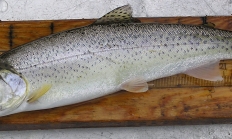
Features: Coastal cutthroat trout are typically are blue/green on top, red along the lateral line, and white on the belly. They are lightly or heavily spotted and adults have a red slash mark on the throat. Habitat: The most common variety of trout in Oregon is the coastal cutthroat, found in the streams and beaver ponds in coastal drainages. They also are stocked in high mountain hike-in lakes where the water stays cool throughout the summer. Techniques: Cutthroats that are year-round residents of small streams may not get any bigger than 8- or 9-inches, but can reward the angler with…
Features: Their eyed-side is greenish-brown to dark brown or black with lighter blotches. Their blind side is white to milky-white. They have a large, stout but flat body, shaped like an elongated diamond . Pacific halibut have been known to reach 500 pounds, but on average are 40 pounds. Habitat: Halibut are a large flatfish and so they spend much time near the bottom of the ocean looking above for food. They prefer chilly water and are primarily found in the Gulf of Alaska. Technique: Boat anglers use heavy rods to fish on or near gravel bottoms in water 150-500…
